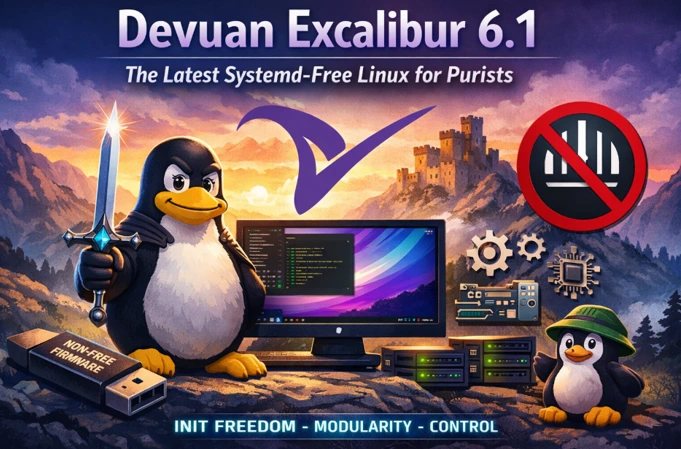
In the world of Linux distributions, few projects carry the philosophical weight that Devuan Excalibur 6.1 does. Released on January 1, 2026, this point release marks the latest milestone in Devuan’s ongoing commitment to “init freedom”—a principle that has defined the distribution since its inception over a decade ago. For users who prioritize control, modularity, and independence from monolithic init systems, Devuan Excalibur 6.1 stands out as a refined, stable choice built on the rock-solid foundation of Debian without the controversial systemd.
As a direct fork of Debian 13.2 “Trixie,” Devuan Excalibur 6.1 brings refreshed packages, targeted bug fixes, and expanded hardware support while steadfastly avoiding systemd dependencies. This release is particularly appealing to Linux purists: system administrators, embedded developers, and desktop enthusiasts who value traditional Unix-like principles over convenience-driven integrations.
The Roots of Devuan: A Brief History of Init Freedom
To fully appreciate Devuan Excalibur 6.1, it’s essential to understand the project’s origins. Devuan emerged in 2014 as a response to Debian’s decision to adopt systemd as the default init system starting with Debian 8 “Jessie.” A group of developers and users—many veteran Unix administrators—viewed this shift as a potential lock-in that could compromise user choice and system simplicity.
The fork quickly gained traction among those who preferred alternatives like SysVinit, OpenRC, or runit. Devuan’s first stable release, version 1.0 “Jessie,” arrived in 2017, mirroring Debian 8 but with full init flexibility. Subsequent releases followed Debian’s cadence:
- Devuan 2.0 “ASCII” (2018, based on Debian 9)
- Devuan 3.0 “Beowulf” (2020, based on Debian 10)
- Devuan 4.0 “Chimaera” (2021, based on Debian 11)
- Devuan 5.0 “Daedalus” (2023, based on Debian 12)
The major release, Devuan 6.0 “Excalibur,” launched in November 2025, syncing with Debian 13 “Trixie” and introducing key structural changes. Now, just two months later, Devuan Excalibur 6.1 refines that foundation with updates aligned to Debian 13.2.
Devuan’s codenames draw from minor planets, symbolizing its independent orbit from mainstream Debian while maintaining close alignment for package compatibility. The project has grown into a vibrant community-driven effort, supported by mirrors worldwide and active forums like Dev1 Galaxy.
What’s New in Devuan Excalibur 6.1
While point releases like Devuan Excalibur 6.1 focus on stability rather than sweeping changes, this update delivers meaningful improvements for new installations and fresh deployments.
Sync with Debian 13.2 Packages
The core of Devuan Excalibur 6.1 is its refreshed package base, pulled directly from Debian 13.2 repositories (with systemd-related components carefully excised or replaced). This ensures users get the latest security patches, bug fixes, and minor enhancements without waiting for the next major cycle. Existing Devuan 6.0 users who maintain regular updates will already have most of these changes via the standard repositories.
Key Fixes and Enhancements
- Improved Accessibility Support: The installer now handles speech-synthesis packages more reliably, making Devuan Excalibur 6.1 a better choice for visually impaired users or those requiring text-to-speech during setup.
- SLiM Login Manager Corrections: Several bugs in the lightweight SLiM display manager have been resolved, improving stability for users who prefer slim, non-systemd-dependent login screens.
- General Stability Polish: Miscellaneous fixes address edge cases from the 6.0 release, ensuring smoother operation across desktops and servers.
These targeted improvements make Devuan Excalibur 6.1 ideal for fresh installs, where the updated ISOs provide a current starting point without massive post-install updates.
Expanded Hardware Reach: Unofficial Raspberry Pi Images
One of the most exciting additions in Devuan Excalibur 6.1 is the availability of community-produced images for Raspberry Pi boards (models 2 through 5). While not officially supported by the core Devuan team, these unofficial builds extend the distribution’s reach into the ARM ecosystem.
For hobbyists, makers, and embedded developers seeking a systemd-free environment on single-board computers, these images offer a ready-to-use alternative to mainstream options. They leverage Devuan’s lightweight init options for efficient performance on resource-constrained hardware.
Core Features Inherited from Devuan Excalibur 6.0
Devuan Excalibur 6.1 builds directly on the solid base of 6.0, retaining its key advancements:
Init Freedom at the Heart
Devuan’s defining feature remains its complete avoidance of systemd. Users can choose:
- SysVinit (the classic default, beloved for its simplicity and predictability)
- OpenRC (popular for Gentoo users, offering dependency-based service management)
- runit (minimalist and fast, ideal for containers or lightweight setups)
This flexibility ensures no lock-in, allowing purists to tailor boot and service management to their needs.
Linux Kernel 6.12 LTS
Powered by the long-term supported Linux 6.12 kernel, Devuan Excalibur 6.1 benefits from enhanced hardware support, real-time PREEMPT_RT capabilities for low-latency applications, and robust stability.
Mandatory Merged-/usr Layout
Following Debian’s lead, Excalibur enforces the merged-/usr filesystem structure (where /bin, /sbin, and /lib symlink to their /usr counterparts). This modernizes the layout without compatibility issues for most users.
PipeWire as Default Audio Server
Replacing PulseAudio in many configurations, PipeWire provides lower latency, better Bluetooth support, and seamless handling of both audio and video streams.
Desktop Environment Options
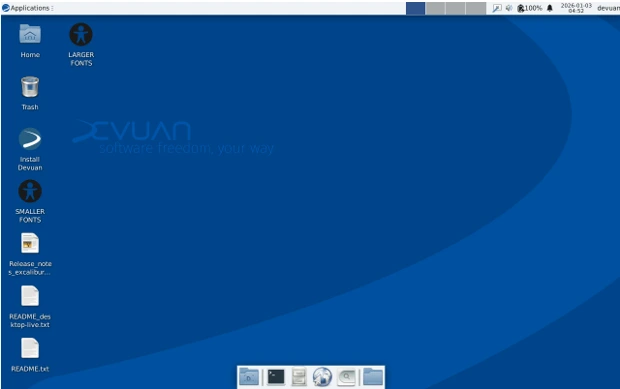
Live and installer ISOs feature Xfce 4.20 as the default—a lightweight, customizable desktop perfect for purists. Other environments like KDE Plasma, Cinnamon, MATE, LXQt, and LXDE are easily installable via tasksel or APT. No GNOME by default, reflecting its heavier systemd ties.
Architecture Support
Official images cover amd64, arm64, armel, armhf, and ppc64el. While i386 (32-bit x86) installer ISOs are discontinued (mirroring Debian), packages remain available for legacy systems.
Installation and Upgrade Paths for Devuan Excalibur 6.1
Downloading and Verifying ISOs
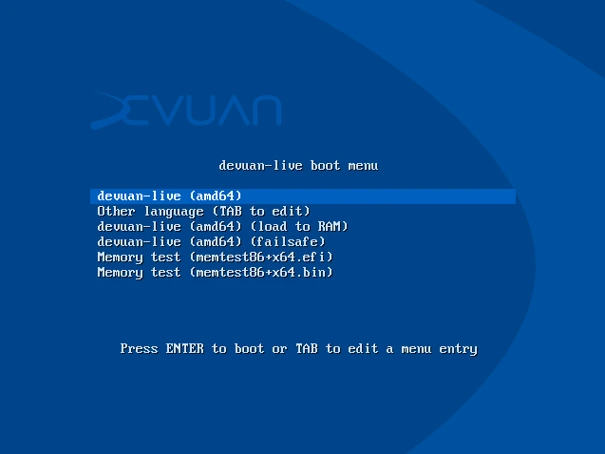
Head to files.devuan.org or a nearby mirror for the latest images:
- Desktop Live ISO: Bootable Xfce environment for testing.
- Minimal Live ISO: Stripped-down for custom builds.
- Netinstall ISO: Network-based for servers or minimal setups.
- Server ISO: Pre-configured for headless operation.
All media include non-free firmware (loaded optionally) and support expert mode to exclude it. Verify downloads with SHA256 checksums and GPG signatures for security.
The Installation Process
Devuan’s installer mirrors Debian’s—text-based, reliable, and feature-rich. Key steps:
- Boot from media.
- Select language, locale, and keyboard.
- Partition disks (guided or manual).
- Choose init system if desired.
- Install base system and select tasks (e.g., desktop environment).
- Configure bootloader (GRUB).
Accessibility tools, including speech synthesis, are improved in this release.
Upgrading Existing Systems
Existing Devuan Excalibur 6.0 users can simply run:
sudo apt update && sudo apt full-upgradeto incorporate 6.1 changes—no special steps required.
For those on older releases like Daedalus 5.0, upgrade to Excalibur first (requiring the usrmerge package beforehand), then apply standard updates.
Migration from stock Debian Trixie is supported via documented repository switches.
Raspberry Pi Setup
Grab unofficial images from arm-files.devuan.org and flash them as usual. Community forums provide support for tweaks.
Why Choose Devuan Excalibur 6.1 Over Mainstream Alternatives?
In an era dominated by systemd-based distros like Ubuntu, Fedora, and even Debian itself, Devuan Excalibur 6.1 appeals to a specific but dedicated audience:
- Purists and Traditionalists: Those who prefer the Unix philosophy of small, composable tools over integrated monoliths.
- Server Administrators: Lightweight init systems mean faster boots, easier debugging, and fewer dependencies.
- Privacy and Control Advocates: No telemetry or forced integrations.
- Embedded and Legacy Hardware Users: Efficient resource use and broad architecture support.
Performance-wise, Devuan often feels snappier on older hardware, with lower RAM usage out of the box.
Devuan vs Debian: Key Differences (2026)
| Feature | Devuan Excalibur 6.1 | Debian 13 “Trixie” |
|---|---|---|
| Init System | SysVinit (default), OpenRC, runit | systemd (default) |
| Systemd Dependencies | Completely removed / replaced | Fully integrated |
| Package Base | Synced with Debian 13.2 | Native Debian 13.2 |
| Kernel Version | Linux 6.12 LTS | Linux 6.12 LTS |
| Filesystem Layout | Mandatory merged-/usr |
Mandatory merged-/usr |
| Audio Server | PipeWire (default) | PipeWire (default) |
| Installer Firmware | Non-free firmware (optional) | Non-free firmware (optional) |
| Philosophy | Init freedom, modular design | Convenience & deep integration |
| Target Users | Purists, servers, embedded systems | General users & desktops |
Community, Support, and Future Roadmap
Devuan thrives on volunteer contributions. Engage via:
- Dev1 Galaxy Forum: Discussions and announcements.
- IRC: #devuan on Libera.Chat.
- Bug Tracker: bugs.devuan.org.
- Package Info: pkginfo.devuan.org.
Development for Devuan 7 “Freia” (based on upcoming Debian 14 “Forky”) is underway, expected in late 2027.
Derivatives like Refracta or Exe GNU/Linux build on Devuan, showcasing its versatility as a base.
Final Thoughts: Pulling the Sword in a Modern Age
Devuan Excalibur 6.1 exemplifies quiet excellence. It doesn’t chase trends or flashy interfaces; instead, it delivers Debian’s vast ecosystem—thousands of packages, rigorous testing—free from systemd’s grasp. For purists who value control, transparency, and the timeless Unix way, this release is a worthy successor.
Whether deploying servers, reviving old laptops, experimenting on Raspberry Pi, or building a principled desktop, Devuan Excalibur 6.1 empowers you to wield Linux on your terms. Download today from devuan.org and join the init freedom movement.
Frequently Asked Questions (FAQ)
What is Devuan Excalibur 6.1?
Devuan Excalibur 6.1 is a point release in the Devuan 6 “Excalibur” series, a systemd-free fork of Debian GNU/Linux. Released on January 1, 2026, it syncs packages with Debian 13.2 “Trixie,” includes bug fixes (such as improved accessibility and SLiM login manager stability), and features refreshed installation media.
How does Devuan Excalibur 6.1 differ from standard Debian?
The primary difference is the complete avoidance of systemd. Devuan offers init freedom with alternatives like SysVinit (default), OpenRC, or runit. It provides nearly identical packages and stability to Debian but without systemd dependencies or integrations.
Can I upgrade from Devuan 6.0 Excalibur to 6.1?
Yes, existing Devuan Excalibur 6.0 users can simply run sudo apt update && sudo apt full-upgrade to receive the updates. No special procedures are needed, as 6.1 primarily refreshes the ISOs with current repository packages.
Is there support for Raspberry Pi in Devuan Excalibur 6.1?
Yes, unofficial community-built images for Raspberry Pi models (2 through 5) are available. These are not officially supported by the Devuan team but can be downloaded from community repositories like arm-files.devuan.org.
Where can I download Devuan Excalibur 6.1?
Download the latest ISOs (desktop live, minimal live, netinstall, etc.) from files.devuan.org or official mirrors listed on devuan.org. Always verify checksums and signatures for security.
Disclaimer
The information in this blog post is based on the latest available data as of January 3, 2026, regarding Devuan Excalibur 6.1. Release details, features, and availability can change. Always verify the most current information directly from the official Devuan website (devuan.org), release notes, and mirrors before downloading or installing. The author and this publication are not affiliated with the Devuan project and provide this content for informational purposes only.
Also Read
Arch Linux Rings in 2026 with a Powerful New ISO