If you’ve been keeping an eye on independent Linux distributions doing genuinely interesting things with system design, then AerynOS 2026.03 should already be on your radar. Released on March 31, 2026, this latest alpha ISO is more than just a batch of package updates — it’s another confident step toward a genuinely different way of thinking about how a Linux system should work.
AerynOS 2026.03 ships with GNOME 50, Linux kernel 6.18.20, KDE Plasma 6.6.3, and a refreshed Moss package manager, among plenty of other changes. Whether you’re a casual Linux enthusiast looking for something fresh or a power user interested in next-generation distro infrastructure, there’s a lot worth unpacking here.
Let’s get into it.
What Is AerynOS, and Why Does It Matter?
Before jumping straight into the changelog, a quick bit of background is useful — especially if you’re newer to this project.
AerynOS is an independent, from-scratch Linux distribution that was previously known as Serpent OS. It’s not based on Arch, Debian, Fedora, or any other existing distro. The team started completely fresh, building their own package manager (called Moss), their own build tool (Boulder), and their own package format (.stone). That’s a significant undertaking, and it’s one of the reasons the community around this project is so invested in watching it grow.
The core philosophy behind AerynOS is atomic updates — meaning system changes happen as complete, consistent transactions rather than piecemeal updates that can leave your system in a broken intermediate state. Think of it less like traditional package management and more like how immutable distributions handle updates, except AerynOS isn’t immutable — it’s compositional. The team describes it as “install once, update forever.”
The project is still in alpha, which is important to keep in mind. It’s not ready for production use. But for testing, experimentation, and those curious about where Linux system design is heading, it’s one of the most interesting projects in the space right now.
AerynOS 2026.03: The Headline Changes
Linux Kernel 6.18.20 LTS
The 2026.03 ISO ships with Linux kernel 6.18.20 LTS, bumping the patch version from the 6.18.15 LTS that shipped with the February release. The 6.18 LTS branch has been the backbone of AerynOS for several months now, providing solid hardware compatibility and long-term support commitments.
For most users testing on modern hardware, this kernel update is largely invisible — which is exactly how it should be. It means better stability and security patches without disrupting the experience. One practical note: the team flagged a known issue where the 2026.03 ISO (like the 2026.02 before it) does not boot from Ventoy USB sticks. They’ve raised the issue upstream with the Ventoy project and are working toward a fix. If you’re planning to try the ISO, use a regular USB flash method instead.
GNOME 50: The Star of the Desktop Show
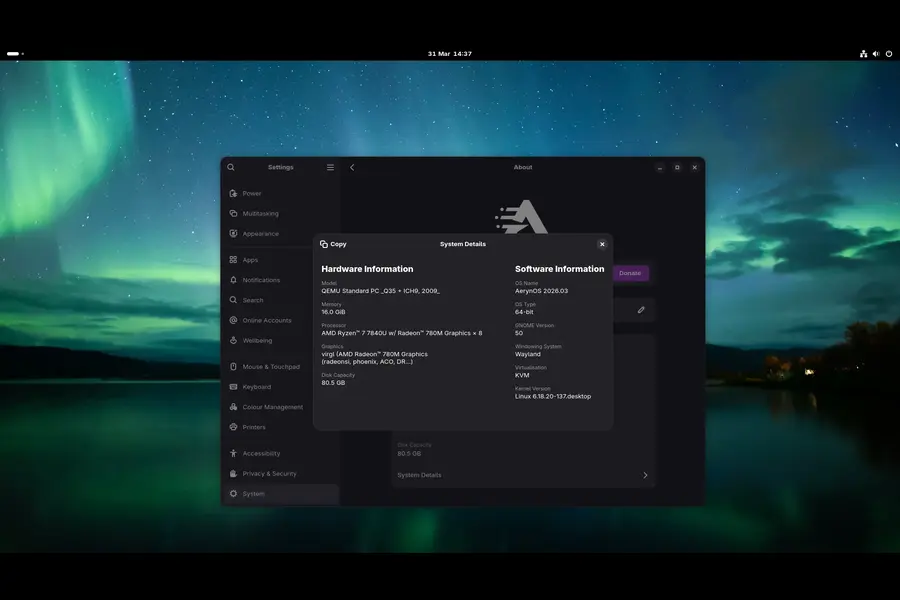
The biggest desktop headline in AerynOS 2026.03 is undoubtedly the arrival of GNOME 50. This is a landmark release for the GNOME Project — a major version bump that introduces several meaningful improvements for day-to-day use.
Here’s what GNOME 50 brings to the table:
Fractional scaling on by default. If you’ve been on a HiDPI display and have had to dig through settings to enable fractional scaling, GNOME 50 finally turns this on as a default. For anyone on a 2K or 4K monitor, this is a welcome change that makes the desktop feel immediately more polished.
Stable variable refresh rate (VRR). This one’s been long-requested. GNOME 50 ships with VRR out of the box in a stable form, which is great news for gamers and anyone using an adaptive sync display.
Improved parental controls. GNOME 50 expands parental control features, giving families and managed deployments better tools to control access — something that’s been quietly maturing over several GNOME cycles.
Wayland-only session. GNOME 50 doubles down on Wayland, dropping the legacy X11 session entirely. For AerynOS, which has always leaned heavily into Wayland, this is a natural fit. The distribution’s entire desktop philosophy aligns well with a Wayland-first world.
The AerynOS team reports no specific regressions with GNOME 50 as of the release date, though they encourage testing and bug reports through their GitHub Issues tracker and Zulip community.
KDE Plasma 6.6.3 + KDE Frameworks 6.24.0
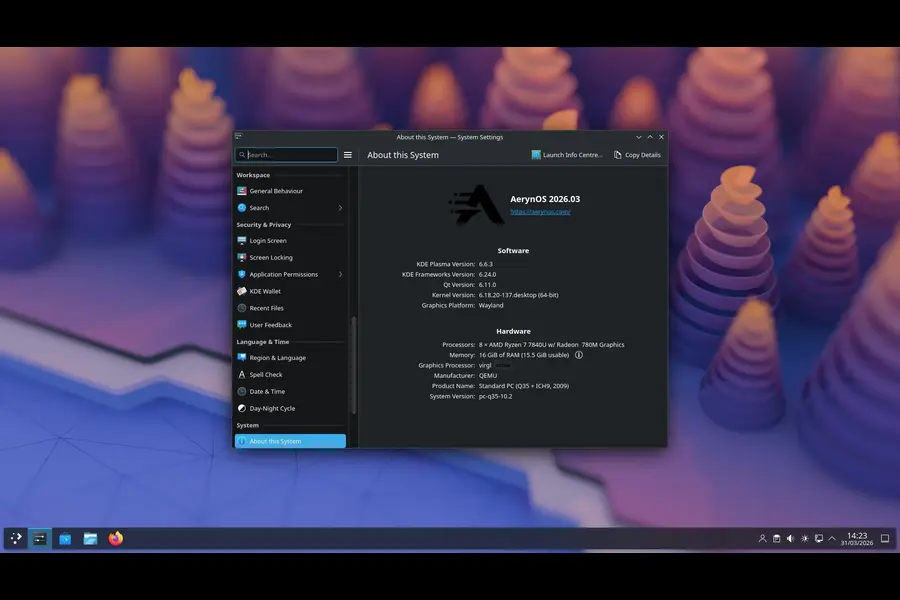
KDE users aren’t left out either. KDE Plasma 6.6.3 lands in this release alongside KDE Frameworks 6.24.0 and KDE Gear 25.12.3 — a comprehensive update across the entire KDE stack.
Plasma 6.6.3 is primarily a maintenance and polish release, addressing bugs and improving stability following the feature-rich 6.6 cycle. For users who prefer KDE’s more configurable approach over GNOME’s streamlined aesthetic, the AerynOS experience with Plasma continues to be well-supported.
Wayland Compositor Ecosystem Updates
One of the more distinctive aspects of AerynOS is how enthusiastically its community has embraced the Wayland compositor ecosystem. Rather than defaulting everyone to a single desktop environment, AerynOS actively supports a range of Wayland compositors — and 2026.03 continues that trend with updates across several of them.
MangoWM, BlueTUI, Awww, and other compositors all received updates in this release cycle. The team notes that the packaging community has really taken to the Wayland compositor choice that AerynOS offers, with new packagers getting involved and driving faster updates and richer ricing options.
There’s also a small but notable change: the default terminal in the Sway package set has been switched from Alacritty to Foot. This aligns with what Sway itself recommends as its default terminal, making the integration feel more intentional and cohesive.
Under the Hood: Moss and Boulder Improvements
This is where things get genuinely interesting for people who care about how Linux distributions actually work.
Moss: Binary Provider Search
Moss, AerynOS’s package manager, gained a meaningful new capability in the 2026.03 cycle: the ability to search by binary provider.
In practical terms, this means you can now run:
Moss Command
| moss search --provides some-binary |
and find out exactly which package provides that executable. This is something many users coming from distributions like Arch (which has pkgfile) or Fedora (which has dnf provides) will recognize as genuinely useful. Figuring out which package you need to install to get a specific tool is a common pain point, and this feature addresses it directly.
The team acknowledges the current implementation is limited and that work is ongoing to improve and generalize it — but it’s a real, usable addition right now.
Moss: Bulk State Deletion
Managing system states is core to how Moss works. The package manager uses a Content Addressable Storage (CAS) architecture, storing all package files in a deduplicated store and hardlinking them into transaction-numbered /usr trees. This lets you keep a full history of your system’s states without the storage overhead of full snapshots.
In 2026.03, Moss gains the ability to remove multiple system states at once, rather than having to delete them one by one. For systems that have been running for a while and have accumulated many historical states, this is a practical quality-of-life improvement.
Boulder: Control Files for Stack Changes
On the build tool side, Boulder — AerynOS’s package build system — now supports control files that make handling large stack changes much easier. These files let packagers skip or modify specific build steps (like test runs) without having to edit each individual recipe. When you’re doing a mass rebuild across hundreds of packages — as AerynOS regularly does — this kind of tooling flexibility saves real time and reduces the chance of errors.
The Stack Updates: A Full Refresh
Beyond the desktop environments and tooling, AerynOS 2026.03 delivered a thorough refresh across core system components. Here’s a summary of the notable version bumps:
| Component | Version in 2026.03 |
|---|---|
| Linux Kernel | 6.18.20 LTS |
| GNOME | 50 |
| KDE Plasma | 6.6.3 |
| KDE Frameworks | 6.24.0 |
| LLVM | 22.1.1 |
| Wayland | 1.25.0 |
| Qt | 6.11.0 |
| FFmpeg | 8.1 |
| Mesa | 26.0.3 |
LLVM 22.1.1 is particularly significant from a compiler infrastructure perspective — LLVM underpins a lot of the toolchain work that AerynOS depends on for building packages. Mesa 26.0.3 brings continued improvements to open-source GPU drivers across AMD (RADV, RadeonSI), Intel (Iris, Crocus), and others. FFmpeg 8.1 updates the multimedia foundation that countless applications rely on for encoding, decoding, and processing audio and video.
Qt 6.11 alongside the KDE updates means the entire KDE application ecosystem benefits from a refreshed Qt foundation — relevant not just for Plasma but for any Qt-based application running on the system.
Hardware Sponsorship: Framework Laptops
The March update blog post included an interesting note about hardware sponsorship. The Framework team has provided an additional AMD AI 300-based Framework 16 laptop to developer Joey Riches, who is using it as a dedicated AerynOS development machine.
The team is enthusiastic about Framework hardware specifically because of its repairability and the fact that Framework actively supports up-and-coming Linux distributions. After disabling Secure Boot, the installation on the Framework 16 proceeded without requiring any additional hardware enablement work — a positive sign for driver support on newer AMD silicon.
The team also noted that while they lost access to a Framework 13 when a previous contributor stepped away, one of the core team members (NomadicCore) personally owns an AMD 7840u-based Framework 13, ensuring continued hardware support for that platform.
Repository Status: Soft Freeze Continues
If you’re a packager or contributor looking to add new packages to AerynOS, the soft freeze from last month is still in effect. The team is not accepting new package recipes that carry heavy reverse dependency rebuild chains — essentially, if adding your package would trigger a wave of rebuilds across the repository, it’s on hold for now.
That said, packages with minimal or no reverse dependency chains are still being accepted. Most Rust and Go packages naturally fit this pattern, so if you’re packaging tools written in those languages, there’s a clear path forward.
The reason for the freeze is straightforward: the team is preparing for some significant infrastructure changes. The Python stack upgrade planned for April — moving from Python 3.11 to a newer version — is described internally as “notoriously invasive.” It will touch a large portion of the roughly 1,500 recipes in the repository, requiring a full rebuild. Getting the tooling right before that happens is prudent engineering.
What’s Coming Next: Looking Past 2026.03
The March update gave a clear picture of what the team is working toward in the coming months.
Python stack upgrade. The move from Python 3.11 to a newer release is the next big infrastructure project. It’s the kind of change that sounds simple but cascades across a huge number of packages, and the AerynOS team is preparing carefully for it.
Full repository rebuild. Alongside the Python work, a complete rebuild of all ~1,500 recipes is planned. This is partly about Python and partly about ensuring everything is built consistently with the latest toolchain improvements.
Versioned repositories. The team has been working toward versioned repository support for several months. This would give users and administrators more control over which version of the software stack they’re running — an important feature for any distribution aiming at serious deployments.
Improved recipe automation. The development work in March centered significantly on automating recipe updates and improving how bootstrap builds are handled in Boulder. Better automation means faster updates and less manual work for packagers.
REUSE compliance. The team mentioned wanting to make the recipes repository properly REUSE (Reuse Uniform Simplified Expressions) compliant — a software licensing standard that makes it clearer and more machine-readable which licenses apply to which files. It’s a detail that matters for organizations evaluating AerynOS for deployment.
Should You Try AerynOS 2026.03?
That depends on who you are and what you’re looking for.
If you’re a tinkerer or Linux enthusiast who enjoys being on the cutting edge of distro development, AerynOS 2026.03 is genuinely worth exploring. The ideas here — atomic updates, content-addressable storage, a compositor-first Wayland experience, and a clean from-scratch design — are compelling. There’s nothing quite like it in the current Linux landscape.
If you’re looking for a daily driver, AerynOS is not there yet. It’s alpha software, there’s no graphical installer (you’ll use the Lichen terminal-based installer), you need to partition your drive manually before installation, and the ISO currently has issues booting from Ventoy. The team is transparent about this.
If you’re a packager or developer, the improving Boulder tooling and the growing repository make this an interesting contribution target. The community is active, the codebase is modern Rust, and the team communicates clearly through their blog and Zulip.
One thing worth noting: installation requires a network connection. The ISO is a live GNOME environment used primarily to launch the Lichen installer, which then downloads the latest package sets from the network. Make sure you have a stable connection before sitting down to install.
Final Thoughts
AerynOS 2026.03 is a release that rewards paying attention to the details. The headline — GNOME 50 and KDE Plasma 6.6.3 — is genuinely exciting for desktop Linux users. But the more you look at the infrastructure changes, the tooling improvements, and the deliberate roadmap the team is executing on, the more impressive the overall picture becomes.
This is a small team doing significant engineering work from scratch, making consistent monthly progress, and being honest about where things stand. That combination is rarer than it should be in open-source development.
If you want to try the latest ISO, head to the AerynOS download page and give it a go in a VM or on spare hardware. And if you find bugs, the team genuinely wants to hear about them — via GitHub Issues or through their Zulip community at aerynos.com.
The project is still young, but the trajectory is clear. AerynOS is building toward something worth watching.
Disclaimer
This article is written for informational purposes only. AerynOS 2026.03 is an alpha release and is not recommended for production or daily-driver use. All information is based on publicly available data from the official AerynOS blog and third-party Linux news sources as of March 31, 2026. Feature availability and project status may change. Always refer to the official AerynOS website for the most current information.
Also Read
How AI Is Rewriting the Rules of Student Learning