Imagine reaching billions of customers directly on their phones with messages they’re almost guaranteed to open. Sounds like a marketer’s dream, right? Well, it’s becoming reality with WhatsApp ads, and that’s Why WhatsApp Ads Could Be the Future of Mobile Marketing. With over 3.14 billion monthly active users as of January 2025, WhatsApp has evolved from a simple messaging app into a global communication giant.
Meta’s bold move, announced on June 16, 2025, to introduce ads in WhatsApp’s Updates tab is set to redefine how brands connect with audiences. Blending seamless user experience with powerful marketing tools, WhatsApp ads are poised to dominate mobile marketing. Let’s explore why this shift is so exciting, backed by the latest data and insights.
The Rise of WhatsApp as a Marketing Powerhouse
WhatsApp, acquired by Meta for $19 billion in 2014, has grown from a simple messaging app to a global phenomenon. With over 2.5 billion active users in 2024 and a presence in 180 countries, it’s the most popular messaging app in over 100 countries. Its appeal lies in its simplicity, end-to-end encryption, and availability in 60 languages, making it a trusted platform worldwide. Unlike traditional social media, WhatsApp offers a private, direct, and personal channel for communication, which is why 69% of its users consider it their primary communication tool.
The introduction of the WhatsApp Business app in 2018 and the WhatsApp Business API has transformed how businesses interact with customers. With over 300 million downloads, the Business app has enabled small businesses to boost engagement by 20% and larger enterprises to send over 100,000 marketing messages at once. WhatsApp’s staggering open rate of 70%—compared to email’s 20%—and a conversion rate of 45-60% make it a goldmine for marketers. These stats underscore why WhatsApp is no longer just a messaging platform but a critical tool for customer acquisition, engagement, and retention.
WhatsApp Ads: A New Era of Monetization
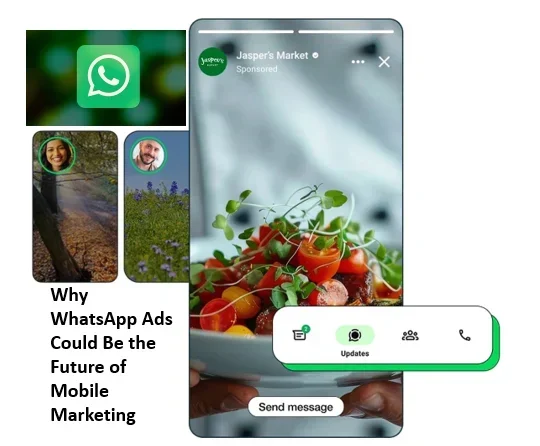
Meta’s decision to introduce ads in WhatsApp’s Updates tab, announced at the Cannes Lions advertising industry conference in 2025, marks a significant departure from its ad-free roots. This move targets the 1.5 billion daily users of the Updates tab, where Status updates and Channels reside. The ads, including Status Advertisements, Promoted Channels, and Channel Subscriptions, are designed to integrate seamlessly without disrupting personal chats. Here’s a breakdown of these new ad formats:
- Status Advertisements: These appear between Status updates, similar to Instagram Stories ads, allowing users to discover businesses and initiate conversations directly.
- Promoted Channels: Businesses can pay to boost their Channel’s visibility in WhatsApp’s directory, enhancing discoverability.
- Channel Subscriptions: Creators and businesses can charge monthly fees for exclusive content, mirroring models like Patreon or YouTube.
Meta emphasizes that personal messages, calls, and statuses remain end-to-end encrypted, and ad targeting relies on limited data like location, language, and user interactions with ads or Channels. For users linked to Meta’s Accounts Center, ad preferences from Facebook and Instagram may influence WhatsApp ads, raising some privacy concerns but also enabling more personalized campaigns.
Why WhatsApp Ads Are a Game-Changer for Mobile Marketing
1. Unmatched Engagement Rates
WhatsApp’s engagement metrics are unparalleled. With a 98% open rate for business messages and a 70% post-optimization open rate, WhatsApp outperforms traditional channels like email and SMS, which typically see 2-5% conversion rates. Click-to-WhatsApp (CTWA) ads, introduced by Meta in 2023, allow users to start a conversation with a business directly from a Facebook or Instagram ad. This seamless transition from ad to chat results in a 15% click-through rate and a 5% baseline conversion rate, with some campaigns achieving up to 60% conversion. For example, Rajasthan Royals, an IPL team, saw a 50% increase in merchandise sales through WhatsApp marketing, while Mercedes-Benz Turkey reported a 63% lead-to-conversion rate in a single campaign.
2. Direct and Personalized Communication
Unlike traditional ads that redirect users to websites or landing pages, WhatsApp ads enable instant, one-on-one conversations. This direct communication fosters trust and allows businesses to address customer queries in real-time, reducing friction in the buyer’s journey. Tools like DoubleTick and Engati enhance this by offering chatbots that qualify leads, recover abandoned carts (up to 60% recovery rate), and provide personalized responses. For instance, Concrete Jungle’s segmented WhatsApp campaigns based on gender and purchase history yielded a 300% ROI, showcasing the power of tailored messaging.
3. Cost-Effectiveness and High ROI
WhatsApp and WhatsApp Business are free, with charges only for the Business API. This eliminates costs associated with traditional advertising, like printing or distribution. CTWA ads, managed through Meta Ads Manager, leverage Meta’s advanced targeting capabilities, allowing businesses to reach specific demographics efficiently. Analytics-powered campaigns on WhatsApp have achieved conversion rates 50% higher than non-data-driven efforts, making it a cost-effective channel. Businesses using WhatsApp chatbots report a 28% lead-to-conversion rate and a 500% increase in lead generation, further amplifying ROI.
4. Integration with Meta’s Ecosystem
WhatsApp’s integration with Facebook, Instagram, and Meta’s Conversions API (CAPI) and Marketing API (MAPI) creates a unified advertising ecosystem. Click-to-WhatsApp ads displayed on Facebook and Instagram feeds, Stories, and Marketplace drive users directly to WhatsApp chats, streamlining the customer journey. This integration allows businesses to sync customer data with CRMs like HubSpot or Shopify, enabling seamless order tracking and personalized follow-ups. For example, Rappi, a Latin American delivery service, used Braze and WhatsApp to re-engage lapsed users with targeted deals, boosting sales and customer retention.
5. Mobile-First and Global Reach
As a mobile-first platform, WhatsApp aligns perfectly with the projected $709.67 billion mobile entertainment market by 2032, where mobile ads will account for over 75% of total ad spend in 2025. With users opening WhatsApp 23-25 times per week and 54% preferring marketing messages via the platform, it’s a prime channel for mobile marketing. Its presence in markets like India, where 80% of adults use WhatsApp regularly, and Saudi Arabia, with 99% per capita penetration, makes it ideal for scaling global campaigns.
6. Privacy-Focused Advertising
Despite privacy concerns, Meta assures that WhatsApp ads won’t use personal messages or phone numbers for targeting. Instead, they rely on basic data like location and Channel interactions, ensuring compliance with WhatsApp’s privacy-first ethos. This balance is crucial in markets like the EU, where regulations like GDPR and the Digital Markets Act (DMA) restrict data linkage across platforms. However, critics like Max Schrems argue that Meta’s cross-platform data usage via Accounts Center may violate EU laws, potentially sparking legal battles. Still, WhatsApp’s commitment to encryption maintains user trust, a key factor in its marketing appeal.
How to Leverage WhatsApp Ads for Maximum Impact
To harness WhatsApp ads effectively, businesses should follow these best practices:
- Set Up a WhatsApp Business Account: Create and verify a business profile with a high-quality logo, contact details, and a compelling description. Apply for Official Business Account (OBA) status for added credibility.
- Use Click-to-WhatsApp Ads: Run CTWA ads via Meta Ads Manager, targeting specific audiences on Facebook and Instagram. Include strong CTAs like “Chat Now” or “Get Instant Support” to drive engagement.
- Personalize Campaigns: Segment audiences based on purchase history, demographics, or engagement levels. Use tools like Gallabox or Chat360 for automated, personalized drip campaigns.
- Leverage Analytics: Track metrics like delivery rate, read rate, click-through rate, and conversion rate to optimize campaigns. Businesses using WhatsApp data with Meta’s APIs see a 30% increase in ad effectiveness.
- Integrate with CRM: Sync WhatsApp with platforms like Shopify or Zoho CRM to streamline order management and customer support.
- Collect Opt-Ins: Ensure compliance with WhatsApp’s opt-in requirements to avoid penalties and maintain user trust.
Challenges and Considerations
While WhatsApp ads offer immense potential, they come with challenges:
- Limited Targeting Options: Unlike Facebook or Instagram, WhatsApp’s targeting is restricted to basic demographics, which may limit precision for some businesses.
- Privacy Backlash: The integration of WhatsApp with Meta’s ecosystem has raised concerns, especially in privacy-sensitive markets like the EU. Users may resist if ads feel intrusive.
- User Experience: Overloading the Updates tab with ads could alienate users, particularly in regions like the UK, where WhatsApp is primarily a messaging tool.
The Future of WhatsApp Ads
WhatsApp ads are set to redefine mobile marketing by combining high engagement, personalization, and cost-effectiveness. As Meta continues to evolve WhatsApp into a super app, similar to WeChat, with features like shopping catalogs and payments, its commercial potential will only grow. Analysts predict WhatsApp’s ad revenue could reach $10 billion annually, driven by its 3.14 billion user base and increasing adoption by large enterprises. The introduction of an ad-free subscription model, similar to YouTube Premium, could further balance monetization with user satisfaction.
In conclusion, WhatsApp ads represent a bold step into the future of mobile marketing. Their ability to deliver direct, personalized, and high-ROI campaigns makes them a must-have tool for businesses in 2025 and beyond. By leveraging WhatsApp’s global reach, seamless integrations, and data-driven insights, brands can build stronger customer relationships and drive exponential growth. Ready to tap into this opportunity? Set up your WhatsApp Business account and start crafting campaigns that resonate with your audience today.
Disclaimer
The information provided in this blog post is for general informational purposes only and is based on the most recent data available as of June 18, 2025. While we strive to ensure the accuracy and reliability of the content, the digital marketing landscape, including WhatsApp’s advertising features and policies, is subject to change. We make no representations or warranties of any kind, express or implied, about the completeness, accuracy, reliability, or suitability of the information for any purpose. Any reliance you place on such information is at your own risk.
This post is not endorsed by WhatsApp or Meta, and any references to their products, services, or announcements are based on publicly available information. Always consult official platforms or professional advisors before making business or marketing decisions. We are not liable for any loss or damage arising from the use of this information.
Also Read
The Last Page: Linux Format Magazine’s Journey Ends with Issue 329