
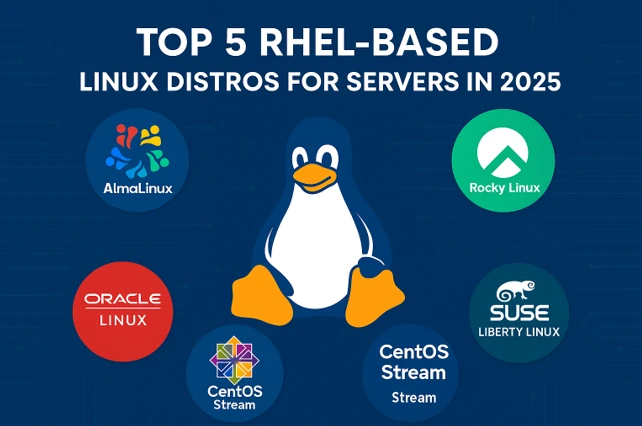
When it comes to server operating systems, Linux reigns supreme for its stability, security, and flexibility. Among the vast ecosystem of Linux distributions, those based on Red Hat Enterprise Linux (RHEL) stand out for their enterprise-grade reliability and long-term support. If you’re a system administrator, IT manager, or tech enthusiast looking to deploy a robust server in 2025, choosing the right RHEL-based distro is critical.
In this blog post, we’ll dive into the top 5 RHEL-based Linux distros for servers in 2025, exploring their features, use cases, and why they’re ideal for your server needs. This guide is packed with the latest official data, practical insights, and a human touch to help you make an informed decision.
Why Choose RHEL-Based Linux Distros for Servers?
Before we jump into the list, let’s talk about why RHEL-based distros are a go-to choice for servers. Red Hat Enterprise Linux is a commercial Linux distribution designed for mission-critical environments, offering a 10-year support lifecycle, rigorous testing, and compatibility with a wide range of enterprise applications. However, RHEL comes with a subscription cost, which may not suit every budget. That’s where RHEL-based distros shine—they provide the same stability and compatibility for free, often with community-driven support or optional paid services.
RHEL-based distros are binary-compatible with RHEL, meaning software tested on RHEL runs seamlessly on these alternatives. They’re optimized for servers, cloud deployments, and enterprise workloads, making them ideal for web hosting, databases, and containerized environments. Plus, with the shift from CentOS Linux to CentOS Stream, new players have emerged to fill the gap, offering stable, production-ready options for 2025.
Top 5 RHEL-Based Linux Distros for Servers in 2025
Here’s our carefully curated list of the top 5 RHEL-based Linux distributions for servers, based on stability, community support, enterprise compatibility, and performance in 2025.
1. AlmaLinux
Overview: Born in 2021 as a direct response to the discontinuation of CentOS Linux, AlmaLinux has quickly become a leading RHEL-based distro. Developed by the AlmaLinux OS Foundation, it’s a community-driven, open-source alternative that maintains 1:1 binary compatibility with RHEL. AlmaLinux is designed for enterprises and sysadmins who need a stable, long-term platform without licensing fees.

Key Features:
- Long-Term Support: AlmaLinux 8.x is supported until 2029, and AlmaLinux 9.x until 2032, ensuring long-term reliability for production servers.
- Binary Compatibility: Seamlessly integrates with RHEL-based applications and workflows, making it a drop-in replacement for CentOS.
- Cloud and Container Support: Official images are available for AWS, Azure, Google Cloud, Docker, and Kubernetes, ideal for modern cloud deployments.
- Community-Driven: Backed by a vibrant community and enterprise sponsors like CloudLinux, with regular security updates and extensive documentation.
- Hardware Support: Supports multiple architectures, including x86_64, ARM64, and IBM Power, catering to diverse server environments.
Use Cases:
- Web hosting and database servers
- Enterprise applications requiring RHEL compatibility
- Cloud and containerized workloads
- Organizations transitioning from CentOS
Why Choose AlmaLinux in 2025?
AlmaLinux has gained significant traction since its inception, with a focus on stability and enterprise-grade performance. Its 10-year support lifecycle matches RHEL’s, making it a reliable choice for mission-critical servers. The distro’s active community and enterprise backing ensure timely updates, and its compatibility with major cloud platforms makes it a versatile option for hybrid environments. If you’re looking for a free, production-ready RHEL alternative, AlmaLinux is hard to beat.
Drawbacks:
- Lacks the commercial support of RHEL, though optional paid support is available through partners like CloudLinux.
- Smaller community compared to Ubuntu, which may limit forum-based troubleshooting for niche issues.
2. Rocky Linux
Overview: Rocky Linux, launched in 2021 by Gregory Kurtzer (a CentOS co-founder), is another heavyweight in the RHEL-based distro space. Designed to fill the void left by CentOS Linux, Rocky Linux is 100% compatible with RHEL and emphasizes enterprise-grade stability and community collaboration.

Key Features:
- RHEL Compatibility: Built from RHEL source code, ensuring identical functionality for enterprise applications.
- Long-Term Support: Rocky Linux 8 is supported until 2029, and Rocky Linux 9 until 2032, aligning with RHEL’s lifecycle.
- Enterprise Focus: Certified for major cloud platforms (AWS, Azure, GCP) and supports containerized workloads with Docker and Kubernetes.
- Community and Documentation: A robust community provides extensive documentation, forums, and wikis, making it accessible for sysadmins.
- Performance: Optimized for high-throughput, low-latency workloads, ideal for database and web servers.
Use Cases:
- Enterprises needing a CentOS replacement
- Web hosting with cPanel or Apache/Nginx
- Mission-critical applications requiring uptime and stability
- Cloud-based deployments and microservices
Why Choose Rocky Linux in 2025?
Rocky Linux has established itself as a rock-solid alternative to CentOS, with a strong focus on enterprise compatibility and community support. Its leadership by a CentOS co-founder adds credibility, and its large installation ISO (over 9GB) ensures comprehensive package availability. For organizations that rely on RHEL-based software but want a free alternative, Rocky Linux delivers without compromise.
Drawbacks:
- Installation can be time-consuming due to the large ISO size.
- No live environment for testing before installation, unlike some other distros.
3. Oracle Linux
Overview: Oracle Linux is an RHEL-based distro developed by Oracle, optimized for Oracle products but versatile enough for general-purpose server use. It’s free to download and use, with optional paid support, and includes unique features like Ksplice for live kernel patching.

Key Features:
- Ksplice Technology: Allows kernel updates without rebooting, minimizing downtime for critical servers.
- RHEL Compatibility: Fully compatible with RHEL, supporting Oracle databases, cloud infrastructure, and enterprise applications.
- Cloud Integration: Strong support for Oracle Cloud, AWS, Azure, and GCP, with pre-configured images for scalability.
- Enterprise Tools: Includes tools for memory management, file organization, and DevOps integration (Ansible, Puppet).
- Support Options: Free to use with community support, or opt for Oracle’s 24/7 enterprise support for mission-critical deployments.
Use Cases:
- Oracle database and application hosting
- Enterprises using Oracle Cloud or hybrid environments
- Servers requiring minimal downtime with live patching
- Organizations seeking optional commercial support
Why Choose Oracle Linux in 2025?
Oracle Linux stands out for its unique Ksplice feature, which is a game-changer for servers where uptime is non-negotiable. Its deep integration with Oracle products makes it a top choice for businesses already invested in the Oracle ecosystem, but its RHEL compatibility ensures it’s versatile for other workloads. The option for paid support adds flexibility for enterprises needing vendor-backed assistance.
Drawbacks:
- Heavy focus on Oracle products may feel restrictive for non-Oracle users.
- Community support is less extensive than AlmaLinux or Rocky Linux.
4. CentOS Stream
Overview: CentOS Stream is the rolling-release successor to CentOS Linux, serving as the upstream development branch for RHEL. While it’s not as stable as traditional CentOS, it offers a balance of cutting-edge features and enterprise compatibility, making it suitable for specific server use cases.

Key Features:
- Rolling Release: Provides continuous updates, giving early access to features destined for future RHEL releases.
- RHEL Compatibility: Maintains compatibility with RHEL applications, though it’s slightly ahead of RHEL’s stable branch.
- Community Support: Backed by a large community with active forums and integration with DevOps tools like Ansible and Puppet.
- Long-Term Support: CentOS Stream 8 is supported until 2029, and CentOS Stream 9 until 2032.
- Enterprise Use: Widely used in corporate environments for testing and development servers.
Use Cases:
- Development and testing environments
- Enterprises experimenting with upcoming RHEL features
- Servers hosting RHEL-compatible applications
- DevOps workflows with automation tools
Why Choose CentOS Stream in 2025?
CentOS Stream is ideal for sysadmins and developers who want to stay ahead of the curve with access to the latest RHEL innovations. Its rolling-release model ensures frequent updates, making it a great fit for non-production environments or organizations comfortable with a slightly less stable platform. Its familiarity for RHEL users and active community make it a strong contender.
Drawbacks:
- Rolling-release model may introduce instability for production servers.
- Not a direct replacement for the stable CentOS Linux, which may disappoint traditional CentOS users.
5. SUSE Liberty Linux
Overview: SUSE Liberty Linux is a newer entrant in the RHEL-based distro space, developed by SUSE as an alternative to CentOS Linux. Built on the SUSE Linux Enterprise Server (SLES) kernel, it offers RHEL compatibility with SUSE’s enterprise-grade stability and optional paid support.

Key Features:
- RHEL Compatibility: Ensures seamless integration with RHEL-based applications and workflows.
- SUSE Backing: Leverages SUSE’s expertise in enterprise Linux, with rigorous testing for stability and security.
- Long-Term Support: Aligned with RHEL’s lifecycle, with support for version 9 until 2032.
- YaST Tool: Includes SUSE’s powerful YaST configuration tool for simplified server management.
- Hybrid Environments: Optimized for mixed Linux environments, supporting cloud, on-premises, and containerized workloads.
Use Cases:
- Enterprises needing RHEL compatibility with SUSE’s ecosystem
- Mixed Linux environments with SLES and RHEL workloads
- Servers requiring advanced configuration tools
- Organizations seeking optional commercial support
Why Choose SUSE Liberty Linux in 2025?
SUSE Liberty Linux combines the best of RHEL compatibility with SUSE’s enterprise expertise. The YaST tool simplifies complex server management tasks, making it appealing for sysadmins who value ease of use. Its support for hybrid environments and optional paid support make it a strong choice for businesses running diverse workloads.
Drawbacks:
- Smaller community compared to AlmaLinux or Rocky Linux, which may limit peer support.
- Less widespread adoption than other RHEL-based distros, as it’s a newer player.
How to Choose the Right RHEL-Based Distro for Your Server
Selecting the best RHEL-based distro for your server depends on your specific needs, technical expertise, and budget. Here are key factors to consider:
Purpose and Workload:
- For production servers requiring maximum stability, choose AlmaLinux or Rocky Linux.
- For Oracle-specific workloads, Oracle Linux is the best fit.
- For development or testing environments, CentOS Stream offers cutting-edge features.
- For hybrid environments with advanced management tools, consider SUSE Liberty Linux.
Support Requirements:
- If you need commercial support, RHEL (not free) or Oracle Linux with paid support are ideal.
- For community-driven support, AlmaLinux and Rocky Linux have strong forums and documentation.
Stability vs. Innovation:
- Prioritize stability for mission-critical applications with AlmaLinux, Rocky Linux, or SUSE Liberty Linux.
- Opt for CentOS Stream if you want early access to new features.
Cloud and Container Compatibility:
- All five distros support major cloud platforms (AWS, Azure, GCP) and containers (Docker, Kubernetes), but AlmaLinux and Rocky Linux have the broadest certifications.
Budget:
All listed distros are free to use, with Oracle Linux and SUSE Liberty Linux offering optional paid support for enterprises.
Comparison Table: Top 5 RHEL-Based Linux Distros for Servers in 2025
| Distro | Support Lifecycle | RHEL Compatibility | Key Features | Best For |
|---|---|---|---|---|
| AlmaLinux | Until 2029 (8.x), 2032 (9.x) | 100% | Community-driven, cloud/container support | Enterprises, CentOS replacements |
| Rocky Linux | Until 2029 (8.x), 2032 (9.x) | 100% | Enterprise-grade, large community | Web hosting, mission-critical servers |
| Oracle Linux | Aligned with RHEL | 100% | Ksplice, Oracle Cloud integration | Oracle workloads, minimal downtime |
| CentOS Stream | Until 2029 (8.x), 2032 (9.x) | High | Rolling release, DevOps integration | Development, testing environments |
| SUSE Liberty Linux | Aligned with RHEL | 100% | YaST tool, hybrid environment support | Mixed Linux environments, SUSE users |
Tips for Deploying RHEL-Based Distros on Servers
Backup Data: Always back up critical data before installing or switching distros to avoid data loss.
Test in a Virtual Machine: Use tools like VirtualBox or KVM to test the distro before deploying it on production servers.
Leverage Official Images: For cloud deployments, use pre-configured images from AWS, Azure, or GCP to simplify setup.
Enable Security Features: Configure firewalls (e.g., firewalld), SELinux, and regular updates to enhance server security.
- Monitor Performance: Use tools like Cockpit (available in Fedora, AlmaLinux, and Rocky Linux) or YaST (SUSE Liberty Linux) for real-time server monitoring.
Conclusion
In 2025, RHEL-based Linux distributions remain a cornerstone for server environments, offering unmatched stability, security, and compatibility. AlmaLinux and Rocky Linux are the top choices for enterprises seeking free, stable alternatives to CentOS, while Oracle Linux excels for Oracle-centric workloads with its unique Ksplice feature.
CentOS Stream is perfect for developers who want cutting-edge features, and SUSE Liberty Linux shines in hybrid environments with advanced management tools. By aligning your choice with your specific use case—whether it’s web hosting, cloud deployments, or mission-critical applications—you can leverage the power of RHEL-based distros to build a robust server infrastructure.
Ready to dive in? Pick one of these distros, test it in a virtual environment, and join the vibrant Linux community to power your servers in 2025 and beyond. Have questions or need help choosing? Drop a comment below, and let’s get the conversation started!
Disclaimer
The information provided in this blog post is based on the latest official data and publicly available resources as of August 4, 2025. While every effort has been made to ensure accuracy, the details, features, and support timelines of the RHEL-based Linux distributions discussed may change over time. Readers are encouraged to verify information directly from official sources, such as the respective distribution’s website, before making decisions for production environments.
The author and publisher are not responsible for any errors, omissions, or damages arising from the use of this information. Always perform thorough testing and consult with IT professionals when deploying server operating systems.
Also Read
Uncover the Top 5 Hidden Gem Linux Distros to Try in 2025!