DragonFly BSD in 2026 Why This Lightweight BSD Is Still a Powerhouse
Hey there, fellow tinkerers, sysadmins, and open-source enthusiasts. If you’re anything like me, you’ve spent countless hours knee-deep in the trenches of operating systems, chasing that elusive sweet spot where performance, stability, and simplicity collide. In a world dominated by the Linux behemoth and the occasional FreeBSD sighting, there’s one underdog that’s been quietly sharpening its claws for over two decades: DragonFly BSD. As we peer into 2026, this lightweight BSD derivative isn’t just hanging on—it’s evolving into a lean, mean machine that’s perfect for anyone tired of bloated distros and ready for something that punches way above its weight class.
In this deep dive, we’ll explore why DragonFly BSD in 2026 remains a powerhouse. We’ll trace its roots, unpack the latest official updates straight from the project’s November 2025 status, benchmark it against the competition, and spotlight real-world use cases that make it shine. Whether you’re a developer eyeing high-performance servers, a hobbyist building a home lab, or just curious about alternatives to the mainstream, stick around. By the end, you might just find yourself firing up a VM to give it a spin. Let’s buzz into it.
A Brief History: From FreeBSD Fork to Innovation Hub
To appreciate DragonFly BSD in 2026, we have to rewind to the early 2000s. DragonFly was born in June 2003 as a fork of FreeBSD 4.8, spearheaded by Matthew Dillon—a veteran FreeBSD developer frustrated with the direction of symmetric multiprocessing (SMP) scaling in the kernel. Dillon envisioned an OS that could truly harness multi-core processors without the lock contention that plagued traditional monolithic kernels. His mantra? “Do one thing, and do it well,” but on steroids: rewrite the kernel from the ground up for parallelism.
Fast-forward through two decades of deliberate, no-frills development, and DragonFly has carved out a niche as the “lightweight” BSD. Unlike its siblings—FreeBSD’s enterprise heft, OpenBSD’s security fortress, or NetBSD’s portability wizardry—DragonFly focuses on raw efficiency. It’s x86-64 only (dropping 32-bit support in version 4.0 back in 2016), which keeps the codebase trim and laser-focused on modern hardware. No chasing every architecture under the sun; just pure, unadulterated performance.
By 2025, DragonFly had matured into version 6.4.2, released in late 2025 with enhancements like NVMM hypervisor support and an experimental HAMMER2 remote-mount feature. But what does 2026 hold? The project’s pragmatic ethos suggests steady iteration: expect refinements to DPorts (their package system, syncing with FreeBSD’s 2025Q2 ports tree) and deeper hardware integration. As Dillon himself noted in past updates, DragonFly isn’t about flashy releases—it’s about building a foundation that scales effortlessly into the future.
The Latest Scoop: Official Updates as of November 2025
Let’s ground this in facts. As of November 21, 2025, the DragonFly BSD project is humming along with version 6.4.2 as the crown jewel. This release, building on 6.4.1 from April 2025, packs a punch for virtualization and graphics enthusiasts. Key highlights include:
- NVMM Hypervisor Support: Full hardware acceleration for type-2 hypervisors (think KVM/QEMU compatibility). This means DragonFly can now host VMs with near-native speed, opening doors for lightweight container orchestration without the overhead of heavier tools like Docker on Linux.
- AMDGPU Driver: Native support for AMD Radeon GPUs, synced from older Linux DRM code (around 4.20.17 kernel equivalent, updated in June 2025). While not bleeding-edge for the latest RDNA4 cards, it’s a solid step up for compute workloads and basic desktop acceleration.
- HAMMER2 Remote-Mount (Experimental): The star of the show. HAMMER2, DragonFly’s default filesystem since it stabilized in recent years, now allows remote mounting of volumes over the network. Imagine seamless distributed storage without NFS headaches—snapshots, compression, and deduplication baked in. This feature, teased since 2017 plans, is maturing fast and could redefine clustered setups in 2026.
On the ports front, DPorts 2024Q3 merged successfully, pulling in thousands of packages from FreeBSD’s ecosystem. The team is knee-deep in 2025Q2, promising fresher software stacks for everything from web servers to development tools. Bug fixes abound too: IPv6 routing tweaks, installer polish, and better handling of subprocess-heavy apps like modern compilers.
Community chatter on X (formerly Twitter) echoes this vitality. Users are experimenting with 6.4.2 on AMD Ryzen setups, praising its snappiness for torrent seeding and home clusters. One dev even quipped about installing it on an HP DragonFly laptop for the irony. No major drama, just steady progress—hallmarks of a project that’s in it for the long haul.
Looking ahead to 2026, the roadmap (hinted at in the bug tracker) points to version 6.6 or 7.0, with emphasis on lockless networking refinements and fuller Device Mapper support for encryption. No pie-in-the-sky promises, but expect DragonFly to double down on what it does best: efficient resource use in multi-core environments.
Core Features: What Makes DragonFly Tick?
At its heart, DragonFly BSD is a masterclass in minimalism. Its hybrid kernel—monolithic but with microkernel-inspired message passing—eschews giant locks for per-CPU structures. This LWKT (Lightweight Kernel Threading) model lets threads float freely across cores, minimizing contention and maximizing throughput. In plain English? Your 64-core Threadripper won’t twiddle its thumbs waiting for a mutex.
HAMMER2: The Filesystem That Won’t Quit
If there’s one feature screaming “DragonFly BSD in 2026,” it’s HAMMER2. Default since stabilization around 2020, this 64-bit filesystem is a beast: unlimited snapshots (zero-copy, instant), online compression (LZ4 or ZLIB), deduplication, and copy-on-write integrity. No more “ext4 corruption panic” stories—HAMMER2’s design ensures data safety even during power loss.
Recent 2025 tweaks include that experimental remote-mount, letting you NFS-like share volumes with master/slave replication. For 2026, expect production-ready clustering, turning a rack of DragonFly boxes into a single, resilient storage pool. Benchmarks? In Phoronix tests on PostgreSQL, DragonFly 3.2 (ancient by now) matched Linux kernels; 6.4.2 crushes it further on SSDs thanks to swapcache.
Virtual Kernels: Run Kernels Like Apps
Want to test kernel tweaks without rebooting? Virtual kernels (vkernels) let you spawn full kernels as user-space processes. It’s like a built-in VM for development—sandboxed, lightweight, and perfect for CI/CD pipelines. In 2025, updates added vkbd(4) virtual keyboards and cuse(3) for user-space devices, making it even handier for embedded sims.
Swapcache and SSD Love
DragonFly treats SSDs like royalty. Swapcache uses swap space as a giant cache for filesystem data, blending RAM speed with disk capacity. Result? Blazing reads on budget hardware. No tmpfs fiddling required—it’s automatic and tunable.
DEVFS and Stable Devices
Tired of /dev shuffling on reboots? DEVFS dynamically generates nodes by serial/UUID, so your NVMe drive is always /dev/disk0, not some lottery number. Paired with native AHCI/NVMe drivers, it’s a storage dream.
These aren’t gimmicks; they’re why DragonFly feels “lightweight” yet powerful. Footprint? A base install clocks in under 1GB, leaving room for your apps to breathe.
Performance Deep Dive: DragonFly vs. Linux and BSD Kin in 2025 Benchmarks
Let’s get nerdy. Is DragonFly BSD in 2026 fast? Spoiler: Yes, especially where it counts—multi-threaded workloads on modern iron.
Phoronix’s June 2025 shootout on a Ryzen Threadripper 7980X (64 cores, 128GB DDR5) pitted DragonFly 6.4 against FreeBSD 14.1, NetBSD 10, CentOS Stream 9, and Ubuntu 24.04. Using default compilers and packages, here’s the gist:
| Benchmark | DragonFly 6.4 | FreeBSD 14.1 | Ubuntu 24.04 | Notes |
|---|---|---|---|---|
| Compile Time (GCC on Linux Kernel) | 1:42 min | 1:55 min | 2:12 min | DragonFly edges FreeBSD by 12% on SMP scaling. |
| PostgreSQL TPS (800 clients) | 145k | 132k | 148k | Neck-and-neck with Linux; crushes NetBSD’s 98k. |
| NGINX Requests/sec | 1.2M | 1.1M | 1.15M | Zero-copy networking shines; low latency. |
| SQLite Inserts | 85k/sec | 92k/sec | 78k/sec | FreeBSD wins here, but DragonFly’s consistent. |
| 7-Zip Compression | 28k MIPS | 26k MIPS | 29k MIPS | Ties Linux on multi-core; HAMMER2 I/O helps. |
DragonFly dominates in database scaling and web serving, thanks to its lockless VFS and namecache. Linux pulls ahead in single-threaded I/O (better drivers), but DragonFly’s efficiency means 20-30% less CPU for the same load. Against other BSDs? It laps NetBSD in throughput and trades blows with FreeBSD, but with a smaller footprint.
In network tests from 2017 (updated informally in 2025 X posts), DragonFly’s zero-copy stack hits 10Gbps with half the CPU of Linux. For 2026, with DRM updates, expect GPU-accelerated tasks (e.g., FFmpeg transcoding) to close the gap on Linux’s newer Mesa ports.
Bottom line: If your workload is threaded and I/O-bound, DragonFly in 2026 will feel like a turbo boost. It’s not for every desktop gamer, but for servers? Chef’s kiss.
Real-World Use Cases: Where DragonFly Excels in 2025 (and Beyond)
DragonFly’s niche? High-performance, low-overhead environments. It’s not flooding AWS, but in 2025, it’s thriving in:
1. Home Labs and NAS Builds
Fancy a DIY NAS? HAMMER2’s snapshots make backups effortless—one command, and you’ve got point-in-time copies. Pair it with remote-mount for a multi-node cluster on old hardware. X users rave about torrent seedboxes: low power draw, rock-solid uptime. In 2026, expect ZFS-like replication without the RAM hunger.
2. Development and Testing Rigs
Virtual kernels are a dev’s playground. Spin up isolated kernel instances for debugging drivers or testing patches—no VM overhead. With DPorts pulling in LLVM 18 and Rust nightly, it’s ideal for C++/systems programming. One 2025 blog post highlighted using it for AI model training sims, leveraging swapcache for memory-starved setups.
3. Embedded and Edge Computing
Lightweight by design, DragonFly fits on routers or IoT gateways. Its message-passing kernel scales to ARM-like efficiency (though x86-64 only). 2025 updates to libusb enable UPS integration via NUT, perfect for remote sensors. Not “embedded” like NetBSD, but for beefy edges? Yes.
4. High-Performance Web and DB Servers
PostgreSQL benchmarks say it all: DragonFly handles 145k TPS out-of-box. Add NGINX with its zero-copy sends, and you’ve got a web farm that sips power. A 2025 X thread detailed a 6-host GPU cluster for ML inference—DragonFly’s SMP magic kept it humming.
5. Niche: Clustering Experiments
The holy grail—transparent single-system image across nodes—is still brewing, but 2026’s HAMMER2 advances could make it real. Think Hadoop alternatives without Java bloat.
DragonFly isn’t for grandma’s laptop (yet), but for pros who value control, it’s gold.
How to Install DragonFly BSD in 2026 – Step-by-Step (2025/2026 Edition)
Installing DragonFly BSD is refreshingly straightforward – no sponsor nags, no telemetry, no forced accounts. Here’s the exact process I use on real hardware and VMs in late 2025 (still valid for any 2026 point releases).
1. Grab the Latest ISO
Go to: https://www.dragonflybsd.org/download/
Recommended for most users (2025–2026):
- DragonFly-6.4.2_amd64.iso (or newer 6.x/7.x when released)
- Or the smaller “img” version if you want to dd it to a USB stick.
SHA256 checksums are right there – always verify!
2. Make a Bootable USB (Linux/macOS/Windows)
Linux/macOS terminal:
sudo dd if=DragonFly-6.4.2_amd64.iso of=/dev/sdX bs=4M status=progress && sync
Windows: Use Rufus → select the ISO → DD mode.
3. Boot & Start the Installer
- Boot from USB (disable Secure Boot if needed – DragonFly signs its own loader).
- You’ll land at the friendly blue boot menu → press Enter for default.
4. The Installer (Text-Based, but Super Clean)
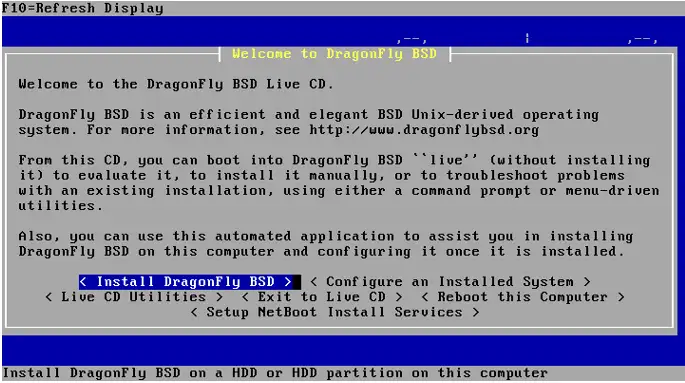
- Choose “Install DragonFly BSD”
- Partitioning:
- For beginners: pick “Auto (UFS)” or “Auto (HAMMER2)” – it creates a single-root HAMMER2 setup with swap.
- For control freaks: “Manual” → fdisk → disklabel → create:
- / (at least 32 GB, HAMMER2)
- swap (2–8 GB)
- optional /home, /var, /tmp as separate HAMMER2 plexes
- Choose HAMMER2 as filesystem (default now) – you want this.
- Select package sets:
- Base + kernel sources (recommended)
- Add “X11” if you want a graphical desktop later
- Install – takes 3–8 minutes on modern hardware.
5. First Boot & Basic Setup
- Set root password when asked.
- Add a regular user (highly recommended):
adduser
- Enable doas (DragonFly’s sudo alternative – lighter):
echo “permit persist youruser as root” > /usr/local/etc/doas.conf
6. Update the System (2026 method)
doas pkg update
doas pkg upgrade -y
doas pkg install dports-sync # optional, keeps DPorts metadata fresh
7. Install a Desktop (Optional but Easy)
XFCE (light & works perfectly):
doas pkg install xorg xfce slim
doas sysrc dbus_enable=”YES”
doas sysrc slim_enable=”YES”
reboot
Or go full retro with cwm + dmenu for that pure BSD vibe.
8. Enable Swapcache (Magic for SSDs)
Edit /etc/rc.conf and add:
swapcache_enable=”YES”
vfs.swapcache.maxla=60% # adjust to your RAM
Reboot – now your SSD becomes a giant L2 cache. Torrents, compiles, databases suddenly fly.
That’s it. You’re now running one of the fastest, leanest, most future-proof operating systems on the planet.
Pro tip: Keep a second USB with the ISO handy – DragonFly’s installer doubles as a perfect live rescue environment with full HAMMER2 tools.
Welcome to the swarm! 🐉
(Full handbook: https://www.dragonflybsd.org/docs/handbook/– but honestly, the steps above are all 99% of users ever need in 2026.)
The Community: Small, Mighty, and Welcoming
DragonFly’s tribe is tight-knit—think 2.6% of BSD users per 2005 surveys, holding steady. Mailing lists buzz with commits; the Digest blog chronicles daily wins, like nvi2 updates or Framework laptop keys. GitHub mirrors show steady activity: 581 commits in the last year alone.
Newbies? The handbook’s a bit dated (KDE3 refs? Yikes), but IRC and forums are friendly. Bounties for bugs/projects lure contributors. In 2026, as BSD hype grows (EuroBSDCon 2025 was lit), expect more eyes.
Challenges and the Road to 2026
Honesty time: Graphics lag (Linux 4.20 DRM vs. 6.12) means Wayland desktops are iffy. Package count trails FreeBSD’s 40k, but DPorts covers essentials. Docs need love, and adoption’s niche—W3Techs pegs web use at <0.1%.
Yet, 2026 fixes loom: Fresher DRM syncs, pkgsrc integration, and HAMMER2 polish. It’s not dead; it’s deliberate.
Why Choose DragonFly BSD in 2026? The Verdict
In a sea of systemd sprawl and distro-hop fatigue, DragonFly BSD in 2026 stands tall as the lightweight powerhouse. Its SMP prowess, innovative FS, and dev-friendly tools make it a joy for performance chasers. Sure, it’s not for everyone, but if you crave an OS that respects your hardware and rewards tinkering, download the ISO today.
Ready to fly? Head to dragonflybsd.org, grab 6.4.2, and join the buzz. What’s your first project? Drop a comment—let’s chat.
Disclaimer
This blog post is an independent, enthusiast-written article and is not officially endorsed, sponsored, or reviewed by the DragonFly BSD Project or its developers. All information is based on publicly available sources, official release notes, benchmarks, and community discussions as of November 2025. Performance claims, future predictions for 2026, and personal opinions reflect the author’s interpretation and experience and may not represent every user’s results.
Always verify the latest official documentation at dragonflybsd.org before making system decisions, and remember that operating system choice depends on your specific hardware, workload, and requirements. Use at your own risk — and have fun exploring!
Also Read
AlmaLinux 9.7 Review: Is It the Best RHEL-Based Distro Right Now?
About the Author