KaOS 2025.05 – A Look at the Latest Release of This Independent Linux Distro
Welcome to an in-depth exploration of KaOS 2025.05, the latest stable release of the independent, KDE-centric Linux distribution that’s making waves in the open-source community. Known for its laser focus on delivering a polished KDE Plasma experience, KaOS continues to stand out in a crowded field of Linux distros by prioritizing quality over quantity.
In this blog post, we’ll dive into the details of KaOS 2025.05, exploring its new features, system updates, performance enhancements, and why it’s an excellent choice for Linux enthusiasts who crave a modern, streamlined desktop experience. Whether you’re a seasoned Linux user or a curious newcomer, this post will give you a comprehensive look at what makes KaOS 2025.05 special.
What is KaOS?
Before we delve into the specifics of KaOS 2025.05, let’s take a moment to understand what KaOS is all about. KaOS is an independent Linux distribution built from scratch, designed to provide a tightly integrated desktop environment centered around KDE Plasma, the Qt toolkit, and 64-bit x86 architecture. Unlike general-purpose distros like Ubuntu or Fedora, KaOS has a singular focus: delivering the best possible KDE Plasma experience. By limiting its scope to one desktop environment and one toolkit, KaOS ensures a cohesive and optimized user experience.
KaOS follows a rolling-release model, meaning once you install the distro, you receive continuous updates without needing to reinstall for new versions. This approach keeps your system up-to-date with the latest software and security patches, making it ideal for users who want cutting-edge technology without the hassle of frequent reinstalls. With KaOS 2025.05, the distro takes another step forward in refining its vision, embracing modern technologies and dropping legacy components like Qt5 to deliver a future-ready desktop.
Key Highlights of KaOS 2025.05
The KaOS 2025.05 release, announced on May 27, 2025, brings a host of updates and improvements, solidifying its reputation as a lean, KDE-focused distribution. Powered by the Linux kernel 6.14, this release ships with KDE Plasma 6.3.5, KDE Gear 25.04.1, and KDE Frameworks 6.14, all built on the Qt 6.9 application framework. Let’s break down the key highlights of this release.
1. A Qt5-Free Future with Qt6
One of the most significant changes in KaOS 2025.05 is the complete transition to Qt6 as the default application framework, marking the end of Qt5 support in the default installation. Qt5, which reached end-of-life several years ago, was retained in previous releases to support applications that hadn’t yet been ported to Qt6. With KaOS 2025.05, the developers have confidently moved to a Qt5-free environment, ensuring that all core applications and components are now Qt6-based.
This shift is a big deal for several reasons:
- Performance Improvements: Qt6 offers better performance, modern features, and improved compatibility with contemporary hardware.
- Future-Proofing: By fully embracing Qt6, KaOS ensures its ecosystem is ready for the next generation of KDE software and applications.
- Streamlined Experience: A Qt6-only environment reduces complexity and potential compatibility issues, providing a more cohesive user experience.
This transition underscores KaOS’s commitment to staying on the cutting edge of KDE development, making KaOS 2025.05 a forward-looking release for users who want a modern desktop environment.
2. KDE Plasma 6.3.5 – A Polished Desktop Experience
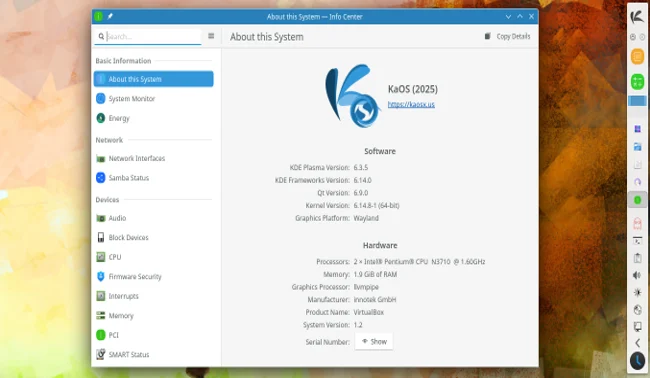
At the heart of KaOS 2025.05 is KDE Plasma 6.3.5, the latest iteration of KDE’s flagship desktop environment. Known for its flexibility, customization options, and sleek design, KDE Plasma 6.3.5 brings a refined user experience with several enhancements:
- Improved Stability: The 6.3.5 point release includes bug fixes and performance optimizations, making the desktop smoother and more reliable.
- Enhanced Visuals: Plasma 6.3.5 offers updated theming and animations, ensuring a visually appealing interface that’s both modern and functional.
- Productivity Boosts: New features like improved window management, better multi-monitor support, and enhanced system tray functionality make Plasma 6.3.5 a joy to use for both work and play.
Accompanying Plasma 6.3.5 are KDE Gear 25.04.1 and KDE Frameworks 6.14, which provide a suite of updated applications and libraries. Notable applications include:
- Dolphin: The file manager now offers better administrative file access, making it easier to manage system files.
- Konsole: The terminal emulator includes new position markers for navigating lengthy outputs, improving usability for power users.
- Kdenlive: The video editor features a new keyframe curve editor with advanced easing methods for smoother transitions.
These updates ensure that KaOS 2025.05 delivers a desktop environment that’s both powerful and user-friendly, catering to a wide range of users from developers to creatives.
3. Linux Kernel 6.14 – Powering the System
KaOS 2025.05 is powered by the Linux kernel 6.14, released on March 24, 2025. This kernel brings several new features and improvements, including:
- Btrfs RAID1 Read Balancing: Enhances performance for systems using Btrfs filesystems.
- Ntsync Subsystem: Improves game emulation with Wine by supporting Windows NT synchronization primitives.
- Uncached Buffered I/O Support: Boosts performance for specific workloads.
- AMD XDNA Ryzen AI NPU Driver: Adds support for AMD’s Neural Processing Units, enabling AI-driven applications.
These kernel enhancements make KaOS 2025.05 a robust choice for users with modern hardware, particularly those leveraging AMD processors or running resource-intensive applications.
4. Updated Core Components
Under the hood, KaOS 2025.05 includes a slew of updated core components to ensure stability, security, and performance:
- Mesa 25.1.1: The latest graphics stack for improved GPU performance.
- PipeWire 1.4.3: A modern multimedia server for seamless audio and video handling.
- Pacman 7.0.0: The Arch Linux-inspired package manager, ensuring efficient software management.
- Systemd 254.24: The init system, providing robust system management.
- OpenSSL 3.5: Enhanced security for encrypted communications.
- GStreamer 1.26.1: Updated multimedia framework for better media playback and processing.
- OpenZFS 2.3.2: Support for the ZFS filesystem, offering advanced data integrity features.
These updates ensure that KaOS 2025.05 remains a secure and efficient platform for both everyday use and specialized tasks.
5. New Applications and Features
KaOS 2025.05 introduces several new applications and features to enhance the user experience:
- Calligra as Default Office Suite: The Calligra office suite, recently updated to version 4.0 with a Qt6-based interface, is now the default office suite. It offers a robust alternative to LibreOffice for productivity tasks like word processing, spreadsheets, and presentations. Users can choose between Calligra and LibreOffice during installation via the updated Calamares installer.
- Zed Editor: A Rust-based code editor, Zed is a fast and capable alternative to Visual Studio Code, catering to developers who need a lightweight yet powerful editing tool.
- Nextcloud-Client: Introduced in the KaOS 2025.03 release and carried forward, this open-source sync client allows seamless integration with Nextcloud for cloud storage and collaboration.
- Zen Browser: A Firefox-based web browser with modern features and a focus on privacy and performance, introduced in KaOS 2025.01 and retained in this release.
- Harper: An open-source grammar and spell-checking tool, also introduced in KaOS 2025.01, enhancing productivity for writers and editors.
These additions reflect KaOS’s commitment to providing a curated selection of high-quality applications tailored to its KDE-centric ecosystem.
6. Improved Installation Experience
The Calamares installer in KaOS 2025.05 has been updated to offer a more flexible and user-friendly experience:
- Office Suite Selection: Users can now choose between Calligra and LibreOffice during installation.
- Filesystem Options: The automated partitioning option supports popular filesystems like XFS (the default), EXT4, Btrfs, and ZFS, eliminating the need for manual partitioning.
- Bootloader and Sound Backend Configuration: New pages in the installer allow users to customize bootloader settings and select a sound backend, both integrated with KDE Plasma 6.
These enhancements make installing KaOS 2025.05 easier and more customizable, catering to both novice and experienced users.
7. Rolling Release Model and System Updates
As a rolling-release distribution, KaOS 2025.05 ensures that users always have access to the latest software without needing to reinstall. Existing KaOS users can update their systems to the latest version by running the command:
sudo pacman -Syu
This command fetches the latest packages from the KaOS repositories, keeping your system in sync with KaOS 2025.05. For new users, the ISO snapshot is available for download from the official KaOS website, providing a fresh starting point for installations.
8. Experimental Bcachefs Support
KaOS 2025.05 continues to support the experimental bcachefs filesystem, introduced in earlier releases. Bcachefs is a next-generation filesystem designed for speed and reliability, and while it’s still in the experimental stage, KaOS users can explore it via manual installation with tools available in the repositories. This forward-thinking approach highlights KaOS’s commitment to adopting innovative technologies.
Why Choose KaOS 2025.05?
With so many Linux distributions available, why should you consider KaOS 2025.05? Here are some compelling reasons:
- KDE-Centric Excellence: KaOS is designed for users who love KDE Plasma and want a distro that optimizes it to perfection. By focusing solely on KDE and Qt, KaOS delivers a cohesive and polished experience.
- Rolling Release Convenience: The rolling-release model ensures your system is always up-to-date without the need for major upgrades or reinstalls.
- Performance and Stability: With the Linux 6.14 kernel, Qt6 framework, and updated components, KaOS 2025.05 offers excellent performance and stability for modern hardware.
- Curated Software Selection: KaOS prioritizes quality over quantity, offering a carefully selected set of applications that integrate seamlessly with KDE Plasma.
- Security Focus: Updates to components like OpenSSL 3.5 and the rolling-release model ensure that security patches are applied promptly, keeping your system secure.
System Requirements and Installation Notes
To run KaOS 2025.05, your system should meet the following minimum requirements:
- CPU: 64-bit x86 processor (x86_64 architecture).
- RAM: 2 GB (4 GB recommended for a better experience).
- Storage: 8 GB (25 GB recommended for optimal performance).
- Internet: A fast internet connection is recommended due to frequent updates in the rolling-release model.
When creating installation media, note the following:
- KaOS ISO files do not support Unetbootin or Rufus. Follow the instructions on the KaOS Download page for creating reliable USB or DVD media.
- DVD burning should be done at a speed no higher than 4x.
- GPG signature verification is recommended to ensure the authenticity of the downloaded ISO. Instructions are available on the KaOS website.
Additionally, RAID installations are not supported in KaOS 2025.05, so users requiring RAID configurations should explore alternative distros.
Community and Support
KaOS has a thriving community of users and developers who are passionate about KDE and open-source software. The official KaOS website provides resources like the Package Viewer for browsing available packages and the Croeso application for configuring new installations. The community forums and IRC channels are excellent places to seek help, share feedback, or contribute to the project.
For those interested in the latest updates, the KaOS team regularly posts news on the official website and social media platforms like X, where posts from accounts like @9to5linux and @linuxiac have highlighted the release of KaOS 2025.05 and its key features.
Conclusion
KaOS 2025.05 is a testament to the power of focused development in the Linux world. By prioritizing KDE Plasma, Qt6, and a rolling-release model, KaOS delivers a modern, efficient, and visually stunning desktop experience. With updates like the Linux 6.14 kernel, KDE Plasma 6.3.5, and the transition to a Qt5-free environment, this release is a significant step forward for the distro. Whether you’re a KDE enthusiast, a developer, or a Linux user looking for a streamlined and secure operating system, KaOS 2025.05 is worth exploring.
Ready to give it a try? Download the KaOS 2025.05 ISO from the official website and experience the beauty and power of KDE Plasma in a distro that’s built to impress. If you’re already a KaOS user, simply run sudo pacman -Syu to bring your system up to date with this latest release.
Disclaimer
The information provided in this blog post about KaOS 2025.05 is based on official sources, including the KaOS website and related announcements, as well as general knowledge about Linux distributions. While every effort has been made to ensure the accuracy and timeliness of the content, the information is subject to change, as KaOS is a rolling-release distribution with frequent updates. Users are encouraged to verify details, such as system requirements, installation instructions, and software availability, directly from the official KaOS website before proceeding with installation or use.
This post is for informational purposes only and does not constitute professional advice. The author and publisher are not responsible for any issues, damages, or data loss that may arise from using KaOS 2025.05 or following the instructions provided. Always back up important data and proceed with caution when installing or updating operating systems. For specific questions or support, consult the official KaOS community forums or other relevant resources.
Frequently Asked Questions About KaOS 2025.05
What’s new in KaOS 2025.05 that makes it worth trying?
KaOS 2025.05 is packed with exciting updates! It’s now fully Qt6-based, dropping Qt5 for better performance and a future-ready system. You get KDE Plasma 6.3.5 for a super polished desktop, Linux kernel 6.14 for top-notch hardware support, and new apps like the Calligra office suite and Zed code editor. Plus, the Calamares installer makes setup a breeze with options to pick your office suite and filesystem. It’s a sleek, modern Linux experience for KDE fans!
Is KaOS 2025.05 good for beginners or just for advanced Linux users?
KaOS 2025.05 is beginner-friendly if you’re comfortable with a bit of a learning curve. The Calamares installer is intuitive, letting you choose things like filesystems and office suites without needing tech wizardry. That said, its rolling-release model and KDE focus appeal most to users who love customizing their desktop and staying on the cutting edge. If you’re new to Linux, you might need a quick peek at the KaOS forums for guidance, but it’s totally doable!
How do I update to KaOS 2025.05 if I’m already using KaOS?
Since KaOS is a rolling-release distro, updating to 2025.05 is super simple. Just open a terminal and run sudo pacman -Syu. This grabs all the latest packages, including KDE Plasma 6.3.5, Linux kernel 6.14, and more, bringing your system up to speed. No need to reinstall! Just make sure you’ve got a stable internet connection, and you’re good to go.
Can I use KaOS 2025.05 on older hardware, or do I need a modern PC?
KaOS 2025.05 is optimized for 64-bit systems, so you’ll need a relatively modern x86_64 processor. The minimum RAM is 2 GB, but 4 GB or more is recommended for a smooth experience. Storage-wise, 8 GB is enough, though 25 GB gives you more breathing room. It’s not super demanding, but older hardware might struggle with the latest KDE Plasma features. Check the official KaOS website for detailed system requirements before diving in.
Why should I choose KaOS 2025.05 over other Linux distros like Ubuntu or Fedora?
KaOS 2025.05 is all about delivering a pure, polished KDE Plasma experience, unlike Ubuntu or Fedora, which support multiple desktop environments. Its rolling-release model keeps you updated without reinstalls, and the focus on Qt6 ensures a future-proof system. If you love KDE’s flexibility and want a distro that’s laser-focused on quality over quantity, KaOS is a fantastic pick. Plus, new tools like Zed and Calligra make it great for developers and creatives!
Also Read
BackBox Linux: The Ultimate Toolkit for Ethical Hackers
About the Author