
Linux Distros Without Telemetry in 2026
Privacy has become one of the most sought-after commodities in our digital age. With Windows and macOS collecting increasingly vast amounts of user data, many are turning to Linux as their sanctuary from corporate surveillance. But not all Linux distributions are created equal when it comes to respecting user privacy. As we navigate through 2026, the telemetry landscape in the Linux ecosystem has evolved significantly, with some distributions introducing data collection while others remain steadfastly committed to zero telemetry.
This comprehensive guide explores Linux distros without telemetry in 2026, helping you make an informed decision about which distribution best protects your digital privacy while meeting your computing needs.
Understanding Telemetry in Linux Distributions
Telemetry refers to the automated collection and transmission of usage data from your computer to developers or organizations. While proponents argue it helps improve software through data-driven decisions, privacy advocates view it as an invasion of user autonomy—especially when implemented as opt-out rather than opt-in.
In the Linux world, telemetry has historically been almost nonexistent, which is one reason many users fled proprietary operating systems. However, recent years have seen several major distributions experimenting with or implementing various forms of data collection, sparking heated debates within the community.
What Data Does Telemetry Typically Collect?
Even “privacy-preserving” telemetry can gather substantial information about your system, including hardware specifications like CPU model and core count, RAM size, GPU details and drivers, display resolutions and refresh rates, disk sizes and filesystem types, installed packages and update frequency, desktop environment and display server protocol, geographic region and timezone, and IP addresses (though some distributions claim not to store these).
The concern isn’t just what’s collected today but what could be collected tomorrow. Once telemetry infrastructure exists, expanding its scope requires only a software update.
The Current State of Telemetry in Major Linux Distributions
Ubuntu: Telemetry Goes Mainstream
Canonical introduced optional telemetry to Ubuntu back in 2018, but the approach has evolved significantly. Ubuntu 25.10 added Ubuntu Insights, a hardware metrics reporting service that operates alongside the existing Ubuntu Report tool. By Ubuntu 26.04 LTS, Canonical aims to consolidate these into a single system.
While the telemetry remains opt-in during installation, the infrastructure is built into the system by default. Ubuntu Insights enforces a one-week delay before sending reports, giving users time to opt out, but this default-installed approach has raised concerns among privacy-conscious users.
The positive aspect is Canonical’s commitment to transparency: they’ve open-sourced the server backend that processes telemetry data, allowing users to verify exactly how their data is handled.
Fedora: The Ongoing Debate
Fedora considered implementing privacy-preserving telemetry for Fedora Workstation, with metrics collection initially enabled but uploading disabled by default. The proposal sparked significant community backlash in 2023, with users concerned about opt-out data collection and the potential for scope creep.
As of early 2026, Fedora has not widely deployed system-wide telemetry, though the debate continues. The distribution emphasizes that any future implementation would be transparent, with all server components open source and the ability to redirect data to private servers.
Manjaro: Community Pushback
Manjaro Linux developed Manjaro Data Donor (MDD) to gather hardware and environment statistics, with plans to implement it as opt-out telemetry. This decision generated substantial controversy in late 2024.
The telemetry collects comprehensive system information including CPU architecture and model, GPU details and drivers, disk information and encryption status, desktop environment specifics, package information and update status, locale and timezone data, and even whether Windows is dual-booted alongside Manjaro.
Community members emphasized that under European GDPR regulations, such telemetry must be strictly opt-in, not opt-out. The backlash was severe enough that many users reported migrating to alternative Arch-based distributions like EndeavourOS.
Top Linux Distros Without Telemetry in 2026
Now let’s explore distributions that have maintained their commitment to zero telemetry, respecting user privacy as a fundamental principle.
1. Debian GNU/Linux
Telemetry Status: None by default
Debian remains one of the purest examples of telemetry-free Linux computing. Apart from the optional ‘popcon’ (popularity contest) package that users can voluntarily install, there is no tracking from Debian itself. Even popcon must be explicitly installed and configured—it’s never enabled by default.
Debian’s philosophy prioritizes user freedom and control. The distribution contains some telemetry client libraries that individual applications might use, but the Debian project itself collects no system-wide usage data.
Best For: Users seeking rock-solid stability, server deployments, and those who want to build their system from a minimal base without any data collection infrastructure.
Considerations: Debian’s commitment to stability means it runs older, thoroughly tested software. This makes it less suitable for users wanting cutting-edge features or the latest hardware support.
2. Linux Mint
Telemetry Status: Zero built-in telemetry
Analysis using network monitoring tools revealed no connections to analytics servers, no data sent to Canonical, Mint developers, or third parties for tracking, and no hidden telemetry logs. This makes Linux Mint one of the most privacy-respecting mainstream distributions.
Linux Mint is based on Ubuntu but strips out Ubuntu’s telemetry components. The distribution doesn’t even include Debian’s optional popcon package. The only network activity comes from standard system functions like time synchronization (NTP), network discovery (mDNS), and DNS queries—none of which transmit identifying information beyond your IP address.
Best For: Windows refugees, beginners, users wanting a polished out-of-box experience without privacy concerns, and general desktop computing.
Why It Excels: Linux Mint combines ease of use with absolute privacy respect. The Cinnamon desktop environment is intuitive for Windows users, and the distribution includes everything you need for daily computing without any data collection whatsoever.
3. Arch Linux
Telemetry Status: None
Arch Linux adheres to a minimalist philosophy that extends to data collection—there is none. Users build their system from a minimal base, installing only what they choose. This transparency and user control makes Arch fundamentally incompatible with any form of default telemetry.
The distribution follows a rolling release model, providing cutting-edge software without the baggage of analytics infrastructure. Everything is documented in the legendary Arch Wiki, and users maintain complete control over their system.
Best For: Experienced users comfortable with command-line installation, those wanting bleeding-edge software, users who prefer building their system exactly to their specifications, and anyone seeking total transparency.
Considerations: Arch requires technical knowledge and time investment. The installation process is manual, and system maintenance demands active user involvement.
4. Tails (The Amnesic Incognito Live System)
Telemetry Status: None—privacy by design
Tails is purpose-built for privacy and anonymity. Updated to version 7.0 in 2025, Tails is based on Debian 13 and includes Tor Browser 14.5.7, with all internet connections forced through the Tor network. The live operating system runs from USB without installation, leaving no traces on the host computer.
By design, Tails cannot collect telemetry—it doesn’t persist data between sessions unless you explicitly create encrypted persistent storage. Even then, no usage data is ever transmitted.
Best For: Journalists protecting sources, activists in repressive environments, whistleblowers, anyone requiring maximum anonymity, and users who need to work on untrusted computers.
Why It’s Special: Tails isn’t just telemetry-free; it’s designed to leave zero digital footprint. Boot it on any computer, use it, shut down, and no evidence remains.
5. Whonix
Telemetry Status: None
Whonix takes a different approach to privacy through isolation. It runs as two virtual machines: a Gateway that connects only to Tor, and a Workstation where you perform your tasks. This architecture makes IP leaks virtually impossible, even if malware compromises your Workstation.
Like Tails, Whonix collects no telemetry. The focus is entirely on providing bulletproof anonymity through isolation and Tor integration.
Best For: Users requiring persistent anonymous computing (unlike Tails’ amnesic nature), those running Whonix inside Qubes OS for maximum security, long-term anonymous operations, and advanced users comfortable with virtual machines.
Key Advantage: The two-VM architecture prevents even compromised applications from discovering your real IP address, making it ideal for extended anonymous work sessions.
6. Qubes OS
Telemetry Status: None
Qubes OS revolutionizes security through compartmentalization. It runs different activities in isolated virtual machines (qubes), so compromise in one area cannot spread to others. Security through isolation is the core principle—not data collection.
Qubes collects no telemetry. The distribution is designed for users with serious security requirements, often running Whonix inside Qubes for the ultimate combination of compartmentalization and anonymity.
Best For: Security researchers, high-value targets, journalists handling sensitive information, anyone requiring separation between work/personal/anonymous activities, and users with significant security threat models.
Considerations: Qubes has steep hardware requirements (16GB RAM minimum, 32GB recommended) and a challenging learning curve. However, for those needing maximum security, it’s unmatched.
7. Void Linux
Telemetry Status: None
Void Linux is an independent distribution built from scratch rather than derived from Debian or Red Hat. It uses the runit init system instead of systemd, and follows a rolling release model focused on stability and simplicity.
Void’s minimalist philosophy extends to privacy—there is zero telemetry infrastructure. Users appreciate its speed, simplicity, and respect for user autonomy.
Best For: Users seeking systemd alternatives, those wanting a fast, lightweight system, advanced users comfortable with minimal documentation, and anyone valuing independence from major distribution families.
8. Artix Linux
Telemetry Status: None
Artix is Arch Linux without systemd, offering multiple init system options (OpenRC, runit, s6). Like its parent Arch, Artix includes no telemetry whatsoever. It provides all the benefits of Arch’s rolling release model and extensive software repository while giving users freedom from systemd.
Best For: Arch enthusiasts who prefer alternative init systems, users concerned about systemd’s scope and complexity, those wanting Arch’s benefits without systemd’s architecture, and advanced Linux users.
9. Alpine Linux
Telemetry Status: None
Alpine Linux is designed for security, simplicity, and resource efficiency. Originally created for embedded systems and containers, it’s now popular for servers and minimalist desktops. Built around musl libc and BusyBox, Alpine produces tiny, fast systems.
Privacy through minimalism is Alpine’s strength. With such a small footprint, there’s simply no room for telemetry infrastructure—and no desire to add it.
Best For: Container deployments, resource-constrained systems, security-conscious server administrators, users building embedded systems, and those wanting minimal attack surface.
10. Devuan
Telemetry Status: None
Devuan is Debian without systemd, created by users who wanted Debian’s stability while avoiding systemd. It maintains Debian’s commitment to free software and user freedom, including zero default telemetry.
Best For: Users who love Debian but prefer init freedom, those concerned about systemd’s architecture, system administrators wanting traditional Unix design, and anyone seeking Debian’s stability with alternative init systems.
11. Gentoo
Telemetry Status: None
Gentoo is a source-based distribution where users compile most software from source code, optimizing for their specific hardware. This compile-from-source approach gives users complete transparency and control—the antithesis of hidden telemetry.
Best For: Advanced users who want maximum performance optimization, those learning Linux internals, users with specific hardware optimization needs, and anyone who enjoys tinkering and customization.
Note: Gentoo requires significant time investment. Compilation can take hours, but the result is a system tailored precisely to your needs with zero privacy concerns.
12. Slackware
Telemetry Status: None
Slackware is the oldest surviving Linux distribution, first released in 1993. It remains committed to Unix simplicity and user control. There is no telemetry, no automatic configuration tools that phone home—just a straightforward, stable system.
Best For: Unix purists, users wanting rock-solid stability, those who appreciate traditional Unix philosophy, system administrators, and users who prefer manual control over automatic convenience.
13. ArchRiot
Telemetry Status: Zero telemetry
ArchRiot is an Arch-based distribution claiming zero telemetry, tracking, or corporate data harvesting, with privacy improvements built in. Released in 2025, it’s specifically aimed at productivity with custom keyboard shortcuts, dark themes, and privacy-focused defaults.
Best For: Users wanting Arch’s benefits with a more opinionated, privacy-focused setup, developers and power users seeking productivity enhancements, and those who want Arch without the time investment of manual installation.
14. EndeavourOS
Telemetry Status: None
EndeavourOS is an Arch-based distribution that makes Arch more accessible without sacrificing its principles. It includes no telemetry, maintaining Arch’s commitment to user control while providing a friendlier installation process and helpful community.
Best For: Users who want Arch without the complex installation, those seeking a balance between accessibility and control, users transitioning from other distributions to Arch-based systems, and anyone wanting rolling releases without telemetry.
Comparison Table: Linux Distros Without Telemetry 2026
| Distribution | Telemetry Status | Difficulty | Release Model | Best Use Case | Based On |
|---|---|---|---|---|---|
| Debian | ● None | Intermediate | Stable | Servers, stable desktops | Independent |
| Linux Mint | ● None | Beginner | Stable (LTS) | Desktop, Windows migration | Ubuntu / Debian |
| Arch Linux | ● None | Advanced | Rolling | Customization, bleeding-edge | Independent |
| Tails | ● None | Beginner | Stable | Anonymity, temporary sessions | Debian |
| Whonix | ● None | Advanced | Stable | Anonymous persistent computing | Debian |
| Qubes OS | ● None | Advanced | Stable | Maximum security, isolation | Fedora / Xen |
| Void Linux | ● None | Advanced | Rolling | Minimalism, systemd alternative | Independent |
| Artix Linux | ● None | Advanced | Rolling | Arch without systemd | Arch |
| Alpine Linux | ● None | Intermediate | Stable | Containers, security, minimal systems | Independent |
| Devuan | ● None | Intermediate | Stable | Debian without systemd | Debian |
| Gentoo | ● None | Expert | Rolling | Performance optimization | Independent |
| Slackware | ● None | Advanced | Stable | Unix purists, stability | Independent |
| ArchRiot | ● None | Intermediate | Rolling | Productivity, privacy-focused | Arch |
| EndeavourOS | ● None | Intermediate | Rolling | Accessible Arch experience | Arch |
Distributions to Approach With Caution
Ubuntu (Opt-In Telemetry)
While Ubuntu’s telemetry is opt-in, the infrastructure is installed by default. Users uncomfortable with any telemetry presence should consider Ubuntu’s derivatives like Linux Mint or Pop!_OS, which remove these components.
Fedora (Proposed Telemetry)
Fedora has proposed but not yet widely implemented telemetry. The community response has been mixed, with significant opposition to opt-out data collection. Users should monitor developments closely.
Manjaro (Opt-Out Telemetry in Development)
Manjaro’s planned opt-out telemetry sparked major backlash. As of early 2026, the implementation status remains uncertain, with the project caught between developer desires for usage data and user demands for privacy respect.
KDE Plasma (Desktop Environment)
Worth noting that KDE Plasma itself has discussed telemetry implementation, though it would be opt-in. Users can check their distribution’s implementation and disable it if present, but many privacy-focused users prefer alternative desktop environments like XFCE, MATE, or Cinnamon.
Why Zero Telemetry Matters
The argument for telemetry always sounds reasonable: developers need data to make informed decisions, improve hardware support, and prioritize features. However, several critical concerns make zero-telemetry distributions preferable for privacy-conscious users.
Principle of Consent: Opt-out telemetry assumes ownership of your data until you explicitly reclaim it. This inverts the ethical relationship between user and software.
Scope Creep: Once telemetry infrastructure exists, expanding what’s collected requires only a configuration change. What starts as anonymous hardware statistics could evolve into detailed usage tracking.
Third-Party Risk: Even if the distribution itself is trustworthy, telemetry systems can be compromised by attackers, providing a centralized target for data harvesting.
Legal Uncertainty: Different jurisdictions have different privacy laws. GDPR in Europe requires opt-in for personal data collection, but interpretations vary, and what counts as “personal data” continues to evolve.
Philosophical Opposition: Many Linux users chose the platform precisely because it represents freedom from corporate data harvesting. Adding telemetry contradicts that fundamental motivation.
Metadata Concerns: Even “anonymous” data can be de-anonymized when combined with other information sources, especially with modern AI analysis capabilities.
Choosing the Right Telemetry-Free Distribution
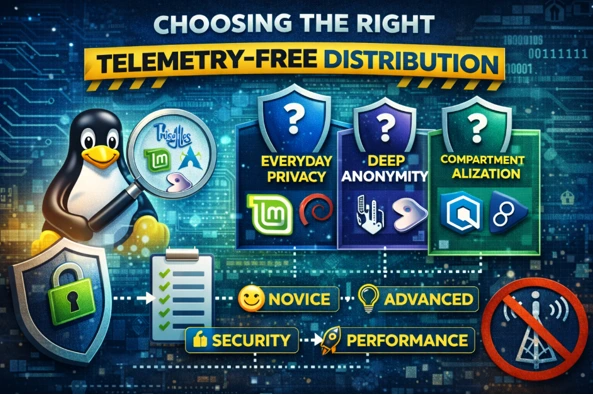
Your ideal distribution depends on several factors. Consider your technical skill level—beginners should start with Linux Mint or elementary OS (which also has no telemetry), while experienced users might prefer Arch, Gentoo, or Void. Think about your privacy threat model: those requiring maximum anonymity should use Tails or Whonix, while general privacy-conscious users will find Linux Mint or Debian sufficient.
Consider your use case as well. For daily desktop computing, Linux Mint offers polish and ease. Server deployments benefit from Debian’s stability or Alpine’s efficiency. Security researchers and high-value targets should evaluate Qubes OS. Developers wanting cutting-edge tools might prefer Arch or Fedora (monitoring its telemetry stance).
Hardware compatibility matters too. Modern hardware may work better with rolling release distributions like Arch or EndeavourOS, while older systems run beautifully on lightweight options like Alpine or Void.
Making the Switch: Practical Steps
Transitioning to a telemetry-free Linux distribution is straightforward but requires planning.
- Research and Test: Download your chosen distribution and test it in a virtual machine or live USB environment before committing to installation.
- Backup Everything: Before installing any operating system, back up all important data to external storage or cloud services.
- Check Hardware Compatibility: Verify that your hardware works with your chosen distribution, particularly WiFi adapters, graphics cards, and touchpads on laptops.
- Start with Dual Boot: If you’re new to Linux, consider dual-booting alongside your current operating system initially, giving yourself time to adjust.
- Join the Community: Every distribution has forums, IRC channels, or Matrix rooms where you can ask questions and get support.
- Learn the Basics: Invest time learning your distribution’s package manager, file system structure, and configuration approaches.
- Verify Your Privacy: Use network monitoring tools like Wireshark to verify that your system isn’t making unexpected network connections.
The Future of Privacy in Linux
The Linux ecosystem is at a crossroads regarding telemetry. As distributions mature and seek to compete more directly with proprietary operating systems, some developers argue that data-driven development is necessary. However, the community’s reaction to Ubuntu’s, Fedora’s, and especially Manjaro’s telemetry proposals demonstrates strong resistance.
The trend appears to be splitting into two camps: mainstream distributions that may implement opt-in or even opt-out telemetry, and privacy-first distributions that maintain zero data collection as a core principle. This diversity is actually healthy—users can choose the distribution that matches their privacy preferences.
Technologies like differential privacy and local-only analytics may bridge the gap, allowing distributions to gather useful development insights without transmitting any data. However, the privacy-conscious will likely always prefer distributions with no telemetry infrastructure whatsoever.
Frequently Asked Questions (FAQ)
Can I disable telemetry on distributions that include it?
Generally yes, but the infrastructure remains on your system. Truly privacy-conscious users prefer distributions that never install telemetry components in the first place.
Is telemetry the only privacy concern with Linux?
No. Consider your web browser (Firefox has telemetry that should be disabled), installed applications (many include analytics), network services (DNS queries can be logged), and online accounts you connect to your system.
How can I verify my distribution isn’t collecting data?
Use network monitoring tools like Wireshark or tcpdump to observe all network traffic from your system. Unexpected connections to analytics servers or developer infrastructure should be investigated.
Are Ubuntu derivatives like Pop!_OS and Zorin OS telemetry-free?
Most Ubuntu derivatives remove Ubuntu’s telemetry components. Pop!_OS and Zorin OS both market themselves as privacy-respecting, but verify this with each distribution’s documentation and network traffic analysis.
What about applications—don’t they collect data?
Individual applications may include telemetry regardless of your distribution. Always check application settings, particularly in browsers (Firefox, Chrome), IDEs (Visual Studio Code), and productivity software. Open-source applications typically make telemetry opt-in and easy to disable.
Conclusion
As we navigate through 2026, the Linux ecosystem offers abundant choices for users seeking computing without corporate surveillance. While some mainstream distributions have introduced telemetry—with varying levels of transparency and user consent—numerous excellent alternatives maintain zero data collection as a core principle.
Linux Mint leads for beginners and Windows refugees, offering a polished, familiar experience with absolute privacy respect. Debian provides unmatched stability for servers and conservative desktop users. Arch Linux and its derivatives like EndeavourOS and ArchRiot deliver cutting-edge software for enthusiasts. Specialized distributions like Tails, Whonix, and Qubes OS serve users with serious anonymity and security requirements.
The choice is yours, and that’s precisely the point. Linux philosophy respects user freedom and autonomy. When a distribution introduces telemetry, users can—and do—vote with their feet, migrating to alternatives that better align with their values.
The distributions listed in this guide have proven their commitment to user privacy over years or even decades. They represent the Linux community’s core principle: your computer should serve you, not collect data about you.
Whether you’re a privacy advocate, a Windows refugee tired of surveillance, or simply someone who believes computing should be private by default, these telemetry-free distributions offer powerful, reliable, and respectful alternatives. The tools for private computing exist—now it’s up to you to use them.
Disclaimer
Information in this article reflects Linux distribution telemetry practices as of early 2026. Distribution policies may change with updates—always verify current practices through official documentation. The absence of system-level telemetry does not guarantee complete privacy, as individual applications and services may collect data independently. This content is for informational purposes only and should not be considered legal or professional advice. Distribution difficulty ratings are subjective and may vary based on individual experience. Always test distributions before installation and implement comprehensive privacy practices across all software.
Also Read
Ready to explore Linux without leaving Windows behind?
About the Author