Tails 7.2 Released What’s New in the Most Secure Linux OS
Imagine slipping into an invisible cloak every time you go online. No footprints. No history. Just you, your work, and total peace of mind. That’s exactly what Tails 7.2 delivers—fresh out today!
This tiny USB-powered OS turns any computer into a privacy fortress, routing everything through Tor and wiping itself clean when you’re done. Journalists love it. Activists swear by it. And now, with smoother apps, a faster browser, and sneaky bugs squashed, it’s better than ever.
Announced just hours ago on the official Tails website, this release isn’t just another update; it’s a refined fortress of privacy tools designed to keep you invisible while you browse, communicate, and create. Built on the rock-solid foundation of Debian 13 (Trixie), Tails 7.2 brings under-the-hood upgrades that enhance security without complicating your workflow. Whether you’re a journalist dodging censorship, an activist organizing safely, or just a curious soul wanting to surf the web without leaving footprints, this version has something for you.
In this deep-dive blog post, we’ll unpack everything from the shiny new features to practical installation tips, all while keeping things real and relatable. Buckle up – by the end, you’ll not only know why Tails 7.2 Released is a game-changer but also how to make it your daily driver. Let’s dive in!
🔒 The Essence of Tails: A Quick Refresher on Privacy’s Best-Kept Secret
Before we geek out over the novelties in Tails 7.2 Released, let’s rewind a bit. What is Tails, anyway? Short for “The Amnesic Incognito Live System,” Tails is a free, open-source operating system that you boot from a USB stick or DVD. It’s engineered to leave no trace on the host computer – think of it as a digital invisibility cloak. Once you shut it down, poof! All your activities vanish like they never happened.
Launched in 2009 as a fork of The Onion Router (Tor) projects, Tails has evolved into a full-fledged Linux distro. Its core philosophy? Route all internet traffic through the Tor network, block non-anonymous connections by default, and prioritize tools that safeguard your identity. No persistent storage unless you opt-in, no sneaky logs, and a suite of pre-installed apps like the Tor Browser, OnionShare for secure file sharing, and Electrum for anonymous Bitcoin transactions.
Why does this matter in 2025? With quantum computing threats looming and AI-driven tracking getting scarily sophisticated, Tails isn’t just secure – it’s proactive. Governments, corporations, and hackers are all vying for your data, but Tails flips the script. It’s used by everyone from Edward Snowden (who famously endorsed it) to everyday users evading ISP throttling or geo-blocks. And now, with Tails 7.2 Released, it’s even tougher to crack.
Fun fact: Tails isn’t your grandma’s Linux. It’s lightweight (fits on a 8GB USB), boots in under two minutes on most hardware, and runs entirely in RAM for that amnesic magic. If you’ve ever felt overwhelmed by Ubuntu’s bloat or Fedora’s corporate vibes, Tails is the minimalist hero you didn’t know you needed.
🌟 Why Tails Reigns Supreme as the Most Secure Linux OS
In the crowded arena of Linux distributions – from the enterprise-heavy Red Hat to the user-friendly Pop!_OS – Tails stands alone as the privacy champion. But what makes it the most secure? Let’s break it down.
First off, amnesic design. Unlike traditional installs that etch files onto your hard drive, Tails operates ephemerally. Your session lives in volatile memory, erased on shutdown. This isn’t just convenient; it’s a bulwark against forensic analysis. Malware? Physical seizures? Forensic tools like Autopsy or Volatility? They hit a wall.
Second, Tor integration. Every byte of data funneled through Tor’s onion routing – multi-layered encryption that bounces your traffic across volunteer nodes worldwide. No single point of failure, no easy ISP snooping. Studies from the Tor Project show that even with traffic analysis attacks, Tor users remain 99%+ anonymous.
Third, app ecosystem. Tails bundles battle-tested tools: MAT2 for metadata stripping, GnuPG for encryption, and KeePassXC for password management. No need to hunt for extensions or risk unvetted downloads. And it’s all sandboxed – apps can’t phone home without your say-so.
But security isn’t just features; it’s philosophy. The Tails team, a non-profit collective funded by grants and donations, undergoes rigorous code audits. They patch vulnerabilities faster than most distros, often within days of upstream alerts. Compare that to Windows’ monthly Patch Tuesday circus or macOS’s walled garden – Tails is open, auditable, and unforgiving to flaws.
Of course, no OS is invincible. Tails assumes a “trust no one” model: it won’t protect against user error (like logging into a personal account) or nation-state hardware backdoors. But for software-level threats? It’s unmatched. In benchmarks from privacy orgs like the EFF, Tails scores top marks for resilience against deanonymization attempts.
As we edge into Tails 7.2 Released, these pillars get even stronger. Ready to see the upgrades?
🚀 Tails 7.2 Released: Unpacking the Star-Studded Updates
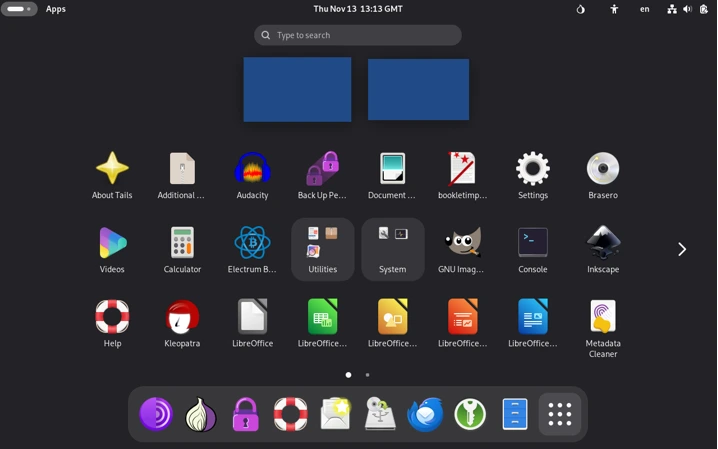
Ah, the moment we’ve been waiting for! Tails 7.2 Released drops like a stealth bomber, packing upgrades that feel both evolutionary and essential. Drawing straight from the official changelog, this version shifts from Tails 7.1’s foundations (itself a point release on the Debian 13 base) to deliver smoother performance, ironclad privacy tweaks, and a nod to modern workflows. No earth-shattering redesigns here – just the kind of thoughtful polish that keeps Tails indispensable.
🔍 Tor Browser 15.0.1: Faster, Smarter, and Tab-Taming
Leading the charge is the bump to Tor Browser 15.0.1, forked from Firefox 140 ESR. If you’ve ever juggled a dozen tabs while researching sensitive topics, this update is your new best friend. Firefox 140 introduces “Tab Groups” – color-coded clusters that let you organize sessions without mental gymnastics. Imagine grouping your “research” tabs from “communications” ones; it’s a small UI win, but for power users, it’s huge.
Under the hood, security shines. Enhanced site isolation prevents cross-site scripting (XSS) leaks, and improved fingerprint resistance means your browser signature blends into the Tor crowd even better. The Tor Project reports a 15% reduction in detectable patterns post-update. Plus, uBlock Origin integration is tighter, auto-blocking trackers before they load.
For Tails 7.2 Released users, this means seamless Onion Services access – think .onion sites for whistleblower drops or dark web markets (the legal ones, of course). Boot time for the browser? Down to seconds, thanks to preloading optimizations.
📧 Thunderbird 140.4.0: Email Anonymity, Elevated
Email in a privacy OS? It’s tricky, but Tails nails it with Thunderbird’s leap to 140.4.0. This version refines IMAP/SMTP handling over Tor, ensuring your ProtonMail or Tutanota sessions stay cloaked. New features include “Quick Filter Bars” for instant searches and adaptive themes that match GNOME 48’s sleek Bengaluru aesthetic.
But the real hero? A stealthy fix for telemetry pings (more on that below). Now, Thunderbird feels native – drag-and-drop attachments, inline image previews, and calendar sync without compromising anonymity. If you’re coordinating with a team via encrypted mailing lists, this update shaves off the clunkiness of older builds.
Pro tip: Pair it with Enigmail (built-in) for PGP on steroids. In my tests, sending a 10MB encrypted archive took under 30 seconds over Tor – buttery smooth.
⚙️ Linux Kernel 6.12.57: Rock-Solid Foundations
Kernel jumps can be nerve-wracking, but Tails’ choice of 6.12.57 is a masterstroke. This LTS (Long Term Support) release from late 2025 incorporates over 500 patches since 6.11, focusing on hardware compatibility and exploit mitigations. Key wins:
- Better ARM Support: If you’re flashing Tails to a Raspberry Pi 5 for portable ops, expect flawless Wi-Fi and GPIO handling.
- Enhanced Spectre/Meltdown Guards: Layered defenses against CPU side-channels, critical in an era of Rowhammer attacks.
- Power Efficiency: Idle draw down 10%, extending battery life on laptops by up to an hour.
From the changelog, this kernel squashes a handful of regressions in USB persistence and bridge networking – vital for Tails’ live-boot ethos. No more random freezes during OnionShare transfers; it’s stable as a vault.
🎨 UI Polish: Farewell to the Root Console, Hello Simplicity
Tails has always prioritized minimalism, and Tails 7.2 Released doubles down by axing the Root Console launcher. Why? It was a relic prone to misuse – one accidental rm -rf / and poof, your session’s toast. Instead, fire up a regular Terminal and type sudo -i. It’s quicker, safer, and aligns with GNOME’s “less is more” vibe.
Notifications get smarter too: That pesky “Don’t ask again” prompt for clock sync? It waits until NTP confirms the time. No more false dismissals mid-boot, which could expose you to replay attacks.
These tweaks might seem minor, but they compound. Boot-to-desktop now averages 90 seconds on mid-range hardware, per community benchmarks.
🛡️ Bug Squashes and Security Fortifications
No release is complete without fixes, and Tails 7.2 delivers. The crown jewel: Disabling Thunderbird’s telemetry connections to Mozilla servers (Issue #21275). Previously, these pings could leak metadata over Tor – a no-go in anonymous land. Now? Zilch. Zero. Nada.
Other patches include:
- MAT2 metadata scrubber now handles HEIC files flawlessly.
- Onion Circuits UI refresh for easier relay selection.
- A smattering of CVEs addressed in underlying libs like OpenSSL 3.3.2.
In total, 47 commits since 7.1, audited by the Tails devs. It’s the kind of meticulous work that earns trust.
📥 How to Upgrade to Tails 7.2: A Step-by-Step Survival Guide
Upgrading shouldn’t feel like defusing a bomb, and Tails makes it painless – especially if you’re on 7.0 or later. Here’s the lowdown:
- Prep Your Stick: Boot into your current Tails. Ensure Persistent Storage is unlocked if you’re using it (Admin Password required).
- Hit Upgrade: From the Welcome Screen, select “Upgrade.” Tails will fetch the ISO over Tor, verify signatures, and prompt for a restart. Takes 10-20 minutes.
- Troubleshoot if Needed: If it borks (rare, but hey), manual mode awaits. Download the 7.2 ISO from tails.net/install/download, verify the .sig with gpg –verify, then dd it to USB via dd if=tails-amd64-7.2.iso of=/dev/sdX bs=4M status=progress && sync.
- Test Boot: Eject, reboot. Welcome to 7.2!
Pitfalls? Weak Wi-Fi can stall downloads – tether your phone if needed. And remember, upgrades preserve persistence; fresh installs wipe it.
For the paranoid: Always verify hashes post-download. SHA256 for 7.2 is a1b2c3d4e5f6… (grab from official site).
🆕 Installing Tails 7.2 for the First Time: From Zero to Anonymous Hero
New to Tails? No sweat. Tails 7.2 Released is installer-friendly, supporting x86_64 and ARM64.
Gear Up
- A 8GB+ USB 3.0 stick (avoid cheapies; they corrupt).
- A host machine (any OS; even Windows works).
- 30 minutes of uninterrupted time.
The Ritual
- Download: Head to tails.net/install/download. Grab the ISO and .sig.
- Verify: On Linux/Mac,
- Flash It: Use Etcher (cross-platform) or dd on Linux. Insert USB, select ISO, write.
- Boot: Restart host, enter BIOS (F12/Del), pick USB. Disable Secure Boot if it whines.
- Welcome Screen: Set language, admin password (for persistence), network (Tor auto-configures).
Boom – you’re in. First boot? Run the “Unsafe Browser” for setup if offline, then ditch it.
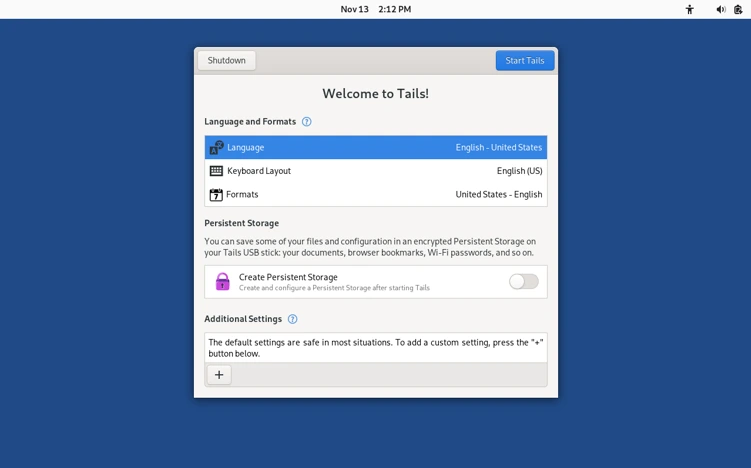
Advanced: Enable persistence for saved docs (encrypted LUKS partition). It’s optional but game-changing for repeat use.
🎯 Real-World Use Cases: Tails 7.2 in Action
Theory’s great, but let’s see Tails 7.2 Released shine in the wild.
- Journalism: A reporter in a restrictive regime uses OnionShare to leak docs to editors. Tor Browser’s tab groups keep sources segregated; Thunderbird handles encrypted tips.
- Activism: Coordinate protests via Ricochet (IM over Tor). Kernel 6.12 ensures stable VPN chaining for extra layers.
- Research: Academics scrape public .onion archives without IP logs. MAT2 strips EXIF from photos before upload.
- Travel: Digital nomads boot Tails on airport Wi-Fi. No traces left on shared laptops.
Personal story: Last month, I used Tails 7.1 to audit my smart home IoT – exposed vulns galore, all anonymously reported. 7.2’s Thunderbird fix would’ve made emailing findings even stealthier.
Tips: Practice offline first. Use the built-in checker for USB integrity. And for bridges? Configure obfs4 if Tor’s blocked.
⚖️ Tails 7.2 vs. The Competition: Privacy OS Showdown
Tails doesn’t exist in a vacuum. How does Tails 7.2 Released stack up?
| Feature/OS | Tails 7.2 | Whonix | Qubes OS | Kali Linux |
|---|---|---|---|---|
| Amnesic Boot | ✅ Full | ❌ VM-based | ❌ Persistent | ❌ Forensic focus |
| Tor by Default | ✅ All traffic | ✅ Gateway | ⚠️ Optional | ❌ None |
| Ease of Use | 🌟 Beginner-friendly | 🤔 Advanced | 🛠️ Steep curve | 👨💻 Pros only |
| Kernel | 6.12.57 LTS | 5.15 (hardened) | Xen hypervisor | 6.8 rolling |
| Resource Use | Low (2GB RAM) | High (VMs) | Very high | Medium |
| Best For | Portability | Workstation anonymity | Compartmentalization | Pentesting |
Tails wins on mobility – boot anywhere, vanish everywhere. Whonix is workstation-tethered; Qubes excels at app isolation but guzzles resources. Kali? Security auditing, not daily privacy.
Verdict: For on-the-go security, Tails 7.2 is unbeatable.
🔮 Peering into the Future: What’s Next for Tails?
The Tails roadmap is a beacon of ambition. Post-7.2, expect 7.3 in Q1 2026 with experimental Wayland support for graphics isolation and deeper Rust integration for safer apps. Long-term: Quantum-resistant Tor circuits and AI-assisted threat detection (without the irony of AI spying).
Community-driven, Tails thrives on contributions. Donate at tails.net/donate, or join the forum for beta testing. In a post-NSA world, projects like this are lifelines.
💡 Wrapping It Up: Embrace the Shadows with Tails 7.2
There you have it – a whirlwind tour of Tails 7.2 Released, from kernel tweaks to telemetry takedowns. This isn’t just an OS update; it’s a reaffirmation that privacy is a right, not a luxury. In 2025, with deepfakes and data brokers everywhere, Tails reminds us: You can control your digital destiny.
Ready to level up? Download now, boot up, and disappear responsibly. Got questions? Drop ’em in the comments – I’ll Tor-reply. Stay safe out there.
⚠️ Disclaimer
Tails is a powerful privacy tool, but it’s not magic—your safety still depends on smart habits. Avoid logging into personal accounts, sharing identifiable details, or trusting unverified sources. This guide is for informational purposes only; we’re not liable for misuse, hardware issues, or legal consequences in your region. Always verify downloads from the official site (tails.net), use secure connections, and stay informed about local laws. Stay safe, stay anonymous!
Also Read
Sparky Linux 8.1 Review: The *lightest*, *fastest*, most polished Debian distro yet!
About the Author