
Why 2026 Is the Best Year to Switch to Linux
I’ve been watching the Linux desktop scene for years now, and I’ll be straight with you—something fundamental has shifted. We’re not talking about incremental improvements anymore. If you’re wondering why 2026 is the best year to switch to Linux, the answer is simple: everything finally came together at once.
Look, I get it. You’ve probably heard the “year of the Linux desktop” joke thrown around since the early 2000s. It became a meme for good reason. But here’s the thing—while everyone was making jokes, Linux quietly grew up. And now? Well, let me walk you through why this year actually might be the year.
Everything Just Happened to Line Up
It’s honestly kind of wild how several major things converged all at once. Microsoft ended Windows 10 support back in October 2025. Gaming on Linux went from “technically possible if you hate yourself” to genuinely viable. Hardware support stopped being a constant headache. And the distributions themselves matured in ways that make them feel… well, normal.
The numbers back this up too. Desktop Linux crossed 4% market share in late 2024, and it’s still climbing. I know 4% doesn’t sound impressive, but in the desktop OS world, that’s actually a big deal. We’re talking about millions of active users, enough that software developers can’t ignore the platform anymore.
Microsoft’s Accidental Gift to Linux
Here’s where things get interesting for a lot of people. Windows 10 reached end of support in October 2025. Microsoft isn’t sending out security patches anymore. No bug fixes. Nothing. You’re on your own.
Now, Microsoft wants everyone to upgrade to Windows 11. Makes sense from their perspective. But here’s the problem—and it’s a massive one—Windows 11 has these really strict hardware requirements that leave tons of perfectly good computers in the dust.
Your computer needs TPM 2.0 (a security chip), UEFI firmware, and a relatively modern processor. If you’ve got a computer from 2017 or earlier, chances are pretty good it won’t make the cut. I’m talking about machines that run perfectly fine, handle everyday tasks without breaking a sweat, but just happen to lack one specific security feature Microsoft decided was mandatory.
So what are your options? Spend $500-1500 on a new computer? Keep running Windows 10 and hope you don’t get hit by malware? Or… try something different?
That’s where Linux enters the picture. And unlike the old days where trying Linux meant signing up for frustration, it’s actually become a legitimate option.
Linux vs Windows: The Actual Comparison
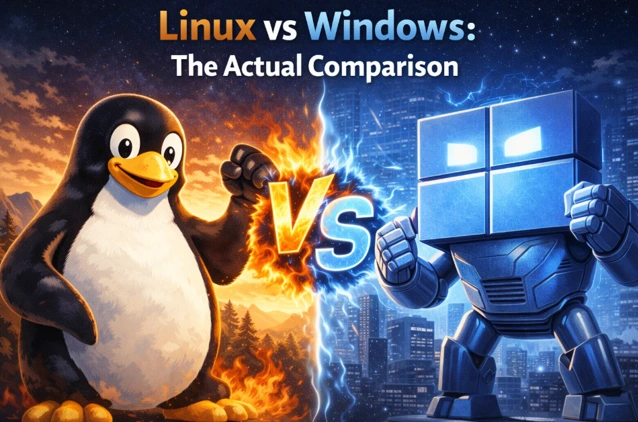
Let me lay out the concrete differences between Linux and Windows 11 as they exist in 2026:
| Feature/Aspect | Linux (2026) | Windows 11 | Advantage |
|---|---|---|---|
| Cost | Free (no license fees) | $139-$199 per license | Linux |
| Hardware Requirements | Runs on 2GB RAM, older CPUs | Requires TPM 2.0, 4GB RAM, modern CPU | Linux |
| Privacy | No telemetry by default, full user control | Extensive telemetry, account integration required | Linux |
| Gaming Compatibility | 80%+ of top Steam games work | 100% native support | Windows (slight edge) |
| Software Updates | User-controlled, no forced restarts | Mandatory, sometimes forced restarts | Linux |
| Virus/Malware Risk | Extremely low, antivirus optional | High, antivirus essential | Linux |
| Hardware Lifespan | Extends life of older machines 5+ years | Forces hardware upgrades | Linux |
| Learning Curve | Moderate (improving yearly) | Familiar to most users | Windows |
| Office Suite | LibreOffice (free), WPS Office (free) | Microsoft Office ($70-$100/year) | Linux (cost) |
| Professional Software | Growing alternatives, web apps | Industry standard applications | Windows |
| Customization | Unlimited control over interface | Limited customization options | Linux |
| Installation Time | 15-20 minutes | 30-60 minutes | Linux |
| System Resource Usage | Low (1-2GB RAM idle) | Moderate (3-4GB RAM idle) | Linux |
| Community Support | Excellent forums, active communities | Official support, paid options available | Tie |
| Boot Time | 10-20 seconds typical | 20-40 seconds typical | Linux |
| File System Performance | Ext4/Btrfs (excellent) | NTFS (good) | Linux |
| Security Updates | Rapid (days), often automatic | Monthly schedule | Linux |
| Multitasking Performance | Excellent, efficient resource management | Good, heavier system overhead | Linux |
| Cloud Integration | Optional, user choice | Heavily integrated, OneDrive default | Depends on preference |
| Pre-installed Software | Thousands of free apps in repositories | Limited, Microsoft apps included | Linux |
Gaming: The Elephant That Finally Left the Room
I’m going to spend some time here because gaming was always the deal-breaker. You’d get someone interested in Linux, everything would sound great, and then they’d ask, “But can I play my games?” And the answer was usually some variation of “well, maybe, if you’re willing to tinker for hours and accept worse performance.”
That’s done. Over. Not an issue anymore.
Valve changed everything with Proton and the Steam Deck. Proton is basically a compatibility layer that lets Windows games run on Linux, and it’s gotten scary good. We’re talking about 80%+ of the top Steam games working right now, many of them performing identically to Windows or sometimes even better.
I fired up Elden Ring on Linux a few months back fully expecting issues. It just worked. Installed Steam, clicked play, and there it was. Same with Cyberpunk 2077 after all its patches. Baldur’s Gate 3 runs beautifully. These aren’t small indie titles—these are massive, graphically demanding games.
The anti-cheat situation deserves its own mention because it was the last real roadblock. Easy Anti-Cheat and BattlEye both support Linux now. Epic Games made their anti-cheat Linux-compatible back in 2024. That opened up competitive multiplayer games that were completely off-limits before.
Does every single game work? No, I won’t lie to you. Some games with very specific DRM or anti-cheat implementations still don’t work. But we’re talking about a small minority now instead of the majority. For most gamers, Linux is a viable platform in 2026.
Hardware Support Stopped Being a Nightmare
Remember having to spend three hours getting your WiFi card working? Or that printer that Linux just refused to acknowledge existed? Yeah, those days are mostly gone.
Modern Linux distributions auto-detect hardware with shocking accuracy. I installed Ubuntu on a friend’s laptop last month—a fairly new Lenovo. WiFi worked immediately. Touchpad with all its gestures worked. Function keys for volume and brightness worked. The whole installation took maybe 20 minutes, and we didn’t touch the terminal once.
Laptop support has gotten particularly good. Dell, Lenovo, and HP all sell laptops with Linux preinstalled now, which means they’re actually testing on these machines. That testing benefits everyone, even if you’re installing Linux yourself on hardware that didn’t come with it.
Graphics cards used to be this whole thing. AMD cards work beautifully now with open-source drivers that come built into the kernel. NVIDIA finally got their act together after years of mediocre Linux support—they open-sourced their kernel modules in 2022 and the experience has improved dramatically since then.
Printers? They mostly just work now. Scanners? Same deal. Your random USB peripherals? Plug them in and they’re recognized. I can’t promise 100% compatibility with every weird device you might own, but the success rate is high enough that hardware issues rarely come up anymore.
Privacy, Control, and Not Being the Product
Let’s talk about something that matters more to some people than others, but should probably matter to everyone: what your operating system is doing behind your back.
Windows 11 collects telemetry. A lot of it. Microsoft knows what you’re doing, when you’re doing it, what applications you use, how you use them. Sure, you can disable some of it, but the defaults are pretty invasive. And they keep adding more data collection with each update.
Most Linux distributions collect exactly zero telemetry by default. The ones that collect anything make it completely optional and tell you exactly what they’re gathering. Ubuntu collects some anonymous usage stats if you opt in during installation. Fedora has a similar opt-in system. But the key word is opt-in—nothing is collected unless you explicitly agree to it.
Beyond privacy, there’s the control aspect. Your computer does what you tell it to do, when you tell it to do it. Updates don’t happen while you’re in the middle of something important. Features don’t appear or disappear based on someone’s product roadmap. Want to keep using the same desktop layout forever? Go ahead. Nobody’s forcing a redesign on you.
I know this sounds almost philosophical, but there’s a practical side to it. Windows 11 pushes OneDrive integration, wants you to use a Microsoft account, keeps nudging you toward Edge browser and Bing search. Linux doesn’t care. Use whatever you want. Store files wherever you want. The operating system isn’t trying to funnel you into an ecosystem.
Professional Software: Better Than You Think
Okay, I need to be honest here. If you’re a professional graphic designer living in Adobe Creative Suite, Linux is going to be a tough sell. Adobe has shown zero interest in supporting Linux, and that’s just reality.
But for a lot of other professional work? The gap has closed considerably.
DaVinci Resolve, which is basically industry standard for video color grading and has become huge in general video editing, runs natively on Linux. And it runs well—we’re talking about professional-grade video editing software that costs nothing (the free version) or $295 (Studio version, one-time purchase).
GIMP handles image editing. Is it identical to Photoshop? No. But it’s powerful, and professionals use it. Krita is phenomenal for digital painting. Inkscape does vector graphics competently. Blender is actually the industry standard for 3D modeling, and it’s open source with excellent Linux support.
For office work, LibreOffice handles Microsoft Office formats surprisingly well. I’ve exchanged documents with Word users plenty of times without issues. Is it perfect? There are occasional formatting hiccups with complex documents, but for typical use, it’s solid. And it’s free, which beats paying Microsoft $70-100 per year.
Programming and development? Linux is honestly better than Windows for most development work. Docker runs natively. Kubernetes works beautifully. The command line tools are powerful and well-integrated. Web development feels natural when your local environment resembles the Linux servers you’re deploying to.
Here’s something that helps a lot: web applications. Figma, Canva, Google Docs, Microsoft 365’s web version—they all work identically on Linux because they run in a browser. As more professional software moves to the web, the operating system matters less and less.
Distribution Choice: Confusing or Liberating?

Linux has dozens of distributions (distros), and this confuses people. “Which one do I choose? What if I pick the wrong one?”
Let me reframe this: you get to choose an operating system tailored to exactly what you need. Want something familiar and stable? Want cutting-edge features? Got an old computer that needs lightweight software? There’s a distro for each of these.
Ubuntu is the most popular for good reason. It’s polished, well-documented, and things just work. Behind it is Canonical, a company providing commercial support and long-term stability. The latest LTS (Long Term Support) version gets five years of updates. For most people trying Linux, Ubuntu is a safe bet.
Linux Mint takes Ubuntu and makes it even more approachable, especially if you’re coming from Windows. The desktop looks familiar. The interface feels intuitive. Everything is where you’d expect it to be. I recommend Mint to almost everyone switching from Windows.
Fedora is for people who want newer software and don’t mind a slightly faster update pace. It’s sponsored by Red Hat and serves as a testing ground for enterprise Linux technologies. It’s stable but modern.
Pop!_OS, made by computer manufacturer System76, targets gamers and creators specifically. They’ve optimized it for that use case, and it shows.
For older hardware, lightweight options like Linux Lite or Lubuntu can resurrect computers that crawl under modern Windows. I’ve seen 10-year-old laptops run smoothly on these distributions.
The beautiful thing? If you try one and don’t like it, switching to another takes an hour or two. Your files stay yours, your cloud services work everywhere, and you’re not locked into anything.
The Community Actually Wants to Help You
The stereotype of Linux users being elitist and unhelpful is outdated. I won’t claim it never happens, but the community has grown up a lot. Most Linux communities now actively welcome newcomers and understand that being friendly is important for the platform’s growth.
Questions that might have gotten snarky “RTFM” (Read The F***ing Manual) responses ten years ago now get patient, detailed answers. The Ubuntu forums are particularly helpful. The Linux Mint community is known for being welcoming. Reddit’s r/linux4noobs exists specifically to help beginners without judgment.
Documentation has gotten so much better too. Distribution wikis explain things clearly. The Arch Wiki is incredibly comprehensive and useful even if you’re not using Arch. YouTube is full of tutorial channels explaining Linux concepts visually and clearly.
Stack Exchange’s Unix & Linux section provides expert-level answers to technical questions. If you run into an issue, someone has probably encountered it before and documented the solution.
What It Actually Costs (Spoiler: Nothing)
Linux distributions are free. Not free-trial-then-pay-us. Not free-but-you’re-the-product. Actually free. Download it, install it, use it forever, no license fees, no subscriptions, no payments.
For one computer, this saves you $139-199 compared to buying Windows. For a household with multiple computers, those savings multiply fast. Small businesses save thousands.
But the savings go deeper than the operating system. The software repositories contain thousands of applications, all free. Office suite? Free. Image editor? Free. Video editor? Free. PDF tools? Free. Audio editing? Free. Programming tools? Free.
Compare this to Windows where professional software can easily cost thousands of dollars. Adobe Photoshop is $20-55/month. Microsoft Office is $70-100/year. Even basic utilities often cost $20-50 each.
Over five years, a single user might save $1,600-4,600 by using Linux instead of Windows and commercial software. That’s not accounting for the hardware costs you avoid by running Linux on older machines instead of buying new computers to run Windows 11.
What You’ll Actually Save Over Five Years
| Expense Category | Windows Cost (5 Years) | Linux Cost (5 Years) | Savings |
|---|---|---|---|
| Operating System License | $139-$199 | $0 | $139-$199 |
| Office Suite Subscription | $350-$500 | $0 | $350-$500 |
| Antivirus Software | $200-$400 | $0 | $200-$400 |
| Photo Editing Software | $120-$600 | $0 | $120-$600 |
| Video Editing Software | $300-$1,500 | $0 | $300-$1,500 |
| PDF Editor | $100-$200 | $0 | $100-$200 |
| Avoided Hardware Upgrade | $400-$1,200 | $0 | $400-$1,200 |
| Total Potential Savings | $1,609-$4,599 | $0 | $1,609-$4,599 |
These are real numbers representing what typical software actually costs. Linux alternatives include LibreOffice (Office), GIMP/Krita (Photo Editing), DaVinci Resolve/Kdenlive (Video Editing), and built-in PDF tools.
Helping the Environment (No, Really)
This might sound like a minor point, but e-waste is a massive problem. Millions of tons of electronics end up in landfills every year, many of them computers that still function fine but can’t run the latest software.
Windows 10 end of support is about to create a wave of discarded computers. Perfectly functional machines that happen to lack TPM 2.0 or have slightly older processors. These don’t need to become waste.
Install Linux on a 2015-era computer and it’ll run smoothly for another five years. That’s a real computer kept out of a landfill, resources not spent manufacturing a replacement, and energy not consumed in that manufacturing process.
Linux also uses fewer resources during operation. Lower RAM usage, less CPU overhead for the same tasks, which translates to lower power consumption. For organizations running many computers, this adds up to measurable electricity savings.
Security: Boring But Important
Linux’s security model is fundamentally sound. Regular users operate with limited permissions. Administrative actions require authentication. This architecture makes it difficult for malware to gain system-level access even if it somehow gets onto your machine.
The practical reality? Desktop Linux malware is extremely rare. It exists in theory, but you’re very unlikely to encounter it. You can browse the web, download files, and install software without the constant threat awareness you need on Windows.
When security issues are discovered, they’re patched quickly. We’re talking days, not weeks. The open-source development model means thousands of eyes are looking at the code, and vulnerabilities get spotted and fixed fast.
You don’t need antivirus software on Linux for typical desktop use. That might sound crazy if you’re used to Windows, but it’s the reality. Save your money and system resources.
Big Organizations Are Switching (That Means Something)
When European governments, educational institutions, and corporations with actual budgets and IT departments choose Linux, pay attention. These aren’t hobbyists or idealists—they’re organizations making pragmatic decisions based on cost, security, and long-term viability.
Various French government offices run Linux. The city of Munich had a complex relationship with Linux (they switched, then switched back, then started switching again), but that whole saga actually helped produce better tools and documentation that benefit everyone.
Schools worldwide use Linux to stretch their budgets while providing students with complete computing environments. Students graduating with Linux experience enter workplaces already comfortable with the platform.
Cloud infrastructure runs almost entirely on Linux. AWS, Google Cloud, Microsoft Azure—their servers run Linux. The websites you visit, the streaming services you use, the cloud storage holding your files—probably running on Linux. This dominance has driven massive investment in Linux development, and desktop users benefit from all that work.
The Learning Curve Isn’t What You Think
Modern Linux doesn’t require command-line wizardry for typical use. You can go weeks or months without opening a terminal. Installation uses a friendly graphical installer. Settings are adjusted through point-and-click control panels. Software installs through app store-style interfaces.
Installing Linux has actually become easier than installing Windows. Ubuntu’s installer is clearer and more straightforward than Windows 11’s setup process. The whole thing takes 15-20 minutes, most of which is the computer copying files.
Software installation happens through graphical “software centers” that look and work like app stores. Search for what you want, click install, done. GNOME Software, KDE Discover, and similar tools make this completely visual and intuitive.
Updates typically happen automatically in the background, or you get a friendly notification asking if you’d like to update. The system handles the technical details. You just use your computer.
Do you need to understand Linux deeply to use it? No more than you need to understand TCP/IP networking to browse the web or fuel injection systems to drive a car. The system takes care of itself. The option to dig deeper exists if you want it, but it’s not required.
How to Actually Make the Switch
If you’re convinced—or at least curious enough to try—here’s how to approach this without stress.
The easiest first step costs nothing and risks nothing: create a live USB drive. Download a Linux distribution (I’d suggest Linux Mint for most people), write it to a USB stick using a tool like Rufus or Etcher, and boot from it. You can test Linux thoroughly without making any changes to your existing system. Everything runs from the USB drive. When you’re done, remove the drive and your computer boots back to Windows like nothing happened.
This lets you verify your hardware works, try the interface, install software, and get a real feel for whether Linux suits you. No commitment, no risk.
If you want more certainty before diving in fully, dual-booting is your friend. Keep Windows and install Linux alongside it. During startup, choose which one to boot into. This gives you a safety net while you transition your daily activities to Linux. Most people find they boot into Windows less and less over time until one day they realize they haven’t used it in weeks.
Your files matter more than your operating system, and the internet makes this easier than ever. Cloud storage (Google Drive, Dropbox, OneDrive) works on Linux just fine. Your browser bookmarks sync. Your email, calendar, contacts—all accessible regardless of operating system. The things that matter to you aren’t locked to Windows.
Being Realistic About the Downsides
I’d be doing you a disservice if I pretended Linux was perfect for absolutely everyone in every situation. It’s not. Nothing is.
If your work absolutely requires Adobe Creative Suite and there’s no flexibility there, Linux is going to create problems for you. Adobe has shown zero interest in Linux support, and running their software through compatibility layers is unreliable at best.
Some specialized professional software simply doesn’t have Linux versions. Certain engineering applications, some tax software, specific industry tools—they might not work. You need to check your specific requirements.
PC Game Pass doesn’t work on Linux because it uses Microsoft’s UWP format, which isn’t compatible. If you’re heavily invested in Game Pass for PC, that’s something to consider.
Occasionally you’ll run into hardware that just doesn’t work. It’s rare these days, but it happens. Some very new hardware might lack Linux support initially. Some very obscure hardware might never get support. This is much less common than it used to be, but it’s not zero.
The learning curve isn’t steep, but it exists. Things are in different places. Some concepts are unfamiliar. There’s an adjustment period. For most people it’s brief, but it’s there.
Why 2026 Specifically?
So why is 2026 the right year rather than 2025 or 2027?
The Windows 10 end of support created urgency. Millions of people need to make a decision about their computing future right now. That decision doesn’t have to be “buy new hardware for Windows 11.”
The technology matured at the right time. Gaming support reached critical mass. Hardware compatibility became reliable. The distributions polished their rough edges. All of this happened to converge around now.
The community reached the size where help is readily available and getting better hardware and software support became inevitable. We’ve crossed a threshold where Linux is taking itself seriously as a desktop platform, and that self-seriousness shows in the quality.
Economic pressures matter too. In 2026, saving $1,600-4,600 over five years means something to people. Free, quality software becomes more attractive when money is tight.
Final Thoughts From Someone Who’s Been Watching This Space
I’ve watched Linux transform from a hobby project into something regular people can actually use. And 2026? All the pieces finally came together—mature software, reliable hardware support, a welcoming community, and real economic incentives.
You don’t need to be technical to run Linux anymore. You don’t need to love the command line. You just need to be willing to try something different.
Will it work for everyone? No. Some people have specific needs that make Windows or Mac the better choice. But for most people, Linux has become genuinely compelling.
Here’s the thing: finding out costs you nothing but an hour. Download a live USB, test it, and see for yourself. If you tried Linux years ago and hated it, give it another look—it’s evolved into something that would surprise you.
If you’ve been on the fence, 2026 is the year to actually try it. The timing is right, the technology is ready, and it might just be exactly what you need.
Disclaimer
This article represents personal observations and experiences with Linux as of early 2026. Your experience may vary depending on your specific hardware, software needs, and use cases. Always test Linux on your own system (using a live USB) before making permanent changes. While every effort has been made to provide accurate information, technology changes rapidly—verify current compatibility for your specific requirements before switching operating systems.
Also Read
Best KDE Plasma Linux Distros in 2026 (Plasma 6 Tested)
About the Author