

Why AerynOS 2025.08 is a Game-Changer for Atomic Linux Fans
In the ever-evolving world of Linux distributions, atomic or immutable systems have carved out a niche for users who prioritize stability, security, and seamless updates. These distros, where the core system is read-only and changes are applied atomically, minimize the risk of breakage during upgrades—a common pain point in traditional mutable setups. For atomic Linux fans, the quest for the perfect balance of reliability, performance, and innovation never ends. Enter AerynOS 2025.08, the latest release from this independently developed rolling-release distro, which promises to redefine what atomic Linux can achieve. With its focus on live atomic updates, deduplicated states, and a ground-up redesign, AerynOS isn’t just another entry in the atomic arena; it’s a potential game-changer that addresses longstanding limitations while introducing forward-thinking features.
This blog post dives deep into why AerynOS 2025.08 is a game-changer for Atomic Linux Fans. We’ll explore its history, core features, technical innovations, comparisons with other atomic distros, and practical benefits. Whether you’re a seasoned Silverblue user or new to immutable systems, understanding AerynOS could inspire your next distro hop. Let’s unpack what makes this release so compelling.
What is AerynOS? A Brief Overview
AerynOS is an independently developed Linux distribution that emphasizes atomicity, performance, and user control. Formerly known as Serpent OS, it was rebranded and relaunched by its creator, Ikey Doherty—a veteran in the Linux space with experience from projects like Solus. Unlike traditional distros that mutate the system in place, AerynOS treats the OS as infrastructure: a stable foundation where updates are transactional and reversible.
At its core, AerynOS is a rolling-release distro designed for desktop use, but with atomic principles baked in from the ground up. This means the system image is immutable, and updates create new states without altering the current one until the swap is complete. The result? No more half-broken systems after a failed update. For atomic Linux fans, this aligns perfectly with the philosophy of distros like Fedora Silverblue or NixOS, but AerynOS differentiates itself through its custom tooling and optimization strategies.
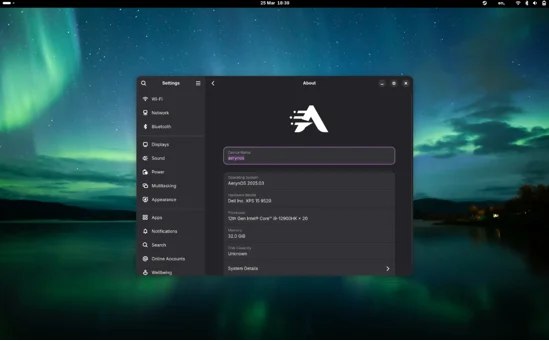
The 2025.08 release marks the third major update of the year, building on the alpha-stage foundations laid in earlier versions like 2025.03. It’s still in alpha, meaning it’s not yet production-ready for all users, but it showcases mature features that hint at its potential. Official downloads are available from the AerynOS website, with the GNOME Edition serving as the primary ISO, which doubles as a live installer for other desktop environments.
The Evolution: From Serpent OS to AerynOS 2025.08
To appreciate why AerynOS 2025.08 is a game-changer, it’s essential to trace its roots. Originally conceived as Serpent OS, the project aimed to create a modern, stateless Linux distro that avoided the pitfalls of legacy systems. Ikey Doherty, drawing from his work on Solus and insights from Intel’s Clear Linux, envisioned an OS that prioritizes atomicity without relying on containers like Flatpak or Snap for everything.
The rebranding to AerynOS in early 2025 signaled a fresh start, with the 2025.03 release introducing GNOME 48 and Linux kernel 6.13. By 2025.08, the distro has matured significantly, incorporating user feedback and technical refinements. Key updates in this version include GNOME 48.4, Mesa 25.2 for enhanced graphics performance, Linux kernel 6.15, and official support for KDE Plasma 6.4.4. Additionally, there’s experimental support for System76’s Cosmic desktop, expanding options for users who prefer Rust-based environments.
This evolution underscores AerynOS’s commitment to being more than “yet another distro.” It’s built as a platform with tools like Moss (package manager), Boulder (build system), and blsforme (boot manager), all designed to enhance atomic operations. For atomic fans, this means a system that’s not just immutable but intelligently managed, with deduplication making multiple states efficient to store.
Core Features of AerynOS 2025.08 That Thrill Atomic Linux Fans
What sets AerynOS 2025.08 apart? Let’s break down the standout features, focusing on those that resonate with atomic Linux enthusiasts.
Live Atomic Updates and Rollbacks
At the heart of AerynOS is its atomic update system, powered by the Moss package manager. Unlike traditional apt or dnf, Moss treats updates as transactions: it generates a new /usr tree using hardlinks from a deduplicated cache, then atomically swaps it into place via renameat2 with RENAME_EXCHANGE. This ensures that either the entire update succeeds, or nothing changes—eliminating partial failures.
Live updates mean no reboots for minor changes; the system applies them instantly while running. If issues arise, atomic rollbacks allow reversion from the boot menu, with deduplicated states keeping storage costs low. For fans of atomic distros, this is a step beyond OSTree-based systems like Silverblue, where reboots are often required. Imagine updating your kernel or desktop environment without downtime—AerynOS makes it reality.
Stateless Design and Hermetic /usr
AerynOS enforces statelessness rigorously: packages cannot include files outside /usr, preventing merge conflicts and ensuring sane defaults. System accounts are managed via systemd userdb and sysusers, phasing out /etc/passwd and /etc/group. This hermetic approach makes the system more predictable and easier to maintain, a boon for atomic users who value reproducibility.
Future plans include immutability via erofs metadata images with overlayfs and fsverity hashes, further hardening the core OS. This positions AerynOS as a leader in stateless computing, rivaling NixOS but with less complexity for everyday users.
Optimized Performance and Toolchain
Performance is a pillar of AerynOS. It uses the LLVM toolchain by default, with libc++ and compiler-rt for better diagnostics and portability, while glibc handles compatibility. Packages are built for x86_64-v2 with optimizations, delivering “blazing-fast” speeds. Mesa 25.2 and kernel 6.15 in 2025.08 enhance graphics and hardware support, making it ideal for gaming or creative work on atomic setups.
The .stone package format—binary, version-agnostic, Zstd-compressed, and hashed with XXH128 (Blake3 planned)—streamlines distribution and verification.
Desktop Environment Flexibility
While GNOME 48.4 is the flagship in 2025.08, KDE Plasma 6.4.4 integration is a major addition, offering Qt-based alternatives for users who find GNOME too opinionated. The live ISO allows installing other DEs via the ‘lichen’ installer, including Cosmic. This flexibility is rare in atomic distros, where DE choices are often limited to avoid complexity.
How AerynOS 2025.08 Compares to Other Atomic Linux Distros
To gauge its game-changing potential, let’s compare AerynOS with popular atomic distros using a table for clarity.
| Feature/Distro | AerynOS 2025.08 | Fedora Silverblue | NixOS | Vanilla OS | openSUSE MicroOS |
|---|---|---|---|---|---|
| Update Mechanism | Moss transactions, live atomic swaps | OSTree, reboot-required | Declarative configs, atomic | ABRoot, container-heavy | Transactional updates |
| Rollbacks | Deduplicated, boot-menu easy | Yes, via OSTree | Yes, generational | Yes | Yes |
| Statelessness | Strict /usr hermetic | Partial | Full declarative | Partial | Partial |
| Package Format | .stone (native binary) | rpm-ostree | Nix expressions | APT-based | zypper |
| DE Options | GNOME, KDE, Cosmic | GNOME primary, others via toolbox | Flexible | GNOME, others | Limited |
| Performance Focus | LLVM-optimized, x86_64-v2 | Standard Fedora | Customizable | Ubuntu-based | SUSE-optimized |
| Maturity | Alpha | Stable | Stable | Beta | Stable |
From this, AerynOS shines in native purity—no heavy reliance on containers like Flatpak for core apps—and its live updates reduce downtime compared to Silverblue’s reboot model. Unlike NixOS’s steep learning curve with declarative configs, AerynOS aims for accessibility while planning state-based management. Against Vanilla OS or MicroOS, it offers better DE variety and deduplication for efficient storage.
Community feedback on Reddit highlights AerynOS’s deduplication as a storage-saver, making it cheaper to maintain multiple states than in other distros. For atomic fans tired of workarounds, this could be the fresh alternative they’ve been waiting for.
Why AerynOS 2025.08 is Truly a Game-Changer
The “game-changer” label isn’t hyperbole. Atomic Linux has grown popular for its reliability in servers and desktops, but many distros still feel like hacks on traditional bases. AerynOS rebuilds from scratch, treating atomicity as the default rather than an add-on. Its innovations—like dynamic kernel command lines reading superblocks and versioned repos to stagger changes—promise fewer disruptions.
For enthusiasts, the benefits are tangible: faster updates, lower risk, and better performance without sacrificing power. In a landscape where Windows 11’s requirements push users to Linux, AerynOS offers a compelling alternative that’s modern and robust. As one YouTube reviewer noted, it could become “a new best distro” for those seeking stateless elegance.
Installation, Usage, and Getting Started
Getting started with AerynOS 2025.08 is straightforward. Download the GNOME Edition ISO from aerynos.com/download—it’s about 2-3GB—and boot it live. The lichen installer handles partitioning and DE selection. System requirements aren’t explicitly stated, but expect modern hardware: 4GB RAM minimum, 20GB storage, and x86_64 CPU.
Once installed, use Moss for updates: moss update applies changes atomically. Roll back via the boot menu if needed. For apps, native .stone packages are preferred, but compatibility layers exist.
Community support is growing on Reddit, Mastodon (hachyderm.io/@AerynOS), and the official GitHub. As an alpha, expect bugs, but the rapid syncs (e.g., weekly repo updates) show active development.
Community, Future Prospects, and Challenges
The AerynOS community is enthusiastic, with posts on X praising its updates and potential. Future plans include full immutability, Blake3 hashing, and state-based package management, evolving toward a hybrid of imperative and declarative models.
Challenges remain: Alpha status means it’s not for mission-critical use, and the small team could slow progress. However, Doherty’s track record inspires confidence.
Conclusion: Embrace the Atomic Revolution with AerynOS
Why AerynOS 2025.08 is a game-changer for atomic Linux fans boils down to its innovative atomic core, performance optimizations, and user-centric design. It bridges the gap between stability and flexibility, offering live updates, efficient rollbacks, and a stateless foundation that outshines many competitors. If you’re frustrated with reboots in Silverblue or the complexity of NixOS, give AerynOS a spin—it might just redefine your Linux experience.
With ongoing development and a clear vision, AerynOS is poised to influence the atomic Linux landscape profoundly. Download it today and join the revolution. For more on atomic distros, stay tuned to our blog.
Disclaimer
The information provided in this blog post about AerynOS 2025.08 is based on official sources, community feedback, and publicly available data as of September 1, 2025. While every effort has been made to ensure accuracy, AerynOS is currently in an alpha stage and may not be suitable for production environments. Features, performance, and system behavior may change with future updates. Users should exercise caution, back up important data, and consult official AerynOS documentation before installing or using the distribution.
The author and publisher are not responsible for any issues, data loss, or damages resulting from the use of AerynOS or reliance on this information. Always verify details from the official AerynOS website (aerynos.com) or community channels for the latest updates and support.
Also Read
Armbian OS Deep Dive: Unleashing Performance & Versatility in 2025
About the Author