Why Distro Hopping Makes Less Sense in 2026
Remember when choosing the right Linux distribution felt like an endless journey? You’d install Ubuntu one week, switch to Fedora the next, try Arch after that, and somehow end up with three different distributions on separate partitions. That constant cycle of installing, testing, and reinstalling different distributions has become a familiar ritual in the Linux community. But here’s the thing: Why Distro Hopping Makes Less Sense in 2026 is becoming increasingly apparent as the Linux ecosystem matures in ways we couldn’t have imagined just a few years ago.
The landscape has shifted dramatically. What once required jumping between distributions to find specific features or capabilities now exists within most mainstream options. This transformation isn’t just about incremental improvements but represents a fundamental change in how Linux distributions are built, maintained, and experienced by users.
The Universal Packaging Revolution Has Arrived
The biggest game-changer that makes distro hopping largely unnecessary is the widespread adoption of universal packaging formats. Flatpak has emerged as the clear winner in the desktop space, with Flathub becoming the de facto standard repository for Linux applications.
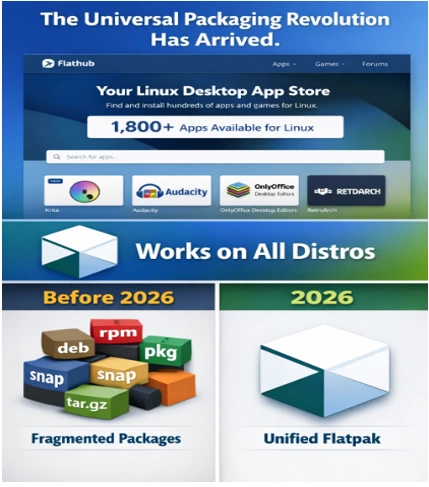
Gone are the days when you needed to switch distributions just to access certain software. Previously, if your favorite application was only packaged for Fedora’s RPM system but you were running a Debian-based distribution, you faced a genuine dilemma. Now, that barrier has collapsed entirely.
According to recent technical evaluations, Flatpak’s runtime sharing mechanism handles deduplication approximately 15% more efficiently than competing formats on disk-constrained systems. More importantly, developers are increasingly recommending Flathub as their primary distribution channel. This shift means that whether you’re running Ubuntu, Fedora, openSUSE, or even Arch, you have access to virtually identical application ecosystems.
Universal packaging has solved the fragmentation problem that plagued Linux for decades. Applications like Spotify, Discord, Slack, and thousands of others install identically across all major distributions. The software you need is no longer tied to your distribution choice.
Immutable Distributions Are Reshaping Expectations
2026 marks a significant turning point with the mainstream adoption of immutable (atomic) distributions. What was once an experimental concept has become a practical reality that’s changing how users think about their operating systems.
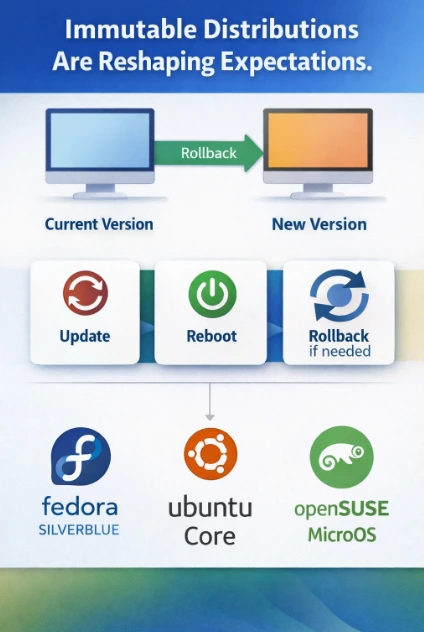
Immutable distributions like Fedora Silverblue, Ubuntu Core Desktop, openSUSE MicroOS, and the gaming-focused Bazzite are built on a fundamentally different architecture. The core operating system remains read-only, with updates applied as complete system images rather than individual package changes.
Think about what this means practically. In traditional mutable systems, a failed update could leave your system in a broken state, requiring hours of troubleshooting or a complete reinstall. This unpredictability drove many users to hop between distributions, searching for that elusive “stable” setup. Immutable systems eliminate this concern entirely.
When you update an immutable distribution, the changes download in the background to a new system image. You reboot into the new version. If anything goes wrong, you simply roll back to the previous image with a single command or boot menu selection. Your system becomes virtually unbreakable.
Red Hat Enterprise Linux 10 now offers an immutable option. Ubuntu 26.04 LTS, releasing in April 2026, introduces immutable core options for desktop users. This enterprise-grade stability is no longer exclusive to servers but available for everyday desktop computing.
The rise of immutable distributions means your choice of base distribution matters less than it used to. The reliability and update safety that once varied significantly between distributions has been standardized at an architectural level.
Desktop Environment Independence Has Matured
Another factor reducing the need for distro hopping is the maturity of desktop environment portability. You no longer need to switch entire distributions just to try a different desktop experience.
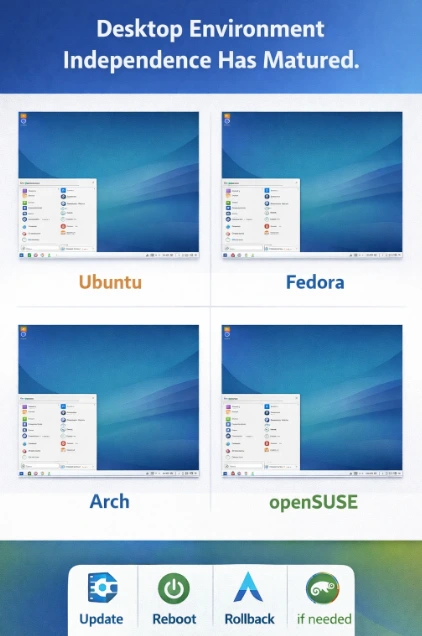
KDE Plasma 6, GNOME 47 and the upcoming GNOME 50, and other major desktop environments now run consistently across different distribution bases. The desktop environment you prefer can typically be installed on any mainstream distribution without significant compromises.
Interestingly, KDE has even launched its own reference distribution called KDE Linux, built on an immutable Arch base. This represents a shift in thinking where the desktop environment defines the experience more than the underlying distribution.
The consolidation around Wayland as the default display protocol across major distributions has further standardized the desktop experience. Whether you’re on Fedora, Ubuntu, or openSUSE, the visual and functional behavior of your desktop environment remains remarkably consistent.
This consistency extends to theming, system settings, and application integration. The desktop environment incompatibilities and quirks that once varied between distributions have largely been resolved through community collaboration and standardization efforts.
Hardware Support Has Become Universal
Hardware compatibility used to be a compelling reason to switch distributions. Certain distributions had better support for specific graphics cards, WiFi adapters, or laptop features. Those distinctions have diminished substantially.
The Linux kernel 6.14 and newer versions ship with comprehensive hardware support that’s consistent across distributions. Most major distributions update their kernels on similar schedules, meaning hardware support variations are minimal.
NVIDIA’s open kernel modules are now supported out-of-the-box on most mainstream distributions. AMD graphics work consistently everywhere. The proprietary driver installation headaches that once varied wildly between distributions have been streamlined through improved installer tools and repository integration.
ARM-based laptops and devices are gaining better support across the board. NPU (Neural Processing Unit) integration for local AI tasks is being standardized in kernel space rather than through distribution-specific patches.
When hardware “just works” regardless of your distribution choice, one major motivation for distro hopping disappears.
The Windows 10 Migration Wave
The Windows 10 end-of-life on October 14, 2025 created an unprecedented opportunity for Linux. With over 800 million devices potentially affected by Microsoft’s deadline, Linux desktop market share climbed to 4.7% globally, representing a 70% increase from 2.76% in July 2022 It’s FOSS.
This wasn’t just about numbers. Real people faced a genuine dilemma. Windows 11’s strict hardware requirements—TPM 2.0, Secure Boot, and newer CPU generations—left countless functional computers unable to upgrade. Rather than discarding perfectly good machines or paying for Extended Security Updates, many users discovered Linux for the first time.
The migration became easier because distributions like Linux Mint, Ubuntu, and Zorin OS specifically designed onboarding experiences for Windows refugees. Pre-configured layouts mimicking Windows interfaces, one-click driver installation, and comprehensive migration guides removed traditional barriers. The timing couldn’t have been better for Linux’s maturity to meet mainstream necessity.
India leads this global shift with a remarkable 16.21% Linux adoption rate. The United States crossed the historic 5% threshold in June 2025, marking the first time a major Western market achieved this milestone. These aren’t tech enthusiasts in forums—these are everyday users choosing Linux because it makes practical sense.
Gaming on Linux Has Standardized
The gaming landscape on Linux has transformed dramatically, eliminating another traditional reason for distro hopping. Steam’s Proton compatibility layer and the success of the Steam Deck have standardized gaming across distributions.
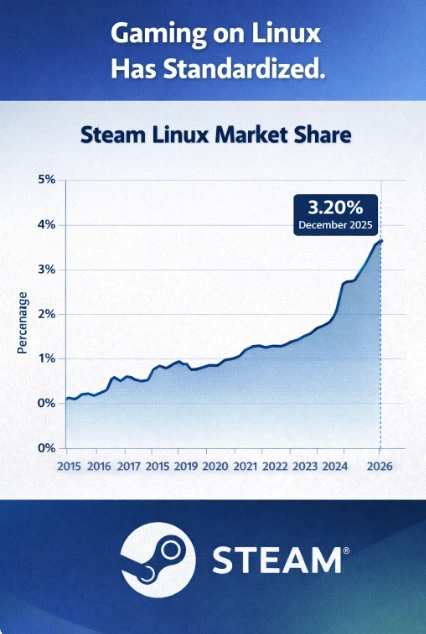
Gaming-focused distributions like Bazzite, Nobara, and CachyOS offer specialized optimizations, but the reality is that modern Fedora, Ubuntu, or Pop!_OS can handle gaming workloads with minimal additional configuration.
Proton works identically across distributions. Wine improvements benefit everyone equally. The Mesa graphics stack, which handles AMD and Intel GPU drivers, updates consistently across major distributions. Even specialized gaming distributions are increasingly built on top of mainstream bases like Fedora or Arch, using universal packages for game launchers and tools.
You no longer need to install a gaming-specific distribution to get optimal performance. The differences in gaming capability between distributions have narrowed to the point of being negligible for most users.
The Convergence of Distribution Philosophies
Perhaps the most significant factor is the convergence of distribution philosophies and feature sets. The dramatic differences that once defined distributions have softened considerably.
Ubuntu, Fedora, and openSUSE all offer similar release models with regular updates and long-term support options. Package manager performance has improved across the board, with tools like DNF5 bringing substantial speed improvements to RPM-based systems.
Security practices have standardized. Full disk encryption via TPM 2.0 is becoming default across major distributions. Secure boot support is universal. Container and virtualization technologies work identically regardless of your chosen distribution.
Even update mechanisms are converging. Whether you’re using apt, dnf, or zypper, the user experience and reliability have reached similar levels of polish. The command-line syntax differs, but the functional outcomes are remarkably consistent.
Cloud Integration and Development Workflows
For developers and professionals, another consideration has shifted. Cloud-based development environments and containerization have reduced the importance of the host operating system.
Docker, Podman, and other container technologies work identically across distributions. If you’re developing in containers, your choice of host distribution becomes almost irrelevant. The development environment inside your containers remains consistent regardless of whether you’re running Ubuntu, Fedora, or any other mainstream distribution.
Cloud IDE solutions like VS Code’s Remote Development, GitHub Codespaces, and similar platforms further abstract away distribution differences. Your development workflow becomes distribution-agnostic.
The Enterprise Momentum
While consumer adoption captures headlines, enterprise and government movements toward Linux signal deeper structural change. Germany’s state of Schleswig-Holstein became the first European region to completely replace Microsoft tools with Linux and LibreOffice in public offices as of April 2024. France operates over 103,000 computers running GendBuntu, a custom Ubuntu-based distribution used by the national gendarmerie.
Denmark’s Ministry of Digital Affairs announced its transition from Microsoft to open-source platforms between June and November 2025. Switzerland committed $231 million to build a national cloud service and passed legislation mandating government-developed software be released as open source. The European Union is actively considering an “EU-Linux” operating system for public administrations across all member states.
These aren’t ideological decisions—they’re strategic ones about digital sovereignty, cost control, and long-term sustainability. When governments trust Linux for critical infrastructure, it validates the platform in ways that consumer market share numbers alone cannot.
Red Hat Enterprise Linux holds 43.1% of the enterprise Linux server market in 2025, while Linux powers 78.3% of web-facing servers. These statistics represent real production workloads running critical systems for Fortune 500 companies, financial services, and healthcare providers.
The convergence of consumer, government, and enterprise adoption creates a reinforcing cycle. Better hardware support follows market share. More applications target Linux when the user base grows. Professional support ecosystems mature as enterprise deployment expands. This momentum makes distribution hopping less necessary—you can choose almost any mainstream distribution confident that hardware, software, and support will be available.
When Does Distribution Choice Still Matter?
This doesn’t mean all distributions are identical or that your choice is meaningless. Certain scenarios still warrant careful distribution selection:
Corporate and Enterprise Environments: Organizations often standardize on specific distributions like Red Hat Enterprise Linux, Ubuntu LTS, or SUSE Enterprise Linux for support contracts, compliance requirements, and long-term stability guarantees. Here, the choice matters immensely, but switching between options (distro hopping) rarely makes sense.
Specialized Use Cases: Distributions like Kali Linux for penetration testing, Tails for privacy and anonymity, or scientific computing distributions serve specific niches. These remain valuable for their intended purposes.
Bleeding-Edge Development: If you need absolute cutting-edge packages and are comfortable with rolling releases, Arch Linux or Fedora offer advantages. But this is a deliberate choice rather than the restless searching that characterizes distro hopping.
Philosophy and Community: Some users prefer distributions aligned with specific philosophical positions regarding free software. Debian’s commitment to FOSS, or Fedora’s position on only including free software by default, matter to certain users. This represents a values-based choice rather than a technical necessity.
The Maturity Advantage
The Linux ecosystem in 2026 has reached a level of maturity where the core user experience has standardized without sacrificing the diversity and choice that defines the platform. This maturity manifests in several ways:
Desktop environments behave consistently across distributions. Critical applications are universally available through Flatpak. Hardware support is comprehensive and distribution-agnostic. Gaming capabilities are standardized through Proton and Steam. Security practices have converged around common standards.
This standardization doesn’t eliminate choice but elevates it. Instead of chasing basic functionality by hopping between distributions, users can now make informed choices based on substantive differences: release cycle preferences, support models, philosophical alignment, or specialized features.
The Psychological Aspect of Distro Hopping
Beyond technical reasons, distro hopping often stems from searching for the “perfect” system. This pursuit can become counterproductive. The constant reinstalling, reconfiguring, and relearning prevents you from actually using your computer productively.
With distributions converging in capability and reliability, the marginal benefits of switching have diminished while the costs remain constant. Every distribution change requires time investment in installation, configuration, and familiarization. When distributions offer substantially similar core experiences, this time investment yields diminishing returns.
The stability and reliability improvements mean you’re less likely to encounter the frustrations that trigger the urge to switch. When your system updates reliably, your applications work consistently, and your hardware functions properly, the motivation to seek alternatives naturally decreases.
Finding Your Long-Term Distribution Home
Given these changes, the approach to selecting a Linux distribution in 2026 should differ from past strategies. Rather than cycling through options, consider these factors:
Support Duration: If you value stability and long update intervals, Ubuntu 26.04 LTS offers support until 2036 with Extended Security Maintenance. Debian provides multi-year support cycles. These remove the need to hop in search of stability.
Update Frequency: Decide whether you prefer regular releases (Ubuntu, Fedora) or rolling releases (Arch, openSUSE Tumbleweed). This is largely a preference question now rather than a capability difference.
Community and Resources: Major distributions have extensive documentation, community forums, and support resources. Your ability to find help when needed might matter more than subtle technical differences.
Default Configuration: Some distributions require more initial setup. Others work immediately. Your tolerance for tinkering should guide this choice, but remember that post-installation differences are minimal once configured.
The Bottom Line
Why distro hopping makes less sense in 2026 comes down to a simple reality: the Linux ecosystem has matured to the point where major distributions offer substantially similar capabilities, reliability, and user experiences. The dramatic differences that once necessitated trying multiple distributions have largely disappeared.
Universal packaging through Flatpak gives you identical application access. Immutable distribution architectures provide comparable reliability. Desktop environments work consistently across bases. Hardware support has standardized. Gaming capabilities are distribution-agnostic.
This doesn’t mean Linux has become homogeneous or boring. Diversity and choice remain core strengths of the ecosystem. Specialized distributions continue serving their niches. Philosophical differences between projects remain meaningful.
What has changed is that the basic functionality, reliability, and capability differences that once drove users to constantly switch distributions have been largely resolved. You can now choose a distribution based on substantive criteria rather than chasing features or fleeing from instability.
The time and energy previously spent on distro hopping can now be redirected toward actually using Linux productively, contributing to projects you care about, or learning deeper aspects of the system. The endless reinstallation cycle can finally end, not because choice has been eliminated, but because choice has become less consequential for basic functionality.
Pick a mainstream distribution that aligns with your values, support preferences, and release cycle desires. Configure it to your liking. Then actually use it. The improvements in the Linux ecosystem mean your chosen distribution will serve you well for years to come, evolving and improving through updates rather than requiring replacement.
Comparison Table: Key Linux Distributions in 2026
| Distribution | Release Type | Package Management | Immutable Option | Best For | LTS Support |
|---|---|---|---|---|---|
| Ubuntu 26.04 LTS | Fixed (2 years) | APT/Snap | Yes (Core) | General use, enterprise, beginners | 5 years (10+ with Pro) |
| Fedora Workstation | Fixed (6 months) | DNF5 | Yes (Silverblue) | Developers, latest features | 13 months |
| Linux Mint | Fixed (based on Ubuntu LTS) | APT | No | Windows migrants, stability | 5 years |
| Debian 13 | Fixed (2+ years) | APT | Limited | Stability, servers, FOSS purists | Long-term |
| Arch Linux | Rolling | Pacman | No | Advanced users, customization | N/A (rolling) |
| openSUSE Tumbleweed | Rolling | Zypper | Yes (MicroOS) | Developers, latest software | N/A (rolling) |
| Pop!_OS | Fixed (Ubuntu-based) | APT | No | Gaming, creativity, System76 hardware | Based on Ubuntu |
| Bazzite | Image-based (Fedora) | rpm-ostree/Flatpak | Yes | Gaming, Steam Deck-like experience | Based on Fedora |
Frequently Asked Questions
Should beginners still try multiple distributions to learn?
For educational purposes, experimenting with a few distributions can be valuable to understand different approaches. However, beginners benefit more from deeply learning one stable distribution rather than constantly switching. Start with Ubuntu, Fedora, or Linux Mint, learn the fundamentals, and only explore alternatives once you understand the basics.
Are there still reasons to switch distributions in 2026?
Yes, legitimate reasons exist: changing from a fixed release to a rolling release model, moving to a distribution with a specific support contract for enterprise use, or adopting a specialized distribution for a particular use case. The key difference is making an intentional switch for specific reasons rather than endless experimental hopping.
Will Flatpak completely replace native packages?
No. Native packages will remain important for system-level software, development tools, and components requiring deep system integration. Flatpak excels for desktop applications. Most distributions will maintain both native packages for system components and Flatpak for user applications, giving users the best of both approaches.
How do immutable distributions affect customization?
Immutable distributions handle customization differently but don’t eliminate it. User-space customizations work identically. System-level changes require layering packages onto the base image or using toolbox containers for development environments. For most users, this approach actually simplifies customization while improving reliability.
What if I’m already committed to a specific distribution?
If your current distribution works well for you, there’s no reason to change. The convergence of features means staying with your chosen distribution is now easier than ever. Focus on learning your system deeply rather than switching based on trends. The improvements in stability, application availability, and hardware support benefit existing users as much as new ones.
Disclaimer
This article reflects current trends and observations in the Linux ecosystem as of early 2026. Distribution features, capabilities, and community dynamics continue to evolve. Your individual experience may vary based on specific hardware, use cases, and personal preferences. Always research and test distributions based on your particular needs before making long-term commitments.
Also Read
Why 2026 Is the Best Year to Switch to Linux
About the Author