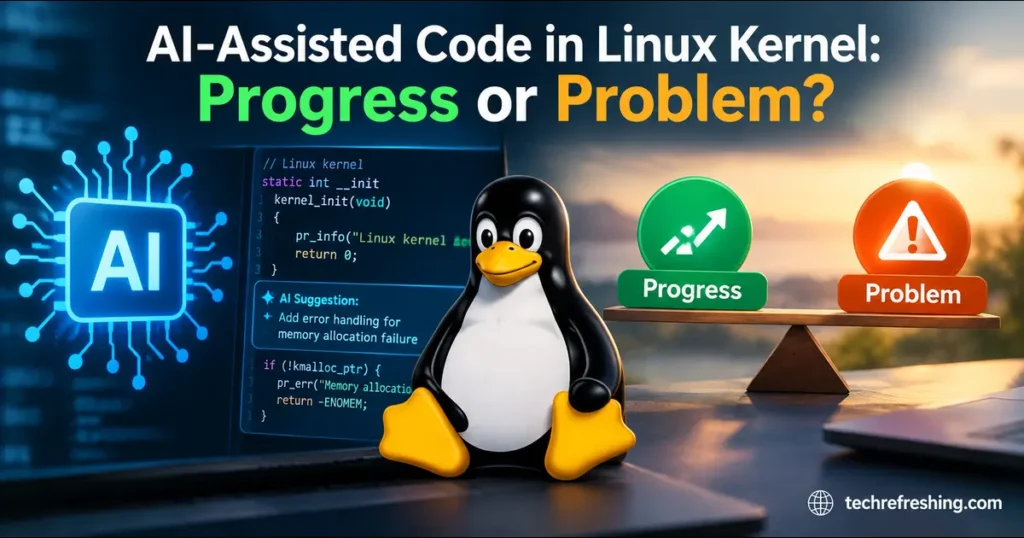
A few years ago, the idea of a chatbot touching Linux kernel code would have started a flame war before lunch. In October 2026, it’s a normal Tuesday on the mailing list.
AI-assisted code in Linux kernel development has moved from “will they allow it?” to “how do we live with it?” The kernel now has a written policy, a record-breaking stream of late-cycle fixes, a security inbox buried in AI-found bugs, and a fresh decision from the Maintainers Summit that surprised a lot of people.
Headlines flatten this story, so this post goes back to the primary sources: the kernel’s own documentation, the mailing-list threads, and the reporting around them. By the end, you should be able to decide for yourself whether this is progress, a problem, or (most likely) both.
How We Got Here: A Short Timeline
The kernel didn’t jump into AI. It crept in, argued about it, and then wrote rules.
- July 2025: A proposal to label AI-assisted patches first appeared on the kernel mailing list.
- January 2026: The labeling idea became part of the kernel documentation.
- April 2026: The official AI coding assistants document drew wide coverage, with reports tying it to the Linux 7.0 release.
- May 2026: With Linux 7.1-rc4, Torvalds called the security list almost entirely unmanageable because of duplicate AI-found reports.
- August 2026: Linux 7.2’s release candidates grew unusually large, and Torvalds called it the new normal.
- October 2026: The Maintainers Summit agreed to deprecate the Assisted-by tag.
That’s a lot of policy movement for one project in about fifteen months.
What the Official Kernel Policy Actually Says
Most summaries get this wrong, so it helps to read the source. The rules live in the kernel’s coding assistants documentation.
The policy never banned AI. It treated AI like any other tool and put responsibility on the person hitting “send.” The core rules were:
- Licensing: Everything must be compatible with GPL-2.0-only, however the code was produced.
- No AI sign-offs: Only humans can legally certify the Developer Certificate of Origin, so AI agents must not add Signed-off-by tags.
- Human accountability: The submitter reviews all generated code and answers for quality and legal issues.
- Attribution: Patches with AI help were asked to carry an Assisted-by line naming the agent, model version and any extra tools.
Think of it this way: the kernel was never asking “did a machine type this?” It was asking “which human will stand behind this on the mailing list?”
The October 2026 Twist: Goodbye, Assisted-by Tag
This is the freshest development, and it’s a big one.
Sasha Levin told the kernel list that the Maintainers Summit reached consensus to deprecate the tag and remove the documentation requiring it. You can read his original mailing-list message, and The Register’s October 14 report covers the full debate. Jeff Layton of Red Hat gave three practical reasons for reversing course:
- Not everyone follows the rule, so the data is unreliable.
- It works as free advertising for proprietary LLM vendors.
- Nobody could clearly say why the kernel collects it in the first place.
There’s an interesting wrinkle. Attribution habits differ between tool makers: Claude adds provenance messages by default, while Codex does not.
Not everyone cheered. Laurent Pinchart pushed back on the list, arguing that a disclosure rule still sets expectations even if some people ignore it. It’s a fair point: the kernel has always had contributors who cut corners, and it rejects their work when it catches them.
Torvalds shut the debate down in his usual style. He compared tool-restriction rules to banning compilers and argued that what matters is whether contributors understand what they submit. In his view, the people worth respecting aren’t the ones avoiding new tools.
This isn’t the kernel going soft on AI. It’s the kernel choosing to judge the patch rather than the process, which is how kernel review has always worked.
The Evidence That AI Is Genuinely Helping
Start with progress, because there’s real substance here.
Bigger, busier release cycles
Release candidates are supposed to shrink as a cycle winds down. That stopped happening. Torvalds called Linux 7.2-rc6 the biggest rc6 in years by commit count. A week later, he described the oversized rc7 as the new normal, with many fixes coming out of AI-assisted review.
The detail that matters is what kind of work this is. TechRadar’s coverage stresses that the growth is in late-cycle bug fixes rather than features, and that humans still write and submit the patches. So the story isn’t “AI writes the kernel.” It’s “AI reads the kernel, finds problems, and humans fix them.”
Linux 7.1 showed the same pattern, with a high number of memory-safety patches in 7.1-rc3 and networking making up about a third of the fixes. Use-after-free bugs in Bluetooth and GPU drivers are exactly what tired human eyes miss and pattern-matching tools catch.
Veteran maintainers changed their minds
The most convincing evidence isn’t a statistic. It’s who is talking. At the Linux Foundation’s Open Source Summit in August, stable-kernel maintainer Greg Kroah-Hartman said LLMs are “good enough now” because code is made of patterns. That’s someone who has reviewed an enormous amount of code, not a hype merchant.
What AI does well in kernel work today
- Scans old driver code for classic bug patterns
- Flags missing error handling and lifetime mistakes
- Helps newcomers understand unfamiliar subsystems
- Drafts test cases and repetitive cleanup patches
- Gives overloaded maintainers a second pair of eyes
The Evidence That AI Is Causing Real Problems
Now the other side. These aren’t hypothetical worries.
The security list is drowning
This is the clearest case of AI creating work faster than people can absorb it. Willy Tarreau, a longtime stable maintainer, said in March that the private list went from roughly two to three reports a week to five to 10 a day, as Tom’s Hardware reported.
The bigger issue is duplication. Multiple researchers run the same tools on the same code and send in the same bug. Torvalds’ fix was blunt: newly merged documentation says AI-found vulnerabilities should be treated as public and sent straight to the relevant maintainers. His reasoning is hard to argue with. If a widely available tool can find a bug, assume others already have.
He also set a quality bar. A raw report isn’t enough. He wants a patch and real understanding behind it, not a drive-by submission.
Review bandwidth hasn’t scaled
Maintainers are people, and there are only so many of them. More patches mean more review. The wider open source world shows the same strain: maintainers estimate that about a quarter of incoming pull requests are slop, rising to 31% on larger projects. That figure covers open source broadly, not the kernel specifically, but the kernel isn’t immune to the same pressure.
Copyright is unresolved
Concerns about coding agents reproducing copyrighted code haven’t gone away. One commenter in a community discussion of the policy put the uncomfortable truth plainly: the kernel handles this by pushing responsibility onto contributors. That’s pragmatic, but it isn’t a solution. A contributor can’t realistically check whether a model echoed a snippet from another project.
Quality control by trust
A CodeRabbit analysis of 470 open-source pull requests found roughly 1.7 times more issues in AI co-authored PRs than in human-only ones. It’s a small sample from outside the kernel, so treat it as a warning light rather than a verdict.
Comparison Table: Where AI Fits in Kernel Work (October 2026)
| Use case | Who does the work | What’s working | What’s hurting | Verdict |
|---|---|---|---|---|
| Code review and bug finding | AI flags, humans verify and fix | Catches memory-safety and lifetime bugs; fuels larger late-cycle fix volume | Oversized release candidates strain maintainers | Net positive |
| Writing patches | Human drives, AI drafts | Speeds up repetitive cleanups and tests | Plausible but wrong code; unclear copyright provenance | Positive with care |
| Security reports | Researchers using AI tools | Surfaces many genuine flaws | Heavy duplication; private list overwhelmed | Mixed, process needed |
| Attribution and disclosure | Contributor | Gave maintainers a signal | Inconsistent, unenforceable, now deprecated | Retired |
| Fully autonomous submissions | AI agent alone | Almost nothing | AI can’t sign off; no accountability | Not acceptable |
Progress vs. Problem: Where I Land
Both camps are right, which is why this debate keeps going in circles.
It’s progress when AI acts as a tireless junior reviewer. The late-cycle fix surge in 7.1 and 7.2 is real, and fixing bugs earlier benefits anyone running Linux on a server, a phone or a car.
It’s a problem when it generates volume without understanding. A flood of duplicate reports or unexplained patches shifts cost from the submitter to the maintainer. That’s the one thing a volunteer-driven project can’t afford.
The kernel’s approach holds the two together. It doesn’t ask “was AI used?” It asks “do you understand this, and will you defend it?” That works equally well for a human who copied a forum answer and for a developer who accepted an agent’s suggestion.
Pros and Cons of AI-Assisted Code in Linux Kernel
Pros
- Wider bug coverage: Tools sweep old, rarely read code that humans have little time for.
- Faster fixes: Problems found mid-cycle get patched before release rather than after.
- Lower barrier for newcomers: Contributors can understand unfamiliar subsystems quicker.
- Less drudgery: Routine cleanups and test scaffolding stop eating maintainer evenings.
- Clear accountability: The human-responsibility rule keeps ownership unambiguous.
Cons
- Maintainer overload: Bigger patch streams land on the same limited reviewer pool.
- Duplicate noise: Many people running identical tools create redundant reports.
- Legal uncertainty: Nobody can easily prove a model didn’t reproduce licensed code.
- Hidden quality drift: Plausible-looking code can carry subtle logic errors.
- Weak provenance: With the tag going away, tracing AI involvement later gets harder.
What This Means for Contributors
If you’re thinking about sending your first AI-assisted patch, here’s the practical version.
- Understand every line. If you can’t explain it on the list, don’t send it.
- Check licensing. Your code must be GPL-2.0-only compatible, and that responsibility is yours.
- Never let a tool add your sign-off. That certification is yours alone.
- Search before reporting. If an AI tool found a bug, someone else probably did too.
- Send a patch, not just a finding. Fixes carry weight; raw output doesn’t.
- Stay candid in your commit message. The tag may be going, but honesty with reviewers still helps.
What This Means for Everyday Linux Users
If you just run Linux, there’s no need to panic. Your kernel isn’t being written by robots on autopilot. Humans still write, submit and merge the code, and Torvalds still decides what ships.
What you may notice is more bug fixes arriving and, hopefully, fewer lingering memory-safety issues in drivers and networking. The risk to watch is quality: if review capacity falls behind, regressions can slip through. That’s why stable-kernel maintainers and distribution testers matter more than ever.
The Bigger Picture for Open Source
The kernel often sets the tone for other projects, and its stance sits between two extremes.
Some projects respond with lockdowns: Ghostty limits AI-generated pull requests, and tldraw auto-closes external ones. Others welcome everything and drown. The kernel’s middle path, which allows tools but demands human understanding and accountability, may become the template. Torvalds has also said Linux is not an anti-AI project.
Still, dropping the disclosure tag shows the community will revise rules that stop earning their keep. That flexibility is probably healthier than any fixed stance.
FAQ
Does the Linux kernel allow AI-generated code?
Yes. Contributors can use AI tools as long as the code is GPL-2.0-only compatible and a human reviews it, certifies it and takes responsibility.
Can an AI sign off on a kernel patch?
No. Only humans can certify the Developer Certificate of Origin, so AI agents must not add Signed-off-by tags.
Is the Assisted-by tag still required?
Not going forward. The Maintainers Summit agreed in October 2026 to deprecate it and remove the documentation that required it.
Why did Linux 7.2 have such large release candidates?
Torvalds said many late-cycle fixes came from AI-assisted review, and he now considers large release candidates the new normal.
Does AI write the Linux kernel now?
Not on its own. AI mostly helps find bugs, while humans write, submit and merge the fixes.
How should AI-found security bugs be reported?
Treat them as public and send them directly to the relevant maintainers rather than the private security list, ideally with a patch.
Who is responsible if AI-written kernel code breaks something?
The human who submitted it. Blaming the tool isn’t accepted.
Conclusion
So, is AI-assisted code in Linux kernel development progress or a problem? After reading the policy, the release data and the arguments from both sides, my answer is that it depends on how it’s used.
As a reviewer and bug finder, it’s already producing real value, with bigger fix streams in Linux 7.1 and 7.2 and respected maintainers changing their minds. As a firehose of unreviewed reports and patches, it wastes the scarcest resource the project has: human attention.
The kernel’s answer is refreshingly old-fashioned. Use any tool you like, but understand your work and own it. That principle held before AI, and it will likely hold after the next wave of models arrives.
Disclaimer: This article is for informational purposes only and reflects publicly reported information as of October 21, 2026. Kernel policies and documentation change quickly, so check kernel.org and the Linux kernel mailing list for the latest official position. Nothing here is legal advice regarding licensing or copyright.
TechRefreshing Guides
Explore More Linux Guides
Discover Linux distributions, troubleshoot common errors, and compare Ubuntu desktop editions.
More practical Linux news, tutorials, and distribution comparisons from TechRefreshing.