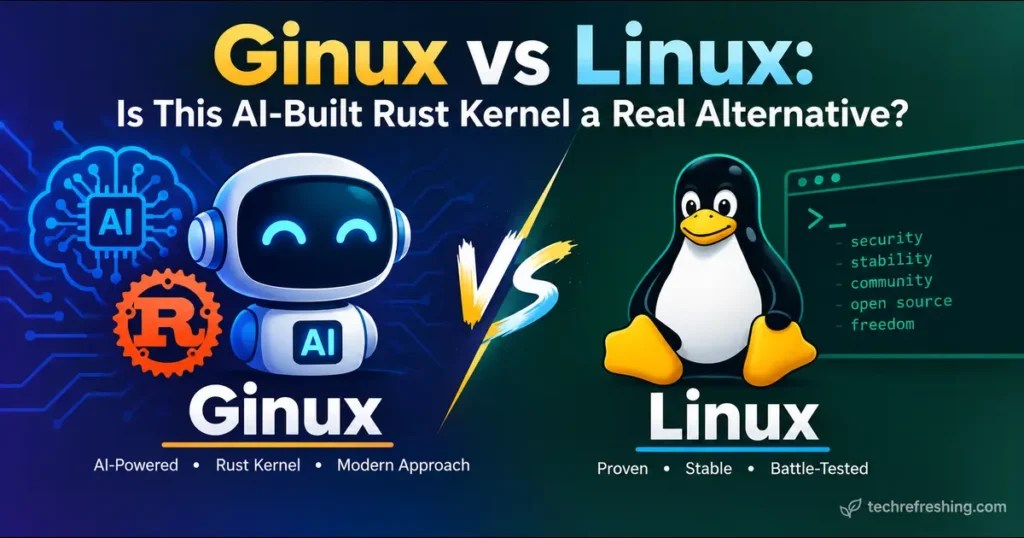
Every few years, someone announces a kernel that is supposed to challenge Linux. Most fade quickly. Ginux is different, but not for the reason the headlines suggest.
Gregory Kurtzer, the founder of CentOS and Rocky Linux, released Ginux in October 2026. He built it in 11 days with an AI coding agent. It isn’t a Linux fork. It boots Rocky Linux 10 all the way to systemd without a Linux kernel underneath.
That sounds like a revolution. The project’s own documentation is far more modest. This Ginux vs Linux comparison sticks to what’s documented, separates the achievement from the hype, and shows where each kernel stands today.
Key Takeaways
- Ginux is an independent, Rust-first x86-64 kernel, not a Linux fork.
- It runs selected unmodified Linux programs and boots Rocky Linux 10 to systemd’s
multi-user.target, but only in QEMU. - Its own README says it is not a production system or a replacement for Linux.
- Linux 7.3 shipped on October 18, 2026, and the kernel’s lead in hardware support, review and ecosystem is measured in decades.
- Ginux matters as a research result and a design experiment, not as a deployment choice.
What Is Ginux?
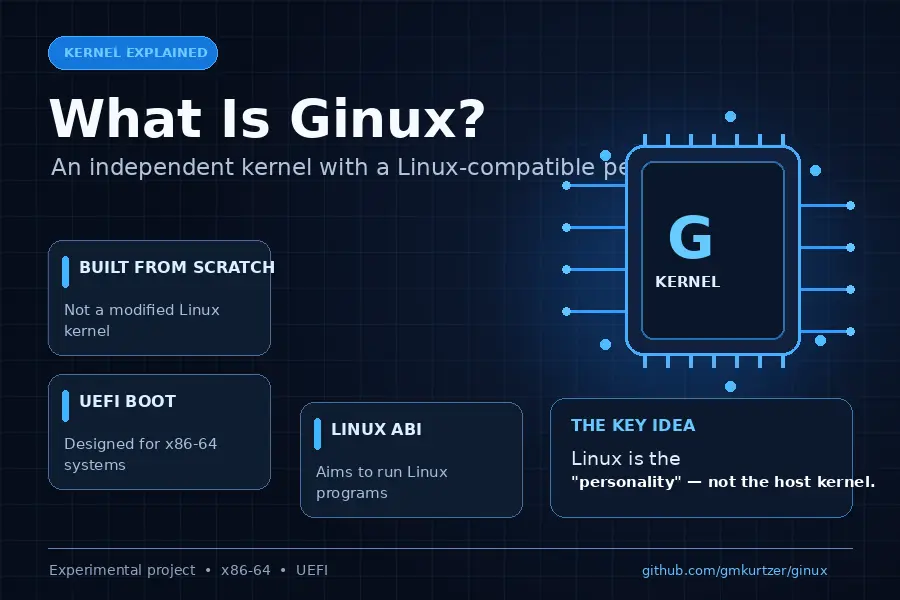
Ginux is an experimental operating system kernel for x86-64. According to the official Ginux repository on GitHub, it boots directly through UEFI and provides its own memory management, scheduler, process model, virtual filesystem, networking, device support and Linux ABI.
“Independent” is the important word. Ginux doesn’t take Linux source code and modify it. It is written from scratch to behave like Linux from the outside, so programs built for Linux can run unchanged. The project’s phrase for this is that Linux is a “personality” Ginux exposes, not the host kernel.
The name is a joke, and the README says so. It blends Linux, GPT and Greg, though the G officially stands for GPT to keep the author’s ego “within its configured resource limit.”
How it was built
Kurtzer calls his method Human-Directed Agentic Engineering (HDAE). Per the repository, one persistent OpenAI Codex task running GPT-5.6 Sol worked for eleven days and produced roughly 139,000 retained lines of implementation and test code, across more than a thousand commits.
The human set the architecture, constraints, milestones and stopping point. The agent wrote, booted, tested and revised the code against executable checks. The author’s technical report on Zenodo documents the method, the architecture, the evaluation and the limitations. It evaluates a commit dated October 23, 2026.
Kurtzer’s background lends the project credibility. He knows distribution engineering and what real Linux workloads demand from a kernel. That shows in the testing strategy: real Alpine and Rocky userspaces act as integration tests, because they expose failures that synthetic tests miss.
Why Ginux Is Getting So Much Attention
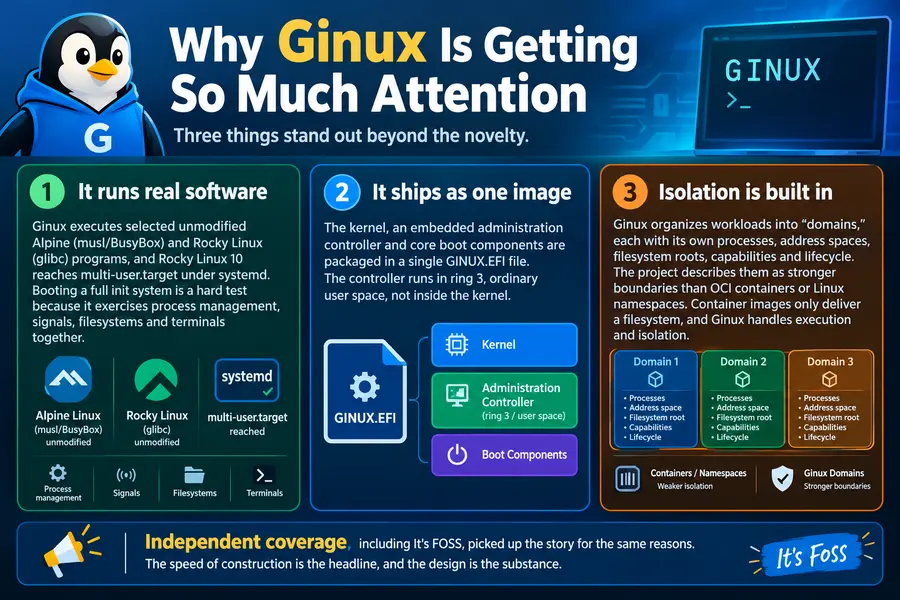
Three things stand out beyond the novelty.
It runs real software. Ginux executes selected unmodified Alpine (musl/BusyBox) and Rocky Linux (glibc) programs, and Rocky Linux 10 reaches multi-user.target under systemd. Booting a full init system is a hard test because it exercises process management, signals, filesystems and terminals together.
It ships as one image. The kernel, an embedded administration controller and core boot components are packaged in a single GINUX.EFI file. The controller runs in ring 3, ordinary user space, not inside the kernel.
Isolation is built in. Ginux organizes workloads into “domains,” each with its own processes, address spaces, filesystem roots, capabilities and lifecycle. The project describes them as stronger boundaries than OCI containers or Linux namespaces. Container images only deliver a filesystem, and Ginux handles execution and isolation.
Independent coverage, including It’s FOSS, picked up the story for the same reasons. The speed of construction is the headline, and the design is the substance.
What Ginux Cannot Do Yet
This is the part many headlines skip. The README is unusually direct about its limits.
- It is described as experimental, and “not production workloads or as a replacement for Linux.”
- The validated target is an x86-64 Q35 virtual machine in QEMU with OVMF, Intel IOMMU and virtio devices.
- There is no physical-hardware profile, and no GPU or NVMe support.
- No independent security audit has been done.
- The aggregate
make testdoes not fully pass at the evaluated checkpoint. A post-execve()supervisor lifecycle probe is a recorded failure, and the author left it documented. - Linux x86-64 is the only implemented personality. Others, such as BSD, are architectural possibilities only.
The Linux compatibility numbers need careful reading. The project classified all 375 syscall numbers in the Linux 6.12 x86-64 interface:
- 82 are complete
- 245 are partial
- 48 are deliberately policy-denied
The README stresses that this means every syscall has an explicit status. It does not mean full Linux conformance. A successful tested workflow is evidence for that workflow only, not for any arbitrary binary.
The performance evidence is equally narrow. The documented comparison is a single-vCPU QEMU test using the same sysbench binary. By the project’s own description it is not a native, multicore or general kernel benchmark, so it can’t support claims that Ginux is faster or slower than Linux.
Where Linux Stands in October 2026
Linus Torvalds released Linux 7.3 on October 18, 2026. IT-Connect’s release coverage notes that the final week after rc7 brought no particular problems. Reports on the release describe a record 18,765 non-merge commits from 3,021 developers, 807 of them first-time contributors. The 7.3-rc1 announcement put the source tree at roughly 41 million lines.
The Linux Kernel Archives also list the long-term branches that production systems depend on, including 6.18, 6.12, 6.6, 6.1 and 5.15.
Linux has its own pressures. Greg Kroah-Hartman warned in September that 7.3 would be a heavy cycle with plenty of patch churn. Phoronix has reported that the kernel is approaching 2,000 CVEs per release. Those figures reflect a huge, heavily scrutinized codebase, and they show the maintenance burden that comes with scale.
Linux isn’t ignoring Rust either. Rust support has been in the mainline kernel since version 6.1, and drivers can be written in it. Ginux’s Rust-first approach is a fresh start, while Linux is migrating gradually.
Ginux vs Linux: Side-by-Side Comparison
| Category | Ginux | Linux (7.3, October 2026) |
|---|---|---|
| Origin | Written from scratch; not a Linux fork | Started 1991; continuous development since |
| Maintainer model | Single author’s research project | Thousands of contributors; Torvalds and subsystem maintainers |
| Latest status | Report evaluates a commit dated October 23, 2026 | 7.3 released October 18, 2026 |
| Primary language | Rust-first, with small assembly boundaries | Mainly C, with Rust support since 6.1 |
| License | Apache 2.0 | GPL-2.0 |
| Architecture support | x86-64 only | Many, including x86-64, Arm and RISC-V |
| Validated environment | QEMU Q35 with OVMF, Intel IOMMU, virtio | Broad physical and virtual hardware |
| Boot method | Single GINUX.EFI UEFI image | Bootloader plus kernel image; distro-dependent |
| Linux binary compatibility | 375 syscall numbers classified: 82 complete, 245 partial, 48 denied | Native implementation |
| Isolation model | Kernel-native domains | Namespaces, cgroups, seccomp and more |
| Hardware drivers | QEMU virtio block and network only | Extensive coverage |
| Security review | No independent audit | Large-scale public review and a mature CVE process |
| Production readiness | Not intended for production | Runs in production worldwide |
How the Two Kernels Differ in Design
Isolation
Linux builds isolation from separate features: namespaces, cgroups, seccomp and capabilities. They work, and containers rely on them every day, but they were added over time and layered together.
Ginux makes the domain a first-class kernel object. A domain owns its processes, address spaces, capability table, CPU and memory policy, IPC objects, filesystem roots and device grants. Capabilities are tied to domain generations, so authority can be cleaned up after a failure.
The design is elegant but unproven at scale. The README admits that resource and device isolation are still incomplete in several paths.
Management
On a typical Linux system, management tools run as separate userspace services. Ginux ships an embedded controller inside the EFI image. The kernel maps it into ring 3, where it configures devices, networking, storage and domains. It can delegate or revoke authority granted at boot, but it cannot create new kernel authority.
Drivers
Linux’s driver tree is its biggest strength. Ginux can run measured Rust driver and protocol services in separate ring-3 domains, with bounded MMIO, DMA, queue and packet authority. That is a promising safety model. The README lists general driver support and a stable third-party driver ABI as future work.
Pros and Cons of Ginux
Pros
- Fresh architecture. Domains, capabilities and a ring-3 controller are built in from the start.
- Memory-safety focus. A Rust-first codebase targets a whole class of bugs common in C kernels.
- Honest documentation. The README lists failures, gaps and non-goals plainly.
- Easy to try.
make doctorandmake runboot it in QEMU. - Permissive license. Apache 2.0 allows broad reuse, including in proprietary products.
- Research value. It is a documented data point on AI-assisted systems engineering.
Cons
- Virtual machine only. No physical hardware has been validated.
- Partial compatibility. Most syscalls in the ledger are only partially implemented.
- No audit. Outside experts haven’t tested its security design.
- No ecosystem. There is no vendor support, distribution packaging or community review at Linux’s scale.
- Unfinished plumbing. Per-domain packet paths, leases and writable domain persistence remain incomplete.
- Maintenance question. Building a kernel quickly doesn’t solve long-term upkeep.
Pros and Cons of Linux
Pros
- Proven everywhere. It powers servers, phones, embedded devices, supercomputers and desktops.
- Huge hardware reach. Decades of driver work cover an enormous range of devices.
- Deep review. Thousands of developers contribute each cycle, and 7.3 shows growth, not decline.
- Long-term branches. Enterprises can stay on supported kernels such as 6.12 or 6.6 for years.
- Vendor backing. Hardware makers ship Linux support, often before a product launches.
Cons
- Enormous complexity. About 41 million lines is hard for anyone to fully understand.
- Security workload. CVE volume is high, and maintainers describe the pace as rough.
- C legacy. Large parts of the kernel still carry the memory-safety risks of C.
- Layered isolation. Container security depends on combining several mechanisms correctly.
Is Ginux a Real Threat to Linux?
No, and its author doesn’t claim otherwise. The README says the project “demonstrates rapid construction of deep systems software, not a production alternative to Linux.” It adds that Ginux doesn’t reproduce Linux’s broad compatibility, hardware enablement, review, vendor ecosystem, community or long-term maintenance.
That list is what defines a kernel’s competitiveness. Writing a kernel that boots is one task. Winning hardware vendors, surviving years of regression testing and building a maintainer community is another, and Linux’s lead there is measured in decades.
So is Ginux “the first serious alternative”? It is a serious experiment: a ground-up kernel, a Linux-compatible ABI, a working systemd boot and a published technical report in one project. It isn’t yet a serious alternative.
Who Should Pay Attention to Ginux?
Kernel and OS researchers can study capability-based design, domain isolation and the Linux ABI surface. The compatibility ledger and specs are useful reading.
Rust and systems developers get a structured codebase with architecture decision records and a documented test strategy.
Cloud and container engineers should watch the domain model. It is an interesting alternative to namespace-based isolation, even if it’s years from production.
Everyone else doesn’t need to change anything. If you run Linux today, nothing about Ginux affects your servers, laptops or phones.
How to Try Ginux Safely
The README lists these requirements: Rust 1.99.0 through rustup, Clang with the x86_64-none-elf target, QEMU with x86-64 and OVMF support, and GNU Make.
The basic flow is make doctor to check your host, then make run to build and boot. At the ginux> prompt, domain new alpine creates a domain, and domain start alpine --attach starts it once its image and init are set.
For the tested Rocky path, use the rockylinux/rockylinux:10-ubi-init image. The base Rocky 10 image doesn’t include systemd, so it won’t work for this test.
QEMU uses KVM on a suitable x86-64 Linux host and TCG on Apple Silicon. Run Ginux inside a virtual machine, never on a machine you depend on.
What Ginux Tells Us About the Next Few Years
The most important lesson isn’t about kernels. It’s about leverage. One person with deep systems knowledge and a capable agent produced a kernel that boots a modern distribution’s init system in under two weeks. According to the README, architecture documents kept the agent aligned and real userspaces caught bugs that synthetic tests missed.
That doesn’t reduce the need for experts. It raises the value of their judgment. The human set the constraints and the stopping point, and the project’s candid limits reflect that discipline.
For Linux, pressure is more likely to come from ideas than from a rival kernel. Domain-level isolation, ring-3 management and Rust-first drivers are concepts Linux developers can study and adapt.
FAQ
What is Ginux?
Ginux is an experimental, independent Rust-first x86-64 kernel created by Gregory Kurtzer. It isn’t a Linux fork, but it implements the Linux ABI so unmodified Linux userspace can run on it.
Is Ginux based on the Linux kernel?
No. Ginux is written from scratch and has its own memory management, scheduler, VFS, networking and device support.
Who created Ginux?
Gregory Kurtzer, founder of CentOS and Rocky Linux, built it with an OpenAI Codex agent running GPT-5.6 Sol over 11 days.
Can Ginux replace Linux?
No. Its README says it is for research and testing, not production workloads, and not a replacement for Linux.
Can Ginux run on real hardware?
Not yet. The validated target is an x86-64 QEMU virtual machine, with no physical-hardware profile and no GPU or NVMe support.
What can Ginux run today?
It runs selected unmodified Alpine and Rocky Linux programs, and Rocky Linux 10 systemd reaches multi-user.target.
What license does Ginux use?
Ginux uses the Apache License 2.0. The Linux kernel uses GPL-2.0.
What is the latest Linux kernel version?
Linux 7.3, released by Linus Torvalds on October 18, 2026.
How much of the Linux ABI does Ginux cover?
It classifies all 375 syscall numbers in the Linux 6.12 x86-64 interface: 82 complete, 245 partial and 48 policy-denied.
Is Ginux secure?
Its capability and generation mechanisms are exercised by tests, but it has no independent security audit and makes no production security claim.
Conclusion: Ginux vs Linux
The Ginux vs Linux question has two honest answers. As a kernel you can deploy, Linux wins on every practical measure: hardware support, compatibility, security review, ecosystem and track record. As a research project, Ginux is a thoughtful, transparent demonstration of what one human and one agent can build in eleven days.
Ginux isn’t the first serious alternative to the Linux kernel. It may be the first serious attempt to find out what an alternative would need to look like. If you work in systems, read the code and the technical report. If you run Linux in production, keep doing what you’re doing, and keep an eye on the domain model.
Disclaimer: This article is for informational purposes only. The details about Ginux and Linux come from public sources available as of October 28, 2026, including the project’s official repository and technical report. Ginux is an experimental research prototype under active development, so features, compatibility figures and limitations may change. This post is not professional advice, and you shouldn’t run Ginux on production systems or machines you depend on. All trademarks and project names belong to their respective owners, and this site is not affiliated with Ginux, its author or the Linux kernel project.
More Linux News & Troubleshooting Guides
Explore the latest Linux security news, portable operating systems, and practical solutions to common Linux problems.
Linux Security
Does Microsoft Defender Now Work on Linux Desktops?
Discover how Microsoft Defender for Endpoint supports Linux desktops, which distributions are supported, and what businesses need to know about licensing and security features.
Read the full guide →Linux Distributions
SparkyOS: A Portable Linux Desktop on a USB Drive
Learn how SparkyOS brings a persistent Arch-based desktop to a USB drive, including its features, hardware requirements, advantages, and limitations.
Explore SparkyOS →Linux Troubleshooting
How to Fix Permission Denied Errors in Linux
Fix common Linux permission errors on Ubuntu, Debian, Fedora, Arch, and other distributions with practical troubleshooting steps and safer file-permission practices.
Fix Linux permission errors →