
As 2025 draws to a close, the Linux ecosystem has witnessed one of its most transformative years in decades. This comprehensive Linux Review 2025 explores how the open-source operating system broke through psychological market share barriers, introduced groundbreaking security features, and embraced artificial intelligence integration like never before. From breaking records in desktop adoption to revolutionizing system security with Rust implementations, this year marks a pivotal moment in Linux’s three-decade journey.
Our Linux Review 2025 covers everything that changed—major distribution releases, the Windows 10 migration wave, AI-native computing, and why millions of users worldwide chose Linux as their primary operating system this year.
The Historic Market Share Breakthrough
Linux Crosses the 5% Threshold in the United States

For the first time in history, Linux desktop market share crossed the 5% threshold in the United States in June 2025, marking a monumental achievement that many thought would never materialize. Globally, Linux reached 4.7% market share in 2025, representing a remarkable 70% increase from the 2.76% recorded in July 2022.
This acceleration is staggering when you consider the timeline. It took Linux nearly two decades to reach 1% market share in 2011 and another decade to hit 2% in 2021. However, the momentum has accelerated dramatically—the transition from 2% to 3% took just 2.2 years, while the jump from 3% to 4% occurred in a mere 0.7 years.
Note: Market share figures are aggregated from multiple analytics sources and show steady Linux desktop adoption growth between 2022 and 2025.
Regional Variations Tell a Compelling Story
India leads major economies with an impressive 16.21% Linux adoption rate as of July 2024, driven by cost sensitivity, government digital literacy programs, and a thriving developer community. European nations maintain above-average adoption rates thanks to government initiatives promoting digital sovereignty.
Germany’s state of Schleswig-Holstein became the first European region to completely replace Microsoft tools with Linux and LibreOffice in public offices as of April 2024. France operates over 103,000 computers running GendBuntu, a custom Ubuntu-based distribution used by the national gendarmerie.
The Gaming Revolution Continues
Linux gaming reached an all-time high of 3.20% market share in the December 2025 Steam Hardware Survey. This represents a 52% increase from October 2024 when Linux stood at 2.00%. SteamOS, powering Valve’s Steam Deck, accounts for approximately 30% of all Linux gaming systems, demonstrating the handheld’s massive impact on Linux gaming adoption.
The numbers don’t lie: Lutris, the open gaming platform for Linux, welcomed 1.4 million new users in 2025. Vulkan API has become the default renderer in 72.6% of Linux-native games, while Flatpak game installations increased by 36.8% year-over-year.
The Windows 10 End-of-Support Migration Wave

October 14, 2025: The Catalyst for Change
Windows 10 reached end of support on October 14, 2025, meaning no more security fixes or technical support for the platform unless customers enrolled in Extended Security Updates. This deadline created a rare market inflection point, pushing everyday users—not just enthusiasts—to seriously consider Linux as a practical alternative.
The migration was driven by several converging factors:
Hardware Gatekeeping: Windows 11’s strict hardware requirements including TPM 2.0, Secure Boot, and curated CPU support created a categorical division where many perfectly functional machines weren’t vendor-supported for Windows 11. For users on limited budgets, forcing a new hardware purchase became untenable.
The End of 10 Campaign: A grassroots movement called End of 10 emerged, spearheaded by contributors from major open-source organizations including GNOME, KDE, and the Free Software Foundation Europe. The initiative provided practical resources including a global directory of PC repair shops and Linux user groups willing to assist with installations.
Real Migration Numbers: Within days of the support cutoff, Zorin Group’s Zorin OS 18 release reached six-figure download milestones in its opening window, with the vast majority coming from Windows systems. Multiple community trackers observed unprecedented spikes in ISO downloads and migration guidance requests.
Major Distribution Releases in 2025
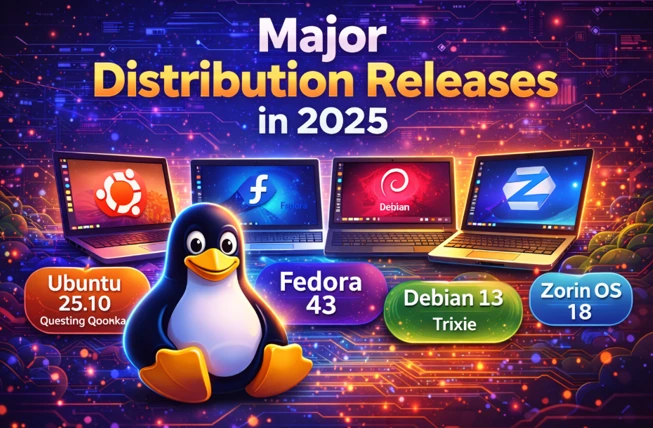
Ubuntu 25.10 “Questing Quokka” – October 2025
Ubuntu 25.10 introduced notable platform upgrades, from improved Bluetooth audio handling to expanded support for confidential computing features. Key highlights include:
Desktop Environment: The release features GNOME 49, introducing media and power controls on the lock screen, improved accessibility and HDR brightness settings. Two new applications joined the default lineup: Loupe as the modern image viewer and Ptyxis as the new terminal emulator.
Security Innovations: Ubuntu 25.10 is the first to benefit from memory-safe implementations of coreutils and sudo-rs, along with improvements in TPM-backed full disk encryption. The sudo-rs implementation, written in Rust, directly addresses a history of memory corruption vulnerabilities—the sudo vulnerability CVE-2021-3156 existed undetected from 2011 to 2021.
Kernel and Graphics: The release ships with Linux kernel 6.17, bringing unconditional SMP support, performance improvements, new SoC and platform enablement, and major updates to Intel and AMD graphics drivers.
Complete Wayland Transition: Ubuntu 25.10 no longer includes a Xorg/X11 session for the GNOME desktop, as GNOME 49 disables X11 support. X11 applications still function via XWayland.
Fedora 43 – October 2025
Fedora Linux 43 released on October 28, 2025, introducing RPM 6.0 with enhanced security focus. Major features include:
RPM 6.0 Security Enhancements: RPM 6.0 provides security enhancements like multiple key signing of packages, helping future-proof package signing as the ecosystem transitions to post-quantum-crypto OpenPGP keys.
Modern Installer: Fedora 43 features updates to Anaconda, including DNF 5 for RPM packaging installation. The Anaconda WebUI installer became the default for all Spins, providing a unified and modern installation experience.
Wayland-Only GNOME: Fedora Workstation 43 features GNOME 49 and is Wayland-only, as GNOME upstream deprecated X11 session support.
Cutting-Edge Toolchain: The release includes Python 3.14, Go 1.25, GCC 15.2, and a wealth of modern development tools that keep Fedora at the forefront of Linux innovation.
Linux Mint 22.3 “Zena” – December 2025
Linux Mint 22.3 “Zena” is the fourth and final update in the Linux Mint 22 branch, based on Ubuntu 24.04.3 LTS and supported until 2029. The release brought significant refinements:
Redesigned Menu System: Linux Mint 22.3 introduces a major revamp to the Mint Menu applet, the Cinnamon desktop’s Start Menu analog. The menu received symbolic category icons through the new XApp Symbolic Icons initiative.
New System Tools: The release includes a revamped System Information tool that makes it easier to inspect and identify system hardware capabilities and drivers. It offers new sections for USB devices, GPU details, PCI components, and BIOS information.
Improved On-Screen Keyboard: Developers rewrote Linux Mint’s on-screen keyboard to drop the use of libcaribou in favor of a native Cinnamon implementation, resulting in better aesthetics and support for input method switching.
File Manager Enhancements: Nemo now allows searching filenames using regular expressions for power users, along with a template manager for frequently used file types.
Kali Linux 2025.4 – December 2025
Kali Linux released version 2025.4 as its final update of the year, introducing three new hacking tools, desktop environment improvements, and enhanced Wayland support.
Desktop Updates: GNOME 49 includes refreshed themes, a new Showtime video player, and reorganized tool folders in the app grid. KDE Plasma was updated to version 6.5, introducing improved window tiling and enhanced screenshot tools.
Full Wayland Support: With GNOME moving to only supporting Wayland, the Kali team added full VM guest utilities support for VirtualBox, VMware, and QEMU, ensuring clipboard sharing and window scaling work seamlessly.
Zorin OS 18 – October 2025
Zorin OS 18 launched on October 14, 2025—the exact day Windows 10 reached end-of-life—positioning itself as the perfect Windows replacement. Based on Ubuntu 24.04.3 LTS and powered by Linux kernel 6.14, the release brought substantial improvements:
Redesigned Interface: The default theme features rounded corners, a floating panel design, and a reactive workspace indicator providing visual feedback for navigation. Two new theme colors—Yellow and Brown—offer additional personalization options in both light and dark variants.
Advanced Window Tiling: A powerful yet simple default window tiling manager allows users to drag windows to the screen top, revealing a pop-up layout grid for efficient workspace arrangement without memorizing keyboard shortcuts.
Windows Migration Tools: Zorin OS 18 detects over 170 Windows installers and suggests native Linux alternatives or web-based versions. OneDrive integration in the Online Accounts feature enables direct cloud file management from the Files app sidebar.
Web Apps Tool: Turn any website into a desktop application, making cloud services like Microsoft 365, Google Docs, and Adobe Photoshop accessible directly from the desktop.
Massive Adoption: Within five weeks of release, Zorin OS 18 reached 1 million downloads, demonstrating unprecedented demand from Windows 10 refugees seeking a modern, supported operating system.
Pop!_OS 24.04 LTS – December 2025
After years of development, Pop!_OS 24.04 LTS with COSMIC Desktop Environment Epoch 1 released on December 11, 2025. This release represents System76’s ambitious effort to create a completely new Rust-based desktop environment.
COSMIC Desktop Environment: Built entirely in Rust, COSMIC (Computer Operating System Main Interface Components) offers a polished desktop experience with separate views for workspaces and applications, an included dock, and support for both mouse-driven and keyboard-driven workflows.
Advanced Window Tiling: Window tiling works per workspace and per display, with slick transitions and intuitive workspace navigation. The system handles multiple applications across workspaces and displays without performance degradation.
Technical Foundation: Based on Ubuntu 24.04 LTS with Linux kernel 6.17, Mesa 25.1 graphics drivers, and NVIDIA 580 series proprietary drivers for those requiring them.
Customization Options: Desktop settings offer extensive customization including color tweaks, panel positions, dock behavior, workspace settings, and more.
Battery Management: The top panel includes a sophisticated battery applet managing power profiles, keyboard backlight, and GPU status with helpful warnings about discrete GPU battery impact and active GPU-using applications.
Pre-installed Software: Ships with Firefox, Thunderbird, LibreOffice, GNOME System Monitor, Popsicle USB creator, and other essential tools, with Flathub and System76 Flatpak repositories enabled out-of-the-box.
Artificial Intelligence Integration in Linux: A Paradigm Shift

AI Becomes Native to Linux Distributions
2025 marked the year artificial intelligence moved from external tools and cloud services to deeply integrated native features within Linux distributions themselves. This fundamental shift transformed how users interact with their operating systems, bringing intelligent assistance directly into the desktop environment.
MakuluLinux LinDoz 2025: The AI Pioneer
MakuluLinux LinDoz 2025 stands out as one of the most AI-integrated Linux distributions available, featuring the Electra AI platform that runs through 27 server connections. Unlike traditional AI models that function as standalone applications, Electra features a visual avatar with human-like voice interaction, offering:
- Text, image, audio, and video generation without relying on external providers like OpenAI
- Free and unlimited AI tools accessible to all users
- Privacy-focused architecture with processing on MakuluLinux’s own servers
- Direct competition with commercial platforms like ChatGPT
Developer Jacque Montague Raymer spent over three years integrating AI functionalities, navigating challenges of maintaining stability across different architectures while ensuring privacy and accessibility.
Deepin Linux 25: UOS AI Integration
Deepin 25 introduced UOS AI, a comprehensive artificial intelligence assistant deeply woven into the system fabric. The implementation includes:
UOS AI FollowAlong: Select any text on screen, and an AI icon instantly appears offering translation, summarization, or explanation—even working offline to remove barriers to knowledge acquisition.
Natural Language Commands: Control system functions through spoken or typed natural language. Dim the screen, create meetings, or manage files without navigating complex menus.
Dual-Mode Engine: Choose between connecting to mainstream online models like DeepSeek, Baidu Qianfan, and iFlytek Spark for cloud computing power, or install the UnionTech YouRong Large Model for complete offline operation with data kept local.
Agent Store: Download specialized agents for different fields, expanding AI’s application scenarios and personalizing the assistant to specific workflows.
Personal Knowledge Assistant: Upload documents that the system converts into a knowledge base for intelligent retrieval, content creation, and domain-specific expertise building.
Ubuntu AI and Canonical’s MLOps Platform
Canonical’s Ubuntu AI builds on the popular Ubuntu platform to deliver an AI-ready environment with preinstalled frameworks including TensorFlow, PyTorch, and Scikit-learn. The distribution offers:
- GPU support optimized for NVIDIA CUDA and AMD ROCm
- Snap packages for simplified AI tool installation and updates
- Containerized environments for safer AI model deployment
- Ubuntu AI Edge: A lightweight variant designed for IoT and mobile AI applications
- Integration with JupyterLab and MLflow for managing ML pipelines
Charmed Kubeflow serves as Canonical’s end-to-end MLOps platform designed to run AI at scale, seamlessly integrating with big data and machine learning tools. The platform includes Charmed MLFlow for experiment tracking and model catalogue management.
Fedora AI: The Innovation Leader
Fedora AI 2025 emerged as a cutting-edge choice for AI research and enterprise workloads. Key features include:
- Latest AI libraries maintained at the bleeding edge
- Strong containerization support through Docker and Podman
- Optimized machine learning toolchains
- Open Neural Network Exchange (ONNX) support for framework interoperability
- Hardware acceleration libraries including oneAPI for Intel-based systems
- Quantum AI Toolkit for experimenting with quantum machine learning
Pop!_OS AI Enhancements
System76 incorporated AI optimizations into Pop!_OS, though full AI integration remains limited compared to MakuluLinux and Deepin. The distribution focuses on:
- LLM optimization for improved fine-tuning and inferencing performance
- Enhanced NVIDIA Tensor Core utilization
- Cloud integration with GCP and AWS for scalable AI workloads
- Performance tweaks specifically targeting large language model workflows
Linux Foundation’s Agentic AI Foundation (AAIF)
In December 2025, the Linux Foundation announced the formation of the Agentic AI Foundation (AAIF), bringing together major tech companies including Amazon Web Services, Anthropic, Block, Bloomberg, Cloudflare, Google, Microsoft, and OpenAI as platinum members.
The foundation launched with three flagship projects:
Model Context Protocol (MCP): Donated by Anthropic, MCP became the universal standard protocol for connecting AI models to tools, data, and applications. The protocol has been adopted by Claude, Cursor, Microsoft Copilot, Gemini, VS Code, ChatGPT, and other major AI platforms.
goose: Block’s contribution—an open-source, local-first AI agent framework combining language models, extensible tools, and standardized MCP-based integration.
AGENTS.md: OpenAI’s simple, universal standard giving AI coding agents consistent project-specific guidance. The markdown-based convention has already been adopted by over 60,000 open-source projects and agent frameworks.
AI-Powered Development Tools on Linux
The Linux ecosystem saw explosive growth in AI-powered development tools:
- Cursor.sh: An AI-first code editor designed to enhance coding efficiency and accuracy
- ChatALL: A platform for building and integrating various chatbot types
- AgentGPT: Scalable backend for automating workflows in enterprise environments
- Fastai: Built on PyTorch, delivering flexibility and abstraction for AI workflows
- DeepSeek: Chinese AI company developing open-source large language models
Local AI Model Deployment
Linux users gained unprecedented access to local AI model deployment, providing free alternatives to commercial services. Tools like Ollama, LM Studio, and Jan.ai enabled users to run powerful language models entirely on their own hardware, addressing privacy concerns and reducing cloud dependency.
Why it matters: Linux distributions in 2025 increasingly integrate AI tooling at the OS level, reducing setup time for developers and accelerating local and enterprise AI workflows.
The AI Security Paradigm
AI integration introduced new security considerations. Distributions implementing local AI models emphasized privacy, keeping data processing on-device rather than sending sensitive information to cloud services. The shift toward Rust-based AI implementations also improved memory safety in AI-adjacent system components.
Looking Forward: AI-Native Operating Systems
The groundwork laid in 2025 positions Linux as the leading platform for AI-native computing. With major distributions integrating AI assistants, development tools maturing, and open standards emerging through AAIF, Linux established itself as the premier operating system for both AI development and AI-enhanced daily computing.
The Rust Revolution in System Components
Memory Safety Becomes a Priority
2025 marked the year when Rust-based system components moved from experimental to mainstream in major Linux distributions. This transition addresses decades of memory safety vulnerabilities that have plagued C-based utilities.
Ubuntu’s Rust Implementation: Ubuntu 25.10 defaults to sudo-rs, a Rust implementation of sudo, changing directly addresses a history of memory corruption vulnerabilities in security-critical code. The distribution also includes Rust-based coreutils implementations.
Kernel Integration Debates: Linus Torvalds mentioned in private communications that he would override maintainer vetoes on Rust code within the kernel, signaling strong support for Rust integration despite some developer concerns about long-term maintainability.
The move to memory-safe implementations represents a fundamental shift in how the Linux ecosystem approaches security, preventing entire categories of bugs at compile time rather than runtime.
Linux Kernel Development in 2025
Major Kernel Releases
Linux 6.17: This kernel version brought substantial improvements across the board:
- Unconditional SMP support for better multicore performance
- Enhanced hardware support for Intel Panther Lake and Wildcat Lake platforms
- AMD SmartMux hybrid GPU support
- Snapdragon X laptop compatibility
- Improved storage performance with Btrfs large folio support
Linux 6.18: Linux 6.18 includes support for PSP encryption of TCP connections, a new encryption scheme offering superior hardware offload capabilities compared to IPsec and TLS. The release also improved kernel slab memory allocation performance and UDP received performance.
Notable Kernel Controversies
Linus Torvalds expressed frustration over “disgusting” testing code in the DRM drivers for Linux 6.15, particularly unhappy with hdrtest testing code that needed to “die” from the perspective of non-DRM driver developers.
Bcachefs was dropped from the kernel in 2025, though changes were eventually merged back for Linux 6.16 before the file system’s future with the kernel remained uncertain.
Enterprise Linux Developments
Red Hat Enterprise Linux Momentum
Red Hat Enterprise Linux leads enterprise deployments with 43.1% market share in managed environments. SUSE Linux Enterprise Server gained 11.2% traction, especially in manufacturing and retail sectors.
Server Dominance Continues
Linux powers 44.8% of all server operating systems and 59.2% of websites with identifiable operating systems. In supercomputing, Linux maintains absolute dominance—100% of systems on the TOP500 supercomputer list run Linux since November 2017.
Distribution Market Share Breakdown
Note: Market share figures are aggregated estimates based on web analytics, surveys, and distro usage reports. Exact numbers may vary by source.
Ubuntu leads all Linux distributions with a 33.9% market share among Linux users, making it the most widely used Linux OS. Its dominance extends to development environments, with 27.8% of developers in the Stack Overflow Survey 2025 using Ubuntu for both personal and professional work.
Zorin OS experienced explosive growth in Q4 2025, reaching 1 million downloads in just five weeks following the Windows 10 end-of-support date. Pop!_OS gained significant attention with its COSMIC desktop environment release, attracting users interested in Rust-based, modern desktop experiences.
Community and Developer Demographics
The 25-34 age group makes up the largest share of Linux users at 21.15%, showing strong engagement among younger professionals. Users aged 18-24 follow at 17.95%, indicating growing interest among students and early-career tech users.
Approximately 78.5% of developers globally use Linux as either a primary or secondary operating system across their workflows, according to the Stack Overflow Developer Survey 2025.
IoT and Embedded Linux Expansion
Raspberry Pi OS, a Debian-based Linux variant, reached 10.2 million active devices in 2025. Linux’s presence extends far beyond traditional computing:
- Smart TVs: 61.3% of global unit sales run Linux-based systems like Tizen and webOS
- Automotive: 32.4% of new vehicles globally use Linux solutions like AGL and GENIVI
- Industrial Automation: Linux-based PLCs represent 33.1% of new systems deployed
- Smart Home: 44.6% of the US market consists of Linux-based devices
- Edge AI: 71.9% of edge inference workloads run on Linux
New and Notable Distributions in 2025
Obsidian Linux
Obsidian introduced an A/B partitioning system on ext4, where two root partitions store system files and updates install on one partition while the other remains untouched. This completely redefines update rollbacks and system recovery, addressing Arch Linux’s reputation for instability. The system automatically switches between partitions during updates, ensuring users can always boot into a working system.
Omarchy
Created by David Heinemeier Hansson (creator of Ruby on Rails and Basecamp), Omarchy represents a curated Linux experience targeting developers who want a production-ready system without extensive configuration. The distribution emphasizes sensible defaults and streamlined workflows for professional software development.
COSMIC Desktop Becomes Reality
System76’s COSMIC Desktop Environment reached Epoch 1 (version 1.0) in December 2025, debuting in Pop!_OS 24.04 LTS. The completely Rust-written desktop environment represents a multi-year effort to create a modern, secure, and performant alternative to GNOME and KDE, with plans for adoption beyond Pop!_OS.
MakuluLinux Innovations
MakuluLinux continued its AI-first approach with LinDoz 2025, positioning itself as one of the most innovative distributions in the AI-native computing space. The distribution’s Electra AI platform demonstrates what’s possible when artificial intelligence is designed into the operating system from the ground up rather than bolted on afterward.
KDE Linux (In Development)
KDE announced plans for an official KDE Linux distribution based on Arch Linux, designed to offer advanced yet stable KDE Plasma experiences with official compatibility support from hardware partners. While still in development as of late 2025, the project signals KDE’s commitment to providing a reference implementation of their desktop environment.
Security and Compliance Advances
TPM-Backed Encryption Maturity
The TPM-backed Full Disk Encryption implementation matured considerably in 2025, though it remains experimental. New capabilities include passphrase support with proper management interfaces, recovery key regeneration, and better integration with firmware updates.
Post-Quantum Cryptography Preparation
The Linux ecosystem began preparing for post-quantum cryptography threats. RPM 6.0’s support for OpenPGP v6 keys and signatures, including post-quantum cryptography algorithms, positions Linux distributions ahead of the security curve.
Cloud and Containerization Evolution
Fedora CoreOS is now buildable from a Fedora base bootc image using a Containerfile, instead of needing composition with a custom tool. This means anyone with Podman can build Fedora CoreOS images through standard CI/CD automation.
The container-native approach continues to reshape how Linux systems are deployed and managed, with bootc and image-based updates becoming increasingly prevalent across distributions.
The Wayland Transition Completes
2025 marked the year when major distributions completed their Wayland transitions:
- Ubuntu 25.10: Removed X11 session entirely for GNOME
- Fedora 43: Wayland-only for GNOME Workstation
- Kali Linux 2025.4: Full VM guest support for Wayland
- GNOME 49: Deprecated X11 support upstream
The transition brings tangible benefits: smoother animations, reduced screen tearing through triple buffering, better hardware compatibility for hybrid graphics, and improved security through better application isolation.
Linux Market Projections
The Linux operating system market is projected to grow from $21.97 billion in 2024 to $99.69 billion by 2032 at a 20.9% compound annual growth rate. This explosive growth reflects Linux’s expanding role beyond traditional computing into cloud, edge, IoT, and automotive sectors.
Environmental and Sustainability Impact
The Windows 10 end-of-support situation highlighted Linux’s role in reducing electronic waste. The End of 10 campaign emphasized the environmental impact of premature hardware replacement, positioning Linux adoption as a solution to reduce electronic waste.
With potentially millions of Windows 10 PCs facing obsolescence despite remaining functionally capable, Linux offers a sustainable alternative that extends hardware lifecycles by years, if not decades.
Looking Ahead: The Year of the Linux Desktop?
After decades of being dismissed as a meme, “The Year of the Linux Desktop” finally feels achievable. The convergence of multiple factors—Windows 10 end-of-support, hardware compatibility issues with Windows 11, improved Linux usability, robust gaming support, and growing privacy concerns—created the perfect storm for Linux adoption.
According to the U.S. government’s Digital Analytics Program tracking over 5,000 federal websites, GNU/Linux crossed the 6% threshold in desktop usage as of August 2025. When including Android (16.2%) and ChromeOS (0.8%), Linux-kernel based systems account for 23% of visitors to U.S. federal websites—more than macOS.
The momentum is undeniable. Linux has evolved from a hobbyist’s playground into a pragmatic, often necessary option for people who want control, privacy, and longer device lifetimes. The community has matured, the software has polished, and the timing has aligned perfectly.
Conclusion
Linux in 2025 represents a historic turning point for open-source computing. The operating system achieved what many thought impossible: breaking through the 5% desktop market share barrier in the United States, welcoming millions of Windows 10 refugees, and establishing itself as a legitimate mainstream alternative to proprietary platforms.
This year brought transformative changes across every dimension. Artificial intelligence moved from external tools to native operating system features through innovations like MakuluLinux’s Electra AI and Deepin’s UOS AI. The Rust revolution addressed decades of security vulnerabilities in critical system components. Major distributions completed the Wayland transition, marking the end of the X11 era. COSMIC Desktop Environment reached 1.0, proving that modern, Rust-based desktop environments can compete with established alternatives.
The numbers speak volumes: global market share reached 4.7%, gaming adoption hit 3.20% on Steam, and developer usage stands at 78.5%. The Linux operating system market is projected to grow from $21.97 billion in 2024 to $99.69 billion by 2032. These aren’t just statistics—they represent millions of people choosing freedom, security, and control over their computing experience.
As we close out 2025, Linux stands not as an alternative for enthusiasts, but as a mature platform ready for mainstream adoption. The question is no longer “if” but “when” Linux will surpass 10% desktop market share. Based on this year’s trajectory, that milestone may arrive sooner than anyone expected.
Disclaimer
This article contains information based on publicly available data and industry reports as of December 2025. Market statistics, version numbers, and feature details are subject to change. Readers should verify specific information from official distribution websites before making decisions.
Also Read
PorteuX 2.5 Review: A Minimal Linux Distro That Still Feels Modern