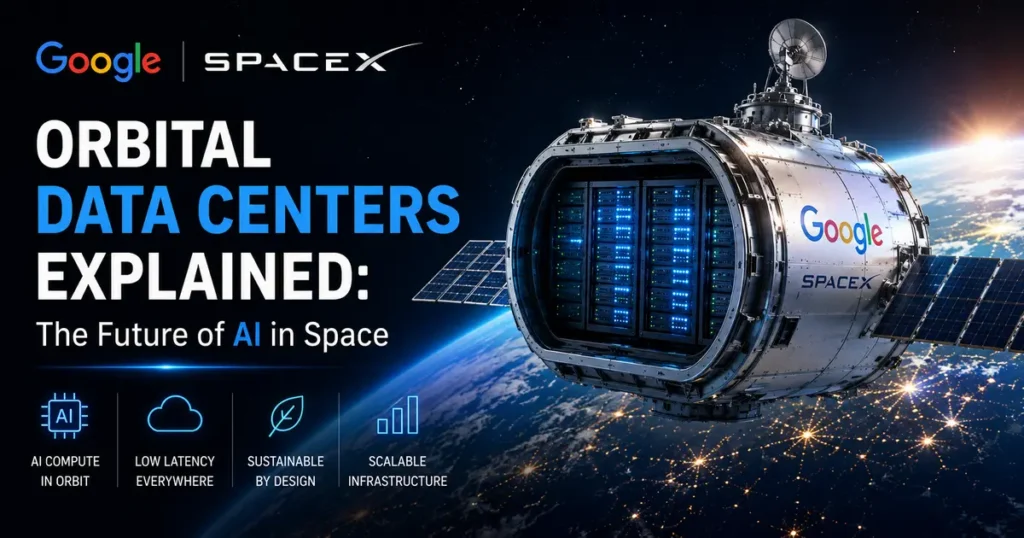
Something extraordinary is quietly taking shape above our heads. In what could turn out to be the most significant infrastructure shift since the birth of cloud computing, Google and SpaceX are reportedly in serious discussions to move artificial intelligence computing hardware out of server farms on Earth and into low-Earth orbit. The story of Google SpaceX orbital data centers explained in full is one that touches on big money, energy constraints, geopolitical ambition, and the raw physics of running a supercomputer in the vacuum of space — and it is unfolding right now.
This article breaks down what we know so far, why it matters, what makes it technically complicated, and who else is chasing the same prize.
What the Reports Actually Say
The talks were first reported by The Wall Street Journal, which cited sources familiar with the matter. According to those reports, Google is in active discussions with SpaceX — and separately with other rocket launch providers — about putting AI computing hardware into orbit.
The timing is not accidental. SpaceX is preparing for what could be the largest IPO in US history, with analysts targeting a valuation somewhere between $1.75 trillion and $2 trillion. A confirmed partnership with Google would dramatically reinforce SpaceX’s pitch to investors that orbital AI infrastructure is a genuine near-term business, not a distant science-fiction fantasy.
For Google’s part, the company is not simply waiting around for SpaceX to solve the problem. It has been quietly building toward this moment through an internal initiative that is now getting serious attention.
What Is Google’s Project Suncatcher?
Project Suncatcher is Google’s internal moonshot programme aimed at determining whether large-scale machine-learning systems can operate sustainably in orbit. CEO Sundar Pichai formally announced it in late 2025, and it represents the most concrete step any major tech company has taken toward actually deploying AI compute hardware in space.
Here is what the project involves:
- Prototype satellites: Google has partnered with San Francisco-based satellite manufacturer Planet Labs to design and launch two test satellites by early 2027. These will carry Google’s custom Tensor Processing Units (TPUs) — the same chips the company uses to power Gemini and other AI models on the ground.
- Laser-based communications: The prototype phase is designed to test not just compute performance but also whether satellites can exchange data with each other and with the ground using high-speed laser links.
- 81-satellite constellation vision: If the prototypes succeed, Google envisions scaling up to a cluster of 81 satellites that would form a high-speed orbital extension of its existing terrestrial data centre infrastructure.
- Dawn-dusk sun-synchronous orbit: The proposed constellation would fly in a dawn-dusk orbit, which keeps satellites bathed in near-continuous sunlight — critical for an energy strategy built around uninterrupted solar power.
Google is not relying solely on SpaceX for launch support. The company has been speaking with multiple rocket providers simultaneously, keeping its options open as the commercial launch market grows more competitive.
Why Would Anyone Put a Data Centre in Space?
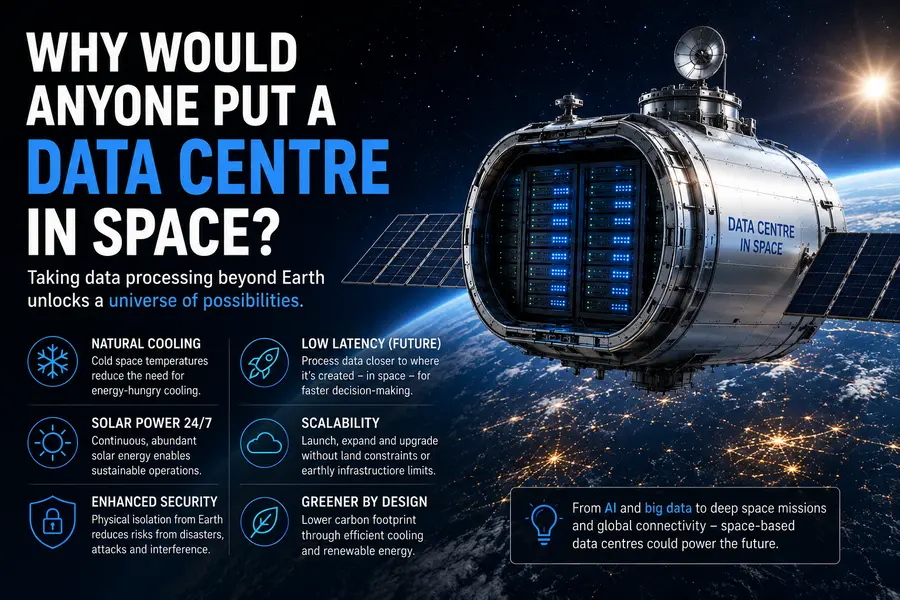
To understand why a company like Google would seriously entertain this idea, you have to understand just how severe the AI infrastructure crunch has become on the ground.
The Energy and Land Problem Is Real
The numbers behind modern AI are staggering. Training frontier models now consumes energy at levels that rival small cities. According to the International Energy Agency (IEA), data centre electricity consumption is projected to surpass 1,000 terawatt-hours by the end of 2026. Meta, Amazon, Microsoft, and Alphabet collectively signalled roughly $725 billion in capital expenditure for 2026 — almost entirely for data centres, custom chips, and GPUs. That represents a roughly 75% increase over the previous year.
And yet, building new data centres on Earth is getting harder, not easier:
- Power grids are maxed out. Key data centre hubs in Northern Virginia, the Nordics, and Singapore are bumping against hard limits on available grid capacity.
- Water is becoming scarce. Conventional data centres consume enormous volumes of water for cooling. Communities increasingly push back against new builds on environmental grounds.
- Local opposition is intensifying. Planning permission for large facilities is being contested in more regions, slowing expansion timelines significantly.
- Land constraints are tightening. Prime locations near fibre corridors and power infrastructure are increasingly expensive and difficult to secure.
Orbital infrastructure, in theory, sidesteps most of these problems in one move.
The Case for Space
Satellites in low-Earth orbit enjoy several compelling natural advantages for compute workloads:
- Continuous solar power. In a properly chosen orbit, satellites can access unfiltered sunlight for the large majority of each orbit, with no atmosphere scattering energy away and no weather interrupting supply.
- Radiative cooling. In the vacuum of space, waste heat can be radiated directly into the cosmic background — no water, no cooling towers, no fans required. The engineering challenge is building radiators large enough, but the physics is favourable.
- No local opposition. A satellite cluster above the Pacific Ocean cannot be blocked by a neighbourhood planning committee.
- Global coverage. A constellation can route workloads to wherever compute capacity is available, in real time, across the entire planet.
SpaceX’s Role: More Than Just a Rocket Company
SpaceX’s involvement in this story goes well beyond being a taxi service for Google’s hardware. Elon Musk has been positioning SpaceX as the foundational infrastructure provider for the next era of AI, and several recent moves underscore how serious that ambition has become.
The xAI Merger
In February 2026, SpaceX completed a landmark merger with xAI — the AI company Musk founded — in a deal that valued the combined entity at approximately $1.25 trillion. With that, xAI’s computing assets, including the massive Colossus 1 supercomputer cluster in Memphis, Tennessee, became part of SpaceX’s portfolio. Musk subsequently folded xAI’s AI products into a new division called SpaceXAI.
The Colossus 1 facility houses over 220,000 Nvidia GPUs and delivers 300 megawatts of computing power. It is already being made available to third parties: Anthropic recently committed to accessing that capacity, with both companies floating the possibility of eventually extending that partnership to orbital infrastructure as well.
The Million-Satellite FCC Filing
In January 2026, SpaceX filed an application with the Federal Communications Commission to add up to one million satellites to its existing constellation — explicitly to support orbital data centre ambitions. SpaceX currently operates roughly 9,500 Starlink satellites, meaning this filing envisions a constellation roughly a hundred times larger than what exists today.
The architectural idea behind the filing is elegant. Rather than attempting to build a single, enormous orbital data centre (which would face crushing thermal and structural challenges), the plan distributes compute workloads across a vast number of smaller satellites, each handling a manageable heat load. The cooling problem does not disappear, but it becomes tractable by refusing to concentrate it in one place.
Launch Economics: The Critical Variable
The single biggest barrier to orbital data centres is not technology — it is cost per kilogram to orbit. As of February 2026, SpaceX’s standard rideshare pricing sat at approximately $7,000 per kilogram. Google’s own internal analysis for Project Suncatcher places the financial equilibrium for space-based computing at around $200 per kilogram — a figure that is not even in the same order of magnitude as today’s rates.
However, SpaceX’s reusable Falcon 9 rockets are steadily driving that number down. One Falcon 9 booster recently completed its 34th flight, and analysts believe that once a booster has flown five to six times, the original production cost has been effectively amortised. Beyond that point, the primary costs are fuel, maintenance, and launchpad utilisation. SpaceX completed 165 orbital launches in 2025 — more than every other launch provider on Earth combined. If Starship reaches full operational reusability at its target cost of roughly $10 to $20 per kilogram, the economic picture for orbital compute changes fundamentally.
The Companies Already Flying
While the Google-SpaceX discussions are still at the negotiation stage, one company has already started proving the concept works in practice.
Starcloud (formerly Lumen Orbit) launched the first high-powered GPU into orbit in November 2025 — an Nvidia H100 that represented approximately 100 times more compute than had ever previously operated in space. In December, Starcloud became the first company to run a large language model in orbit (Google’s open-source Gemma model) and the first to perform in-orbit LLM training. By March 2026, it had raised $170 million at a $1.1 billion valuation — reportedly the fastest path to unicorn status in Y Combinator’s history. Its next satellite is targeting 200 kilowatts of power capacity.
Amazon and Blue Origin have also discussed orbital data centre ambitions over the past year, though no concrete commitments have been announced. Amazon’s cloud division leadership has publicly stated that orbital data centres are “nowhere close” to being practical at present — a view that simultaneously reflects genuine scepticism and competitive positioning.
The Real Engineering Challenges
The enthusiasm is real, but so are the obstacles. Anyone presenting this as a solved problem is getting ahead of the facts.
Radiation Exposure
Processors in low-Earth orbit are bombarded by cosmic radiation and charged particles in ways that ground-based hardware never experiences. This causes bit-flip errors — where a single high-energy particle can flip a memory bit from a 0 to a 1 — and over time, it causes permanent circuit damage. Conventional radiation-hardened chips that are certified for space use typically lag multiple generations behind the latest commercial processors in performance. Achieving the level of compute density needed for frontier AI workloads, using radiation-tolerant hardware, is an unsolved engineering challenge.
One approach is to accept higher failure rates and design the system for graceful degradation, routing around failed nodes and replacing them frequently. This works if SpaceX can drive launch costs low enough that continuous replenishment is economically viable.
The Cooling Problem
In space, there are no fans and no liquid cooling loops drawing on nearby rivers or aquifers. Waste heat must be expelled by radiation alone, through large flat panels that emit infrared energy into space. The challenge is scale: analysis of the thermal requirements for even a one-gigawatt orbital facility suggests it would require hundreds of thousands of square metres of radiator panels — an engineering undertaking that is theoretically possible but economically brutal at today’s launch costs.
SpaceX’s distributed-constellation approach helps by breaking this problem into smaller pieces spread across many satellites, each handling a fraction of the total thermal load.
Hardware Obsolescence
GPU performance roughly doubles every two years. On the ground, data centres can cycle in new hardware on a rolling basis. In orbit, every hardware upgrade requires a new launch, a docking procedure, or a satellite replacement. An Nvidia H100 launched in 2026 would be three or four generations behind the leading-edge processor by the time the satellite reaches the end of its operational life, which is typically five to six years. Investors and operators need to price in a much faster depreciation curve for orbital compute assets than for terrestrial ones.
Latency
Orbital servers are not in the same place as the users querying them. Round-trip latency from a low-Earth-orbit satellite to a ground station and back adds milliseconds to every interaction. For most AI batch processing workloads — model training, large-scale inference jobs, scientific simulation — this does not matter. For real-time consumer applications requiring immediate responses, it remains a meaningful constraint.
What This Means for the Broader AI Race
The Google-SpaceX talks are not happening in isolation. They reflect a structural shift in how the technology industry thinks about the infrastructure layer beneath AI.
The race for AI compute is no longer primarily about who has the best model architecture or the most talented researchers. Increasingly, it is a battle over physical infrastructure, energy access, and who controls the next generation of computing capacity. The companies that secure abundant, affordable compute — wherever that compute physically lives — will have a decisive advantage in the decade ahead.
Seen in that light, the discussion about putting servers in orbit is less exotic than it first appears. It is, at its core, a very old story about competitive advantage through infrastructure ownership — just relocated 300 miles above the Earth’s surface.
SpaceX’s IPO narrative depends heavily on demonstrating that its launch and satellite capabilities can anchor a multi-trillion-dollar new market in space-based compute. A confirmed partnership with Google would validate that narrative in the clearest possible terms. For Google, the appeal is hedging against the real and growing constraints on terrestrial data centre expansion, while also potentially owning a first-mover advantage in a computing paradigm that no one has fully figured out yet.
What Happens Next
Several developments will determine how quickly this story moves:
- Project Suncatcher prototypes (early 2027): The two Planet Labs satellites carrying Google TPUs will be the most concrete test yet of whether space-based AI compute works as intended. Their performance data will inform whether Google pursues the full 81-satellite constellation.
- SpaceX IPO (mid-2026): The public offering will crystallise how investors value the orbital data centre narrative and could accelerate or constrain SpaceX’s investment in the infrastructure needed to make it real.
- Starship operational cadence: The economics of everything described in this article depend on Starship achieving the launch frequency and cost targets SpaceX has promised. Progress on that front will be the single most important variable to watch.
- Regulatory approvals: SpaceX’s FCC filing for one million additional satellites will go through an extended review process. How that proceeds will shape the possible scale of the orbital compute market.
- Competing announcements: With Amazon, Meta, and others circling the same concept, it is likely that additional major partnerships or unilateral programmes will be announced before the end of 2026.
Final Thoughts
The idea of running AI workloads from satellites orbiting 300 miles above the Earth still sounds, on first hearing, like something out of a science fiction novel. But the conversations now happening between some of the most well-resourced technology companies in the world suggest it is moving, steadily and seriously, toward becoming an engineering and commercial reality.
The energy constraints, grid limitations, and community opposition that are slowing data centre construction on the ground are genuine and worsening. The advantages of orbital solar power and space-based cooling are real. The launch economics, while not yet viable at the scale required, are trending in the right direction, driven primarily by SpaceX’s reusability programme.
What Google, SpaceX, and the rest of the industry are attempting will not happen overnight. There will be failed prototypes, revised cost estimates, and engineering surprises that nobody has anticipated yet. But if the Suncatcher satellites perform as hoped, and if Starship delivers on its cost targets, the infrastructure layer beneath the next generation of AI may turn out to be something you can see from your backyard on a clear night — a string of lights moving silently across the dark, carrying the computations that define modern life.
Disclaimer
This article is based on media reports and publicly available information at the time of publication. The discussions between Google and SpaceX regarding orbital data centers have not been officially confirmed by either company. Details, timelines, and partnerships mentioned are subject to change. This content is intended for informational purposes only and should not be taken as financial or investment advice.