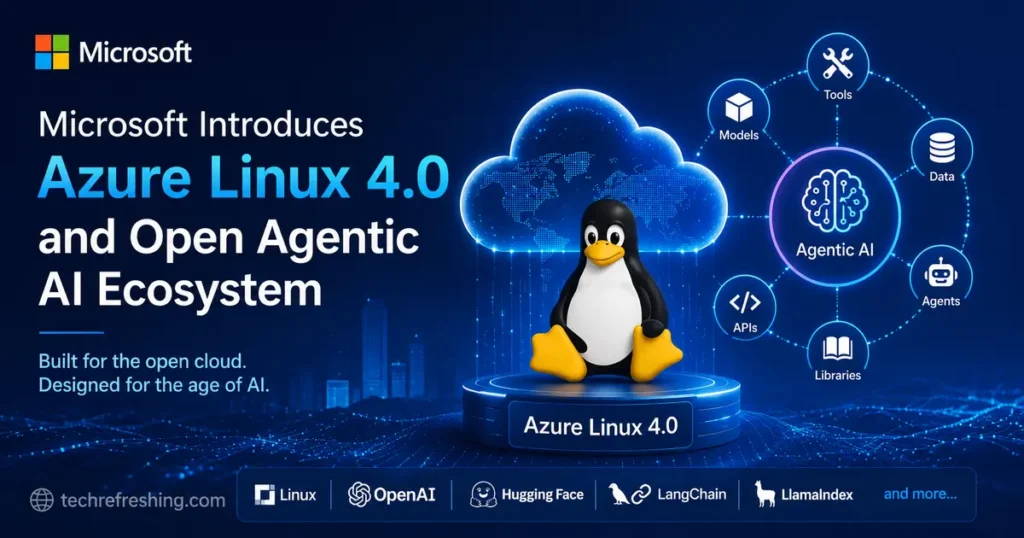
Open source has always been the engine underneath the cloud. Now it’s becoming the engine underneath AI — and Microsoft just made one of its biggest bets on that future. At Open Source Summit North America 2026 in Minneapolis, Microsoft Introduces Azure Linux 4.0 and Open Agentic AI Ecosystem initiatives that collectively redefine how developers build, deploy, and secure AI-native workloads. This isn’t incremental progress. It’s a fundamental shift in how Microsoft is thinking about the next chapter of cloud computing.
Let’s break down everything that was announced, why it matters, and what it means for developers and organizations building on Azure today.
What Is Azure Linux 4.0 and Why Does It Matter?
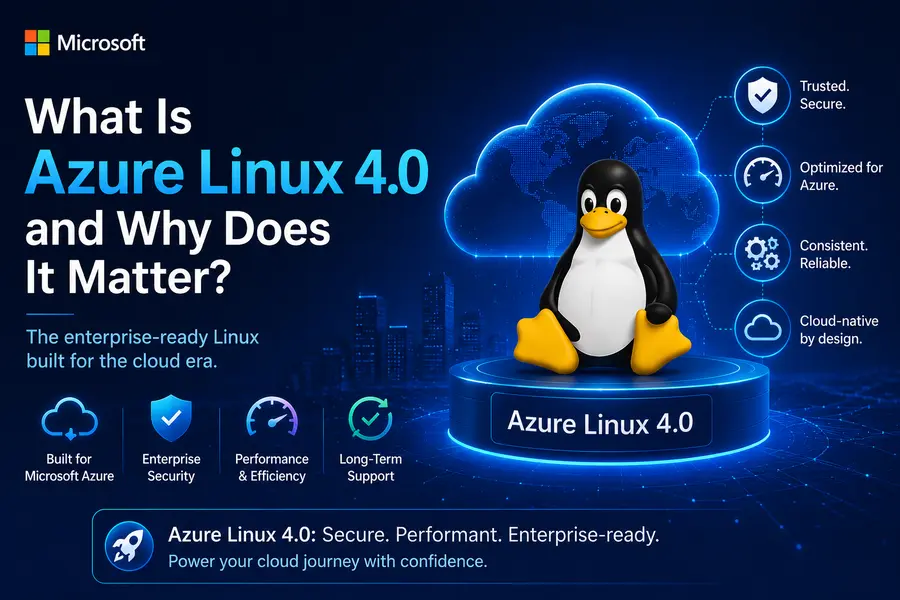
Azure Linux isn’t a new name, but version 4.0 raises the bar significantly. Microsoft announced the upcoming public preview of Azure Linux 4.0 on Azure Virtual Machines, alongside the general availability of Azure Container Linux — an immutable, container-optimized operating system purpose-built for cloud native and AI workloads.
The broader rollout is tied to Microsoft Build on June 2, 2026, making this one of the most significant infrastructure announcements heading into the summer.
So what makes Azure Linux 4.0 different from what came before?
Built for AI Workloads from the Ground Up
The core design philosophy here is that the OS layer should essentially be invisible to developers — secure by default, consistent across hosts and containers, and out of the way. That’s a deceptively ambitious goal when you’re dealing with the scale of AI training clusters and inference endpoints serving billions of tokens per day.
Azure Linux 4.0 and Azure Container Linux share a few key characteristics:
- Hardened security posture with a significantly reduced package footprint
- Transparent supply chain so teams know exactly what’s in their OS
- Consistent performance from the host layer all the way up to the container
- Smaller attack surface ideal for regulated and security-sensitive workloads
- Maintained by the same team that operates the Azure cloud itself
That last point is worth sitting with. When the team building the OS is the same team running the cloud it runs on, you get a level of operational alignment that’s genuinely hard to replicate. Security patches, performance tuning, and compatibility guarantees aren’t managed across organizational seams — they’re owned end to end.
Azure Container Linux: Immutable and Container-Optimized
Azure Container Linux is now generally available, representing a maturation of Microsoft’s immutable OS strategy. Immutable operating systems have become a best practice in production Kubernetes environments because they eliminate configuration drift, reduce the blast radius of misconfigurations, and make rollbacks far more predictable.
For teams already running Kubernetes on AKS, Azure Container Linux is the logical foundation — hardened, minimal, and maintained upstream.
The Scale That Makes This All Necessary
Context matters here. These aren’t theoretical improvements for future workloads — they’re responses to real-world scale that most people still find staggering.
According to Brendan Burns, Corporate Vice President and Technical Fellow at Microsoft, more than two-thirds of customer cores in Azure run Linux. The platforms powering Microsoft 365, GitHub, and OpenAI’s ChatGPT all run on Linux foundations.
When ChatGPT scales across more than 10 million compute cores worldwide and serves a billion queries a day, Linux and Kubernetes are what hold it all together. Azure Linux 4.0 is designed to be the foundation that scales alongside those kinds of numbers — without introducing the operational complexity that typically comes with growth at that level.
Microsoft’s open source journey goes back further than most people realize. In 2009, the company contributed more than 20,000 lines of Hyper-V driver code to the Linux kernel — a small patch at the time, but a clear early signal of where things were headed.
Building an Open Agentic AI Ecosystem: The Bigger Picture
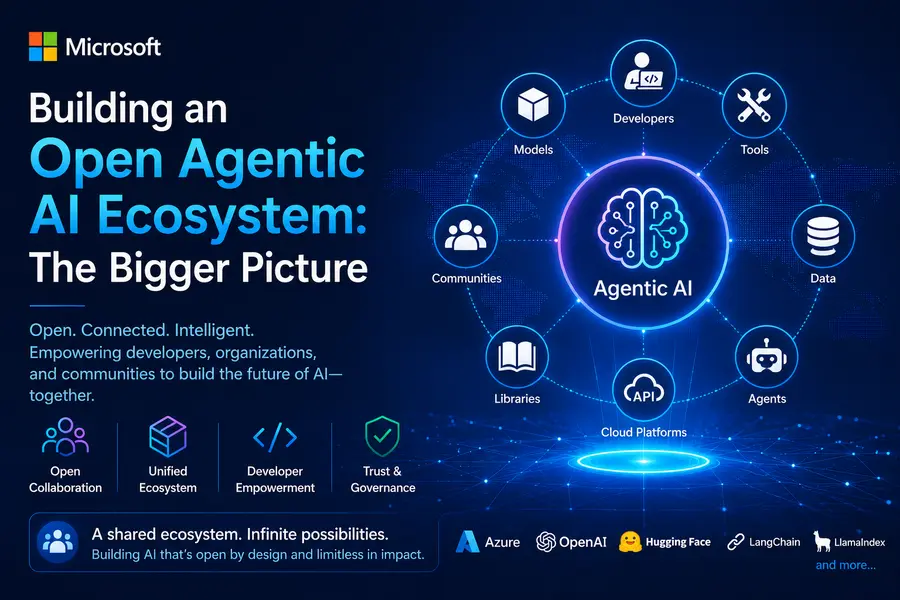
The OS announcements are important, but they’re really the foundation layer for something much larger. Microsoft’s keynote at Open Source Summit was titled From Open Source to Agentic Systems: Building the AI Native Era — and that framing tells you everything about the strategic direction.
The thesis is straightforward: the move from cloud native to AI native is the next major evolution of open source. Just as Linux, Kubernetes, and containers built the cloud era, open standards and shared community infrastructure will build the agentic era. But this only works if the foundations are open — not locked inside any single vendor’s stack.
The Microsoft Agent Framework
At the center of Microsoft’s agentic strategy is the Microsoft Agent Framework, an open-source SDK and runtime specifically designed for building, deploying, and managing multi-agent systems.
This framework carries forward the lessons learned from two earlier projects: Semantic Kernel and AutoGen. Rather than maintaining two separate tracks, Microsoft has brought them together into a single foundation that:
- Maps cleanly from local development to cloud deployment
- Includes built-in observability, evaluation, and lifecycle management
- Provides the primitives that production multi-agent systems actually need
If you’ve worked with either Semantic Kernel or AutoGen, the Agent Framework is worth paying close attention to. It’s designed for the scale and reliability expectations of enterprise production environments, not just research prototypes.
Ray and NVIDIA Dynamo Integrations
Microsoft isn’t trying to own the entire agentic stack — and that’s actually what makes the approach credible. Two key partnerships announced as part of this ecosystem:
- Ray — the widely adopted open framework for distributed AI workloads — is being integrated so agents and AI workloads can compose naturally across the ecosystem.
- NVIDIA Dynamo on AKS — enabling autoscaling LLM inference for production AI deployments on Azure Kubernetes Service.
These aren’t just logo partnerships. The goal is genuine interoperability so that developers using Ray today don’t have to abandon their existing infrastructure to plug into Microsoft’s agentic tooling.
Agent-to-Agent (A2A) Protocols
One of the more forward-looking pieces of this announcement is the work on A2A (agent-to-agent) protocols — open interfaces that allow agents from different vendors, frameworks, and clouds to communicate, delegate tasks, and coordinate with each other.
This is the kind of infrastructure that doesn’t get headlines but absolutely determines whether the agentic ecosystem becomes open or fragmented. Without shared communication standards, you end up with a dozen incompatible agent ecosystems that can’t talk to each other — the same problem that plagued early web services before REST emerged as a de facto standard.
Agent Governance Toolkit
Perhaps the most practically urgent piece of the open agentic stack is the Agent Governance Toolkit, which provides the control-plane primitives organizations need to deploy agents responsibly:
- Identity — who or what is this agent?
- Policy — what is it allowed to do?
- Audit — what has it done, and when?
- Access boundaries — what data and systems can it reach?
The analogy Microsoft draws here is instructive: just as Kubernetes needed RBAC and admission controllers before enterprises would trust it with production workloads, agentic systems need governance primitives before they can be trusted with consequential decisions. The Agent Governance Toolkit is open source specifically because these primitives belong to the community, not any single vendor.
The Agentic AI Foundation: An Open Standards Body for Agents
Perhaps the most significant organizational announcement is that Microsoft is a founding member of the Agentic AI Foundation (AAIF), which has already become the fastest-growing project in Linux Foundation history.
The AAIF’s mission is establishing open standards for:
- Agent-to-agent communication
- Agent runtimes
- Agent orchestration
The AAIF is explicitly designed to complement what the Cloud Native Computing Foundation (CNCF) has done for cloud native infrastructure — and the two are built to work together, not compete. The speed of adoption signals how urgently the ecosystem wants this to be open. Customers building multi-agent systems don’t want to bet their entire agentic infrastructure on a single vendor’s proprietary stack. Open standards are the protection against that kind of lock-in, and the AAIF is how that protection gets institutionalized.
Securing the Open Source Supply Chain for AI
Agentic systems are only as trustworthy as their dependencies. As agents become more autonomous and start touching critical systems, every package, library, and runtime they rely on becomes part of their trust boundary. That’s a serious security challenge — and it’s one that Microsoft is investing in substantially.
OpenSSF and Alpha-Omega Investment
Microsoft has made a multi-phase investment in OpenSSF (Open Source Security Foundation) and Alpha-Omega:
- An initial kick-start investment to seed Alpha-Omega’s mission of improving security across critical open source software through expert engagement and automated security testing.
- A second round of funding specifically to scale AI-powered open source security solutions — using agentic capabilities to harden the supply chain itself.
This is a meaningful loop: the same agentic tools being built for developers are being turned inward to protect the open source ecosystem those tools depend on.
GitHub Secure Open Source Fund
Microsoft is also a founding partner in the GitHub Secure Open Source Fund, which takes a refreshingly human-centered approach to open source security:
- $10,000 direct financial support per selected project
- A three-week program of security education and mentorship from GitHub Security Lab
- Access to tooling and ongoing check-ins after the program ends
The insight behind this model is that open source security doesn’t improve by auditing packages — it improves by investing in maintainers as people. When the humans maintaining critical infrastructure have time, resources, and knowledge, the security improvements compound across every downstream dependency.
Microsoft’s CNCF Contributions: Three Years of Leading
If you want to understand how serious Microsoft is about open source leadership, the CNCF contribution data tells the story clearly. For three consecutive years, Microsoft Azure has been the largest public cloud contributor and the second-largest overall contributor to CNCF projects.
That includes core upstream work in:
- Kubernetes — the container orchestration platform running the cloud
- Helm — the package manager for Kubernetes
- containerd — the industry-standard container runtime
- Istio — the service mesh for microservices connectivity
- Envoy — the high-performance edge and service proxy
Beyond those foundational projects, Microsoft contributes heavily to OpenTelemetry, ArgoCD, HolmesGPT, OPA Gatekeeper, and Cilium.
Open Source Projects Microsoft Has Launched and Donated
Microsoft hasn’t just contributed to other people’s projects — it’s launched and donated significant projects to the community:
| Project | What It Does |
|---|---|
| Dapr | Graduated CNCF project for cloud-agnostic distributed applications. |
| KAITO | Kubernetes AI Toolchain Operator for deploying and fine-tuning AI models on AKS. |
| KubeFleet | Multi-cluster orchestration with smart scheduling and progressive rollouts. |
| Radius | Application-centric platform spanning Azure, AWS, and private clouds. |
| Drasi | Change-driven workflows over real-time data. |
| Copacetic | Supply-chain-focused container patching. |
| Dalec | Declarative format for building system packages and containers securely. |
| Flatcar | Container-optimized Linux accepted into CNCF at the incubating level. |
| Headlamp | Kubernetes dashboard UI for managing and visualizing cluster workloads. |
| Inspektor Gadget | eBPF-powered observability toolkit for Kubernetes and container runtime insights. |
Every one of these projects started with a real operational problem Microsoft encountered running Kubernetes at Azure scale. That’s the kind of credibility that doesn’t come from press releases — it comes from shipping production systems.
How AI Is Already Changing Open Source Development
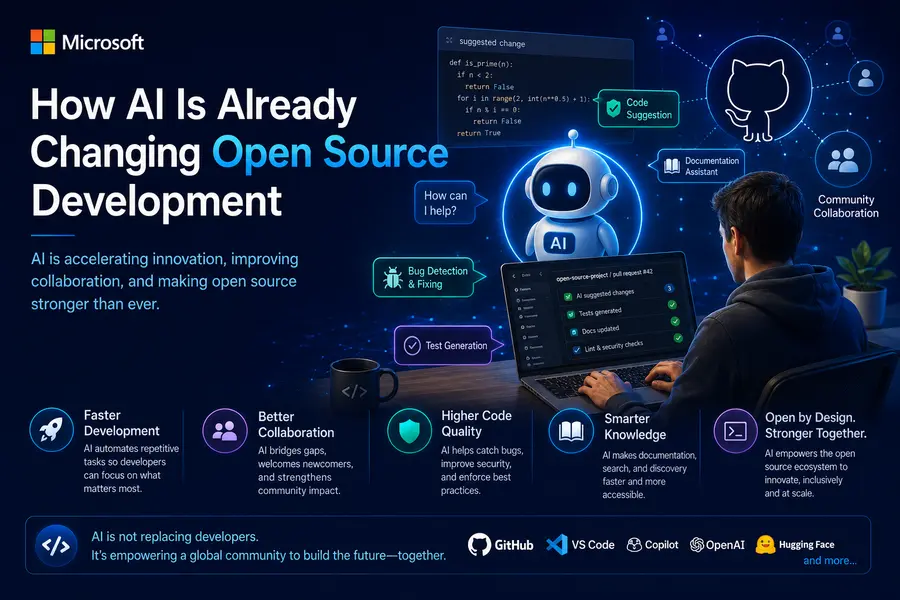
It’s worth stepping back and acknowledging something that gets buried in the product announcements: AI is already changing how open source itself gets built, not just what runs on top of it.
- Maintainers are using coding agents to triage issues, generate tests, and review pull requests
- Agentic tooling is starting to handle the toil of dependency updates and security patches
- The contribution loop is opening to more developers, across more languages, at a faster pace than the ecosystem has ever seen
This is genuinely good for open source — more contributions, less maintainer burnout, faster iteration. But it also raises the stakes on the fundamentals: provenance, supply chain integrity, review discipline, and clear standards. The communities that figure out how to fold AI into their workflows while keeping the trust model intact are the ones who will define the next decade of open source development.
The Principles That Carry from Cloud Native to AI Native
After a decade of cloud native development, certain principles have proven durable. Microsoft’s position — and the AAIF’s — is that these same principles apply to the agentic era:
- Open interfaces, so agents and workloads remain portable across clouds and frameworks
- Shared governance, so no single vendor controls the trajectory of the ecosystem
- Distributed innovation, so the best ideas can come from anywhere in the community
- Collective security, so the foundation everyone depends on stays trustworthy
Kubernetes and Linux fueled the cloud era. The bet here is that they’ll also be foundational for the agentic era — alongside the new open standards the community is building right now through bodies like the AAIF.
What Should Developers Do Right Now?
If you’re building on Azure or planning to, here’s what’s most immediately actionable:
1. Register for the Azure Linux 4.0 public preview at aka.ms/AzureLinuxForm to be among the first to get access when it launches.
2. Watch Microsoft Build on June 2, 2026 — the broader rollout of Azure Container Linux and additional agentic ecosystem announcements are expected there.
3. Explore the Microsoft Agent Framework if you’re building multi-agent systems — it’s the unified successor to Semantic Kernel and AutoGen.
4. Look into the Agentic AI Foundation (AAIF) at aaif.io if you want to be part of shaping open standards for agent interoperability.
5. Check out the Agent Governance Toolkit if your organization is deploying agents in regulated or enterprise environments.
Final Thoughts
Microsoft Introduces Azure Linux 4.0 and Open Agentic AI Ecosystem at a moment when the infrastructure choices being made today will shape what’s possible for the next decade. The pattern here mirrors what happened with Kubernetes: a complex, consequential technology becomes reliable at scale only when the community agrees on open standards, shared governance, and collective investment in security.
Azure Linux 4.0 gives the cloud a hardened, AI-optimized foundation. The Agent Framework, AAIF, and Agent Governance Toolkit give agentic systems the portability, interoperability, and trust model they need to move from demos into production. And the sustained investment in OpenSSF, Alpha-Omega, and the GitHub Secure Open Source Fund addresses the supply chain risk that gets more serious as agents touch more systems.
The cloud era was built on open source. The AI native era will be too — and the building blocks are taking shape right now.
Disclaimer
This blog post is written for informational purposes only and is based on publicly available information from Microsoft’s official Open Source Blog (May 18, 2026). All product names, trademarks, and announcements referenced herein belong to their respective owners. Features such as Azure Linux 4.0 public preview are subject to change by Microsoft. This post is not affiliated with, sponsored by, or endorsed by Microsoft Corporation.