



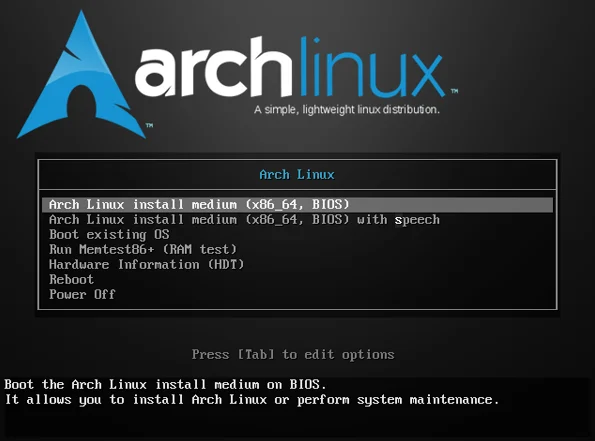

Arch has a reputation for being intimidating, and honestly, that reputation isn’t wrong. But it’s also one of the clearest ways to actually understand how a Linux system fits together. No version number to track. No desktop environment forced on you. Barely any gap between a project releasing something upstream and it showing up in your repositories. If you’re weighing whether Arch is worth the learning curve — or you’re already running it and just hit a wall — this page is meant to be where you start. Below you’ll find what Arch is actually like day to day, how the rolling-release model works, and where to go on TechRefreshing for the deeper guides.
Arch at a Glance
| Detail | Arch Linux |
|---|---|
| Project | Arch Linux, community-run and independently governed |
| Distribution family | Independent, rolling release |
| Current release model | No versioned releases — continuously updated; monthly ISO snapshots for new installs only |
| Desktop environment | None by default — user chooses at install |
| Package manager | pacman |
| Package format | Arch package (.pkg.tar.zst) |
| Additional software | Arch User Repository (AUR), community-maintained, not officially supported |
| Release cycle | Rolling — no fixed version or end-of-life dates |
| Default display system | Depends on the desktop environment chosen |
| Best suited for | Users who want full control and are comfortable with hands-on maintenance |
| Official website | archlinux.org |
What Arch Is Like to Use in 2026
Calling Arch a “distribution” undersells what it actually is. It’s closer to a well-organized starting point than a finished product — no default desktop, no bundled office suite, no media player waiting for you after install. You boot into something minimal and add exactly what you want. Depending on your mood, that’s either the entire appeal or the entire problem.
Once it’s set up, though, Arch tends to feel lighter than distros carrying years of defaults nobody asked for. You know why every package is on the system, because you’re the one who put it there. That comes at a cost: Arch assumes you understand roughly what you’re doing, and it won’t paper over a bad configuration the way a more opinionated distro might.
And the software itself is about as current as a general-purpose Linux distribution gets. New packages typically land within days of upstream shipping them — faster than Fedora, and well ahead of Ubuntu or Debian’s pace.
Arch’s Rolling Release Model
There’s no version number here, and no scheduled release cycle the way Fedora or Ubuntu run one. Just a single, continuously updated set of repositories. Run pacman -Syu regularly and the system stays current indefinitely — there’s no “now upgrade to the next version” step, because there isn’t a next version to upgrade to.
What Arch does put out monthly is an installation ISO, something like archlinux-2026.08.01-x86_64.iso. That’s purely for people doing a fresh install, not a release in the Fedora or Ubuntu sense. Arch’s own downloads page is blunt about this: existing systems never need a new ISO, since pacman -Syu keeps them on the same rolling stream a brand-new install would land on anyway.
One nice side effect of all this: there’s no end-of-life date lurking in your future. Nothing “expires” the way a Fedora or Ubuntu release does. But that freedom comes with a catch — staying current stops being optional the moment you go too long without updating. Arch only officially supports full system upgrades, and putting one off for months tends to make the eventual catch-up a lot messier than it needed to be.
Installing Arch: archinstall vs Manual
Arch’s install process has a reputation of its own, and it earned it — though it’s gotten noticeably friendlier over the past couple of years. The live ISO now ships with archinstall, an official guided installer that steps through partitioning, bootloader setup, networking, and desktop environment selection through a menu, instead of demanding every command be typed from memory.
The old-school route is still around and still fully documented, right down to the last detail, in the Arch Installation Guide: partitioning by hand, mounting the filesystem, bootstrapping with pacstrap, wiring up the bootloader, configuring networking yourself. A lot of longtime users still do it this way, mostly because it forces you to actually understand what you’re building — which tends to pay off six months later when something breaks at 11pm.
Neither method is the “correct” one. archinstall gets you to a working desktop faster. The manual guide teaches you more about what’s under the hood.
Package Management: pacman and the AUR
Pacman is Arch’s package manager, and it’s fast and unfussy — pretty much everything you do on the system routes through it eventually. A fresh install pulls from the core, extra, and (for 32-bit compatibility) multilib repositories, which cover a solid chunk of open-source software on their own.
Then there’s the Arch User Repository, the AUR — a huge, community-run collection of build scripts (PKGBUILDs) that let you compile software Arch doesn’t officially package. Niche utilities, newer versions than what’s in the official repos, things other distros wouldn’t bother packaging at all. It’s arguably Arch’s single biggest practical selling point, and it deserves a caveat: the AUR isn’t official, and the Arch Project doesn’t vet it. Anyone can upload a PKGBUILD, so glancing at what a script actually does before you build it isn’t paranoia — Arch has had to deal with malicious AUR packages before, and it’ll probably happen again.
Most people don’t run makepkg by hand for every AUR package. They install a helper — yay or paru are the common ones — that automates the fetch-build-install loop. Neither is official either, but both are widely trusted and well documented.
[INTERNAL LINK: Arch AUR guides]
Desktop Environments and Display Server on Arch
There’s no default desktop on Arch — you pick one at install time, through archinstall’s profiles, or you add it yourself afterward. GNOME, KDE Plasma, Xfce, and newer Wayland-native compositors like Hyprland or Niri are all just packages here, none of them privileged over the others.
That also means your display server situation depends entirely on what you install. Go with GNOME and you inherit whatever GNOME’s current Wayland/X11 stance happens to be. Go with a lightweight window manager and you’re making that call yourself. Arch doesn’t layer a policy on top the way Fedora does with Workstation — it just gives you the pieces.
Hardware, Drivers and Compatibility
Because Arch ships kernel and driver updates almost as soon as they land upstream, it’s often one of the better options for very recent hardware — new laptops, GPUs, and Wi-Fi chipsets tend to work here before they work on distros still sitting on an older kernel branch.
NVIDIA is handled directly in Arch’s own repositories — both the open-source Nouveau driver and NVIDIA’s proprietary packages, including the newer open kernel modules, are right there through pacman. That’s a real difference from distros that push proprietary drivers off to a third-party repo. Intel and AMD graphics generally just work through the mainline kernel and Mesa, both of which Arch keeps current as a matter of course.
There’s a flip side, and it’s the same one Fedora deals with: being close to the edge means you’ll occasionally catch a fresh regression in a driver or kernel update before a slower distro even gets to it. What you actually experience depends a lot on the specific machine in front of you.
[INTERNAL LINK: Arch NVIDIA troubleshooting]
Performance and System Requirements
Arch doesn’t publish a minimum RAM or storage number the way some distros do — there’s no default install to measure. A bare command-line base barely uses anything; a full desktop with a browser and a dev toolchain will need considerably more. A base install runs fine on modest, older hardware, and from there the footprint is really just whatever you decide to put on top of it.
There are no official Arch benchmarks to point to, so none are made up here. As a general rule: since Arch skips most of the background tooling other distros bundle by default, a system you built deliberately can end up leaner than an equivalent Fedora or Ubuntu install. That’s about what you chose to install, though — not some inherent speed advantage baked into Arch itself.
Arch for Gaming
Arch shows up a lot as a gaming base, partly because of that driver freshness and partly because of how deep the AUR runs — Lutris, Bottles, various Proton-GE builds, all a quick yay -S away when they’re not in the official repos. Steam, Proton, and Vulkan behave the same as on any current Linux distro, and Mesa or kernel updates tend to hit Arch before most other distros see them.
NVIDIA users still have the same choice as anywhere else: Nouveau or the proprietary driver, both sitting right there through pacman. And like on every distro, anti-cheat-protected multiplayer games remain the sticking point — no amount of driver freshness fixes a title that simply refuses to run on Linux. Checking ProtonDB before assuming something will work is still the move.
Arch for Developers
If there’s one crowd Arch was practically built for, it’s this one. Because packages track upstream so closely, you get current compilers, runtimes, and libraries without waiting for a distro’s release schedule to catch up — genuinely handy when the fix you need only landed upstream a few weeks ago.
Containers and virtualization are well covered through the official repos — Podman, Docker, QEMU, libvirt, all packaged and kept current. Anything niche or too new for the official repos, the AUR usually has it.
The catch is the same one that applies everywhere else on Arch: you’re the one keeping the system updated correctly, and you’re the one figuring out what broke when it does.
[INTERNAL LINK: Arch pacman guides]
Keeping Arch Updated
In principle, updating Arch is one command: pacman -Syu, run regularly. Where people get into trouble is straying from that. Arch’s documentation is direct about it — partial upgrades are not supported. Sync the package database without immediately upgrading everything, and you can end up with mismatched library versions and applications that quietly stop working, since Arch doesn’t keep old libraries around for backward compatibility the way some distros do.
The safe habit is simple enough: always pair a sync with a full upgrade (pacman -Syu), update regularly instead of letting a system sit for months, and rebuild AUR packages when their dependencies get a version bump. A neglected system can still be brought back up to date — it just gets harder the longer it’s been left alone.
[INTERNAL LINK: Arch upgrade and update guides]
Common Arch Problems and Troubleshooting
Think of this as a starting point rather than a fix for everything — the dedicated troubleshooting guides go much deeper on each of these.
- Broken system after an update — nine times out of ten this is a partial upgrade. Confirm
pacman -Syuactually ran in full, not just-Sy. - Won’t boot after a kernel update — boot an older kernel entry from the bootloader. Keeping
linux-ltsinstalled alongside your main kernel is cheap insurance. - NVIDIA issues — check whether Nouveau or the proprietary driver is actually active, and confirm it matches your currently installed kernel.
- pacman database or signature errors —
pacman -Syyforces a fresh sync. A corrupted keyring usually needs reinitializing per the Arch Wiki’s instructions. - AUR build failures — usually a missing dependency or a stale PKGBUILD. Check that package’s AUR comments before anything else.
- Wi-Fi not detected —
lspciorlsusbwill tell you whether the kernel even sees the hardware. - No sound — make sure PipeWire is actually running:
systemctl --user status pipewire. - Slow mirrors — regenerate your mirrorlist with
reflector. This fixes more sluggish-update complaints than people expect. - Bootloader problems — regenerate the GRUB or systemd-boot config after a kernel update before doing anything more drastic.
- Desktop environment issues after an update — check the upstream project’s release notes first; it’s rarely Arch’s fault specifically.
uname -r and journalctl -b are worth having memorized regardless of what’s going wrong.
[INTERNAL LINK: Arch pacman troubleshooting]
Arch vs Ubuntu vs Fedora vs Manjaro
People usually don’t need a spec sheet to pick between these four — they need to know where each one is actually going to cost them time, and when. That’s the angle below.
| Question | Arch | Ubuntu | Fedora | Manjaro |
|---|---|---|---|---|
| What are you actually buying into? | A base you assemble yourself, package by package | A finished desktop with a big company and community behind it | A GNOME desktop that stays close to what GNOME upstream ships | Arch’s package base with the rough edges sanded down |
| How much setup before it’s usable? | Hours, even with archinstall | Minutes | Under an hour | Well under an hour |
| What happens if you ignore updates for six months? | A genuinely painful catch-up upgrade | Mostly fine until your LTS release nears end of support | You’ll need a major version upgrade at some point regardless | Manageable, but you’ll want to catch up before it snowballs |
| Where do you hit friction first? | The first time a partial upgrade breaks something | Wanting a package that’s not in Ubuntu’s repos yet | Wanting a codec or driver Fedora won’t ship by default | Occasionally, packages a few weeks behind what Arch users already have |
| NVIDIA and gaming, out of the box? | Proprietary driver is one pacman command away | Available during setup, straightforward | Works, but needs a third-party repo first | Same ease as Arch, with more guided tooling |
| Who’s it actually built for? | People who want to know exactly what’s on their machine | People who just want a computer that works | People who want current software without doing the assembly themselves | People who want Arch’s freshness without Arch’s homework |
None of these is “the best” distro — that framing doesn’t really hold up once you actually use a few of them. Arch just asks more of you up front in exchange for asking less of you later, in the sense that nothing on the system is a mystery. Whether that’s a fair trade depends entirely on how much you enjoy that kind of ownership.
Arch Pros and Cons
Pros
- Software that’s often just days behind upstream
- No forced defaults — you build exactly what you want
- The Arch Wiki, which is genuinely one of the best pieces of Linux documentation anywhere, Arch user or not
- The AUR opens up an enormous amount of software the official repos don’t touch
- No end-of-life dates hanging over you
- You end up understanding your own system, almost by accident
Cons
- Steep learning curve if you’re new to Linux
- No safety net if you run a partial upgrade or misconfigure something
- AUR packages are unofficial — quality is genuinely all over the place
- Fast-moving software means the occasional fresh regression
- This is not a “set it and forget it” system, ever
Who Should Use Arch?
If you’re new to Linux, this probably isn’t where you should start — Arch assumes a level of comfort with how systems fit together that most beginners haven’t had time to build yet. Experienced users who actually want to understand what’s running under them, and don’t mind troubleshooting it themselves, tend to get the most out of it. Developers benefit a lot from the near-immediate access to current toolchains and everything sitting in the AUR, especially with newer frameworks. Anyone on recent hardware is usually well served too, since driver and kernel freshness tends to mean things just work sooner.
Gamers willing to do a bit of setup can build a solid rig on Arch, though Manjaro or one of the gaming-focused Arch derivatives gets you most of the way there with less fuss. And if what you actually want is a low-maintenance daily driver — something you don’t have to think about — Fedora, Ubuntu, or an Arch-based distro like Manjaro will serve you better than Arch itself will.
Arch Guides and Troubleshooting on TechRefreshing
This page is the permanent home for everything we publish on Arch — installation guides covering both archinstall and the manual route, pacman and AUR walkthroughs, hardware and driver guides, update and system-maintenance guides, a troubleshooting library that keeps growing, desktop-environment setup guides, and gaming and comparison content for anyone still deciding if Arch is worth it. New Arch content gets linked from here as we publish it, so it’s worth bookmarking if you want a running reference.
[INTERNAL LINK: Arch installation guides]
Final Verdict: Is Arch Worth Using in 2026?
Arch in 2026 is still one of the more rewarding distributions if you’re willing to put in the time — and one of the least forgiving if you’re not. Its biggest strength is control: nothing on the system exists without you having put it there, and none of it is more than a few days behind whatever its upstream project actually shipped.
The real cost is upkeep. Arch isn’t going to quietly save you from a partial upgrade or a bad config the way a more opinionated distro might, and staying current is an ongoing responsibility rather than something you deal with twice a year. If you want to actually learn Linux, or you need the freshest software stack available, that’s a genuine strength. If you just want a computer that works without thinking about it, it’s a burden you didn’t need to take on.
It fits developers, experienced Linux users, and anyone who’d rather understand their system than be protected from it. It’s not a good match for beginners, or for anyone hoping for years of stability without having to touch anything.
Frequently Asked Questions
Is Arch Linux good for beginners?
Not really recommended as a first distro — it expects a comfort with the command line and system internals that most beginners haven’t built up yet.
Is Arch Linux free?
Yes. Free and open-source, downloadable at no cost from archlinux.org.
What is the current Arch Linux release?
There isn’t one, technically — Arch has no version numbers and updates continuously through pacman -Syu. The monthly ISO snapshots are for new installs only, and the most recent ones have been shipping a current Linux kernel in the 7.x series as of late summer 2026.
Is Arch more up to date than Fedora?
Generally, yes. Arch packages usually reach users within days of an upstream release, while Fedora bundles updates into two versioned releases a year.
Is Arch good for gaming?
With a bit of setup, yes — Steam, Proton, and Vulkan all work well, and the AUR makes it easy to grab extra gaming tools. Anti-cheat-heavy multiplayer titles are still worth checking individually before you assume they’ll run.
What is the AUR, and is it official?
It’s a large, community-run collection of build scripts for software the official repos don’t carry. It isn’t vetted or supported by the Arch Project, so it’s worth glancing at what a package actually does before installing it.
Is Arch related to Manjaro?
Manjaro is its own distribution built on Arch’s package base, with a more automated installer and a delay before updates reach users. It isn’t part of the official Arch Project, even though the two are closely connected.