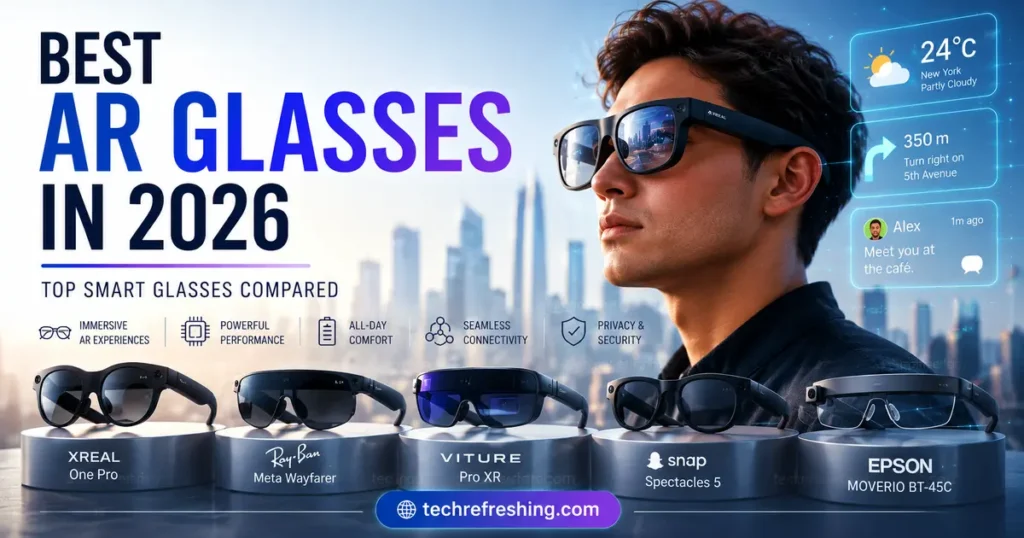
If you’ve been waiting for AR glasses to actually get good, 2026 is your year. The best AR glasses in 2026 are no longer science-fiction prototypes or clunky developer kits — they’re real products you can buy today, wear on your face, and genuinely use. Whether you want a pair that looks like normal Ray-Bans, a private cinema you can take on a plane, or the clearest virtual display you’ve ever seen, there’s now a device built specifically for you.
That said, shopping in this space is still confusing. “AR glasses,” “smart glasses,” “XR glasses” — these terms get used interchangeably, but the devices they describe are very different. This guide cuts through the noise, compares the top options available right now in the USA, and tells you exactly which pair fits your lifestyle.
What to Know Before You Buy: Three Types of Smart Glasses
Before jumping to the rankings, understand one thing: “smart glasses” in 2026 is actually three different product categories.
- AI Glasses (no display): Look like normal sunglasses. Built-in camera, speakers, and a voice-activated AI assistant. You interact through audio — no visible screen. Best for everyday wearability and social situations.
- AR/XR Display Glasses: Feature a built-in virtual screen projected through the lenses. You plug them into a phone, PC, or gaming console via USB-C to watch content or work. Designed for private viewing and portable productivity.
- True Spatial AR Glasses: Overlay digital objects on the real world you can interact with. The most advanced category, and still the rarest and most expensive.
Buying the wrong type is the most common mistake people make. Don’t expect holographic overlays from a pair of Ray-Bans, and don’t expect to wear display glasses to a dinner party without everyone noticing.
Best AR Glasses in 2026 — Quick Comparison Table
| Product | Price | Type | Display | Weight | Best For |
|---|---|---|---|---|---|
| VITURE Beast | $549 | XR Display | 174″ virtual, 1200p, 1250 nits | 88g | Movies, gaming, productivity |
| Ray-Ban Meta Gen 2 | $379 | AI Glasses | No display | ~50g | Everyday AI assistant |
| XREAL One Pro | $599 | AR Display | 310″ ultrawide, 1080p, 700 nits | 87g | Cinema + spatial computing |
| Meta Ray-Ban Display | $799 | AI + HUD Display | HUD overlay | 69g | AI + notification glanceable display |
| Rokid Glasses | ~$499 | AI + Display | Micro-LED monocular | 49g | Lightweight AI display hybrid |
| Snap Spectacles 5 | $99/mo (dev) | True AR | 46° FOV spatial AR | N/A | Developers / AR experiences |
| XREAL 1S | $449 | AR Display | 135″ virtual, 1080p | ~80g | Budget AR display |
1. VITURE Beast — Best Overall AR Display Glasses
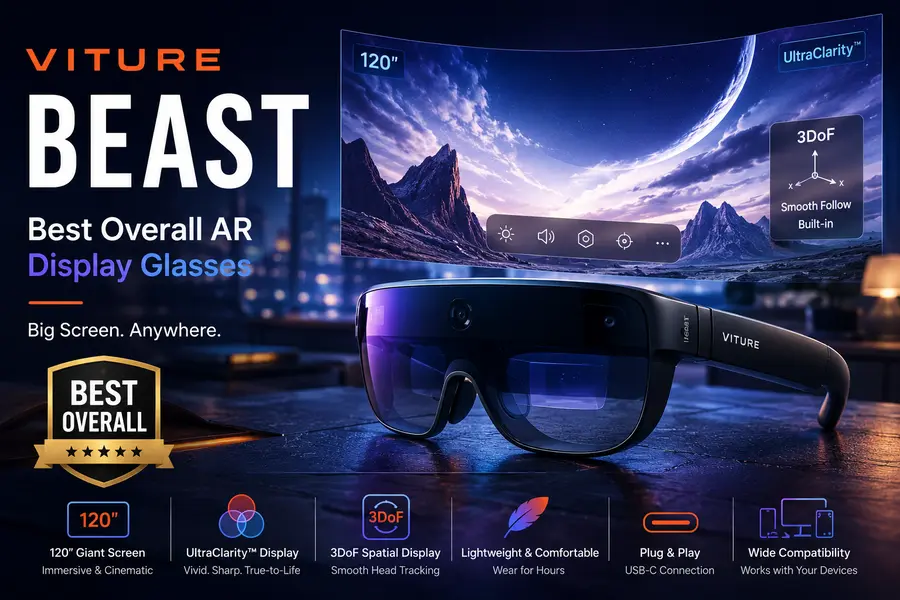
Price: $549 | Available at: Amazon, Best Buy, VITURE.com
If there’s one product that defines the best AR glasses in 2026 right now, it’s the VITURE Beast. Launched on April 27, 2026, it immediately swept editorial awards across major tech publications.
Tom’s Guide called it “the best AR glasses that money can buy right now.” PCMag awarded it 4.5/5 and an Editors’ Choice, calling it “one of the most impressive head-tracked viewing experiences currently available.” CNET’s Scott Stein — 16+ years on the beat — gave it an 8.4/10 Editor’s Choice and said the micro-OLEDs were “the best I’ve seen, both in brightness, resolution and field of view.” WIRED named it “Best Smart Glasses for Picture Quality.”
Key Specs
- Display: Dual Sony Micro-OLED panels, 174-inch virtual screen at 4 meters
- Resolution: 1920×1200 per eye (4K-like)
- Brightness: 1,250 nits perceived — the brightest display glasses available right now
- Field of View: 58 degrees
- Refresh Rate: Up to 120Hz
- Tracking: Built-in VisionPair™ 3DoF (no external device needed)
- Dimming: Industry-first 9-level electrochromic dimming with Smart Auto Transparency
- Audio: HARMAN-tuned speakers
- Weight: 88 grams
- Compatibility: PS5, Xbox Series X|S, Nintendo Switch, Steam Deck, ROG Ally, iPhone 15/16/17, Android, Mac, PC via USB-C
What separates the Beast from everything else isn’t just the numbers — it’s that the 3DoF head tracking is built directly into the glasses. Competitors require external hardware or a connected puck to achieve spatial anchoring. With the Beast, the screen stays pinned wherever you look, right out of the box. That alone changes how usable these are for productivity.
Who Should Buy This
Anyone who wants the best portable display for movies, remote work on a virtual monitor, or gaming on handhelds. The compatibility with essentially every device you own makes it surprisingly versatile.
Verdict: The new benchmark for AR display glasses in 2026.
2. Ray-Ban Meta Gen 2 — Best AI Smart Glasses for Everyday Use
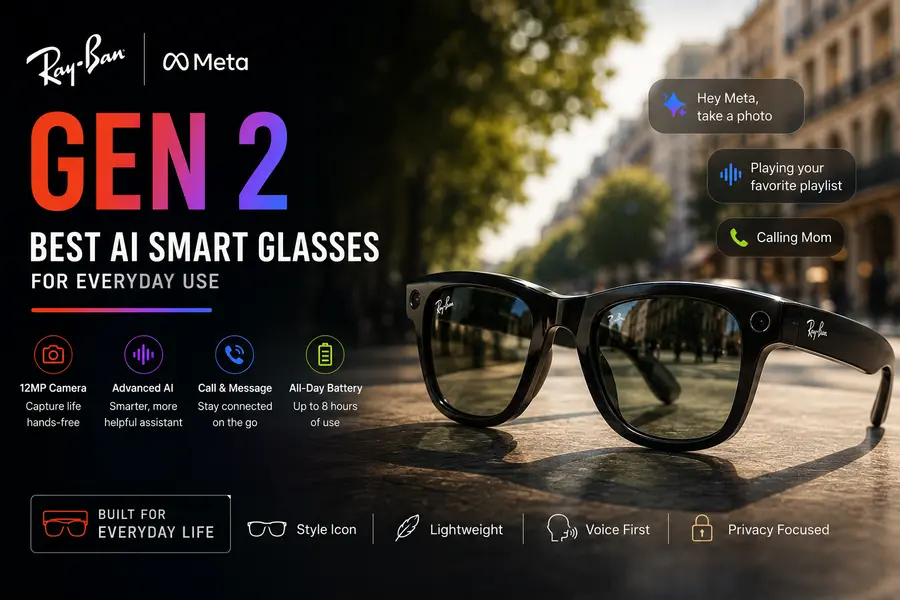
Price: $379 | Available at: Ray-Ban.com, Meta.com, LensCrafters, Amazon, Best Buy
The Ray-Ban Meta Gen 2 is still the gold standard for glasses that look and feel like actual glasses. Meta launched these in late 2025 and they remain the best-selling smart glasses by a wide margin heading into 2026 — and for good reason.
Key Specs
- Camera: 12MP ultra-wide, 3K Ultra HD video at up to 60fps
- Battery Life: Up to 8 hours (doubled from Gen 1); charging case adds up to 48 hours
- Speakers: Open-ear, with Conversation Focus noise isolation
- Microphones: 6 mics
- AI: Meta AI via voice; real-time translation, visual context
- Design: Wayfarer, Skyler, Headliner styles — looks identical to regular Ray-Bans
- Weight: ~50 grams
The Gen 2 upgrade is meaningful. Eight hours of real-world battery life means you can actually wear these all day without worrying about running out. The 3K camera is a significant jump — your first-person footage finally looks good enough beyond social media. Meta AI integration means you can ask questions, get navigation prompts, identify objects in your environment, and translate conversations without pulling out your phone.
There’s no visible display, which is the design choice that makes these socially acceptable anywhere. Nobody can tell you’re wearing smart glasses. That’s exactly the point.
Who Should Buy This
People who want AI in their glasses without a visible screen — commuters, creators, professionals who spend time outdoors or in meetings. If you’re new to smart glasses, start here.
Verdict: The most wearable, most practical smart glasses on the market.
3. XREAL One Pro — Best for Display Clarity and Spatial Computing
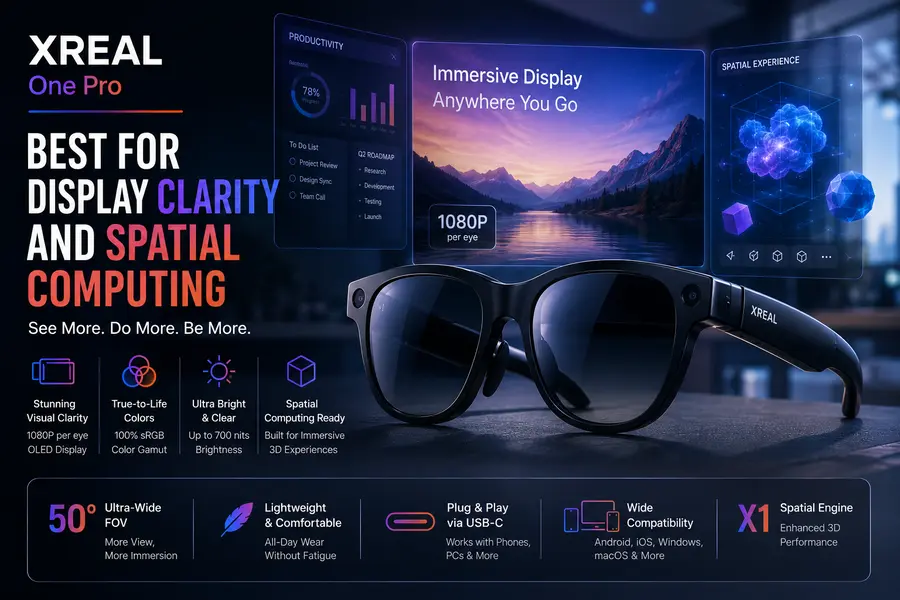
Price: $599 | Available at: XREAL.com, Amazon
XREAL has been one of the most serious players in AR display glasses for years, and the One Pro is their best work yet. XREAL permanently dropped the price from $649 to $599 in early 2026, making it slightly more competitive against the VITURE Beast.
Key Specs
- Display: Sony Micro-OLED, up to 310-inch ultrawide virtual screen
- Resolution: 1920×1080 per eye (ultrawide: 3840×1080)
- Brightness: 700 nits perceived
- Field of View: 57 degrees
- Refresh Rate: Up to 120Hz
- Chip: Proprietary X1 spatial computing processor
- Audio: Bose-tuned open-ear speakers
- Weight: 87 grams
- IPD: Physically adjustable
The X1 chip is what gives XREAL an edge in the spatial anchoring department. The screen genuinely stays fixed in virtual space as you move your head, which is something early AR glasses struggled with badly. The ultrawide mode — showing a 3840×1080 picture when connected to a computer — is genuinely useful for multi-window workflows while traveling.
The 700-nit brightness falls below the VITURE Beast’s 1,250 nits, which matters in brighter environments. But for indoor use and productivity, this is still an exceptional display. The Bose audio partnership also shows — the speakers punch well above what you’d expect from glasses.
Who Should Buy This
Frequent travelers, remote workers who want a portable dual-monitor setup, and anyone who values the Bose audio integration. Strong choice for MacBook and PC users.
Verdict: A premium display experience with best-in-class spatial computing chip.
4. Meta Ray-Ban Display — Best AI + Display Hybrid
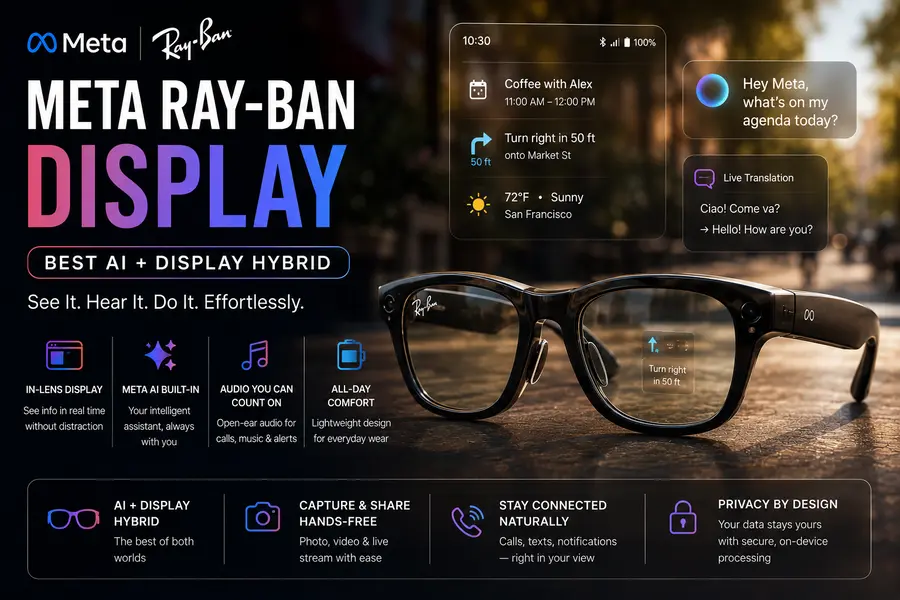
Price: $799 | Available at: Ray-Ban.com, Meta.com, Best Buy
This is where things get genuinely exciting. The Ray-Ban Display brings a HUD (heads-up display) to the classic Ray-Ban form factor — combining Meta AI’s camera smarts with a notification-style display built into the lens.
Key Specs
- Display: In-lens HUD overlay (glanceable notifications, AI responses)
- Camera: 12MP ultra-wide, 3K video at 30fps, 3x digital zoom
- Battery: Up to 6 hours with mixed usage; charging case adds 24 hours
- Storage: 32GB internal
- RAM: 2GB
- Connectivity: Wi-Fi 6, Bluetooth 5.3
- Weight: 69 grams
- Prescription Ready: Rx range -4.00 to +4.00
- Neural Wristband: Pairs with Meta Neural Band (sEMG) for gesture control
- Water Resistance: IPX4
The Ray-Ban Display isn’t trying to be a cinema screen. It’s a smarter version of smart glasses — you get the everyday wearability of Gen 2 plus a subtle display that shows you information without requiring you to pull out your phone. Navigation turn-by-turn, message previews, AI responses — all visible at a glance.
The $799 price is a premium, but this is the most polished integration of AI and display in eyewear that actually looks like eyewear. Third-party app support opened up in early 2026, which means the software ecosystem is growing.
Who Should Buy This
Power users who want the full Ray-Ban experience with a working display. Great for professionals who want hands-free information access throughout the day.
Verdict: The best AI-plus-display integration in a fashionable frame.
5. Rokid Glasses — Best Lightweight Display AI Glasses
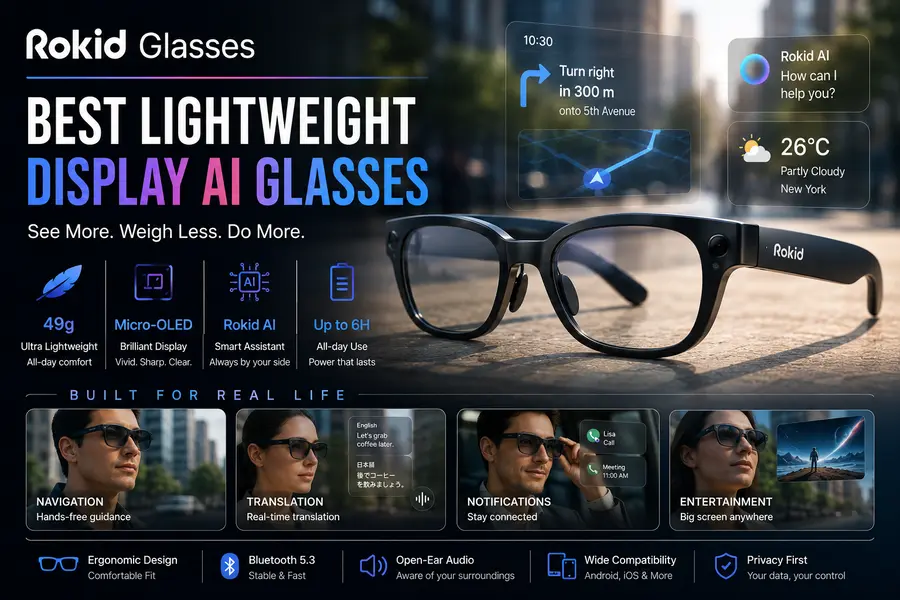
Price: ~$499 | Available at: Rokid.com, Amazon
Rokid flew somewhat under the radar compared to Meta and XREAL, but as of early 2026, the Rokid Glasses claimed the number one spot globally in the display-AI smart glasses category. The headline stat is the weight: just 49 grams, which is remarkable for glasses that include both a display and a 12MP camera.
Key Specs
- Display: Micro-LED monocular (single-lens overlay)
- Camera: 12MP
- Weight: 49 grams — lightest display AI glasses available
- AI: Integrated AI assistant with voice control
- Battery: Built-in with charging case
The monocular display approach means you get a small overlay in one lens — ideal for navigation prompts, notifications, and quick AI responses, but not built for long viewing sessions. That’s actually fine for how most people use display glasses day-to-day.
The tradeoff: the 12MP camera struggles in low light, and prescription lens support adds significant cost. But if you want the most normal-looking glasses that still include a visible display, Rokid is currently leading that category.
Who Should Buy This
Users who want the lightest possible smart glasses with an integrated display for information overlays and AI assistance throughout the day.
Verdict: The lightest display-AI glasses available — ideal for all-day comfort.
6. XREAL 1S — Best Budget AR Display Glasses
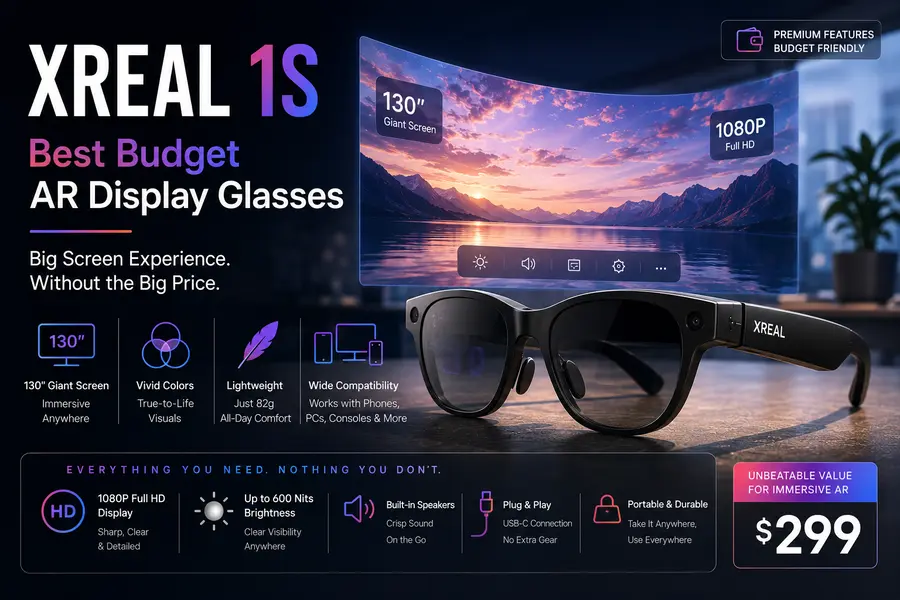
Price: $449 | Available at: XREAL.com, Amazon
XREAL launched the 1S at CES 2026 as a step up from the entry-level Air series while keeping cost below the One Pro. For anyone who wants a quality AR display experience without spending $600+, this is the most sensible buy.
Key Specs
- Display: Virtual screen up to 135 inches
- Resolution: 1920×1080
- Refresh Rate: 120Hz
- Real 3D: Free OTA update converts 2D content to 3D
- Weight: ~80 grams
- Connectivity: USB-C
The Real 3D feature — which converts regular 2D content into a 3D experience in real time — is available on the 1S and it works better than expected. It’s a genuinely fun addition for gaming and movies and arrived as a free over-the-air update to existing users too.
Who Should Buy This
First-time buyers who want a serious AR display experience without paying flagship prices. Great entry point into the category.
Verdict: The smart budget pick — solid display, fair price, real upgrade over the Air 2.
What’s Coming: AR Glasses to Watch in 2026
The current lineup is excellent, but the next six months will bring significant launches worth knowing about.
- Snap Spectacles (Consumer “Specs”): Targeting a fall 2026 launch at approximately $2,500. These would be the first true consumer AR glasses with full spatial computing — digital objects placed in the real world, not just a screen overlay. Hand tracking, Snap OS, 46-degree field of view. A bold price for bold tech.
- XREAL Aura (Project Aura): XREAL’s Android XR glasses, announced at Google I/O 2026. Targeting a 70-degree field of view with full hand tracking and Android XR integration. Launching before end of 2026.
- Google/Samsung Android XR Audio Glasses: Google previewed audio-first Android XR glasses at I/O 2026 (designed with Gentle Monster and Warby Parker). Display-equipped model confirmed for 2027.
- ASUS ROG XREAL R1: Purpose-built for gaming with a 240Hz micro-LED display — the first AR glasses to hit that refresh rate. Coming later in 2026 for power users.
How to Choose: A Practical Buying Guide
You want glasses no one notices → Ray-Ban Meta Gen 2 ($379)
Social wearability is the priority. Zero visible display, looks exactly like Ray-Bans, 8 hours of battery. Start here.
You want the best display for movies and gaming → VITURE Beast ($549)
Brightest screen, best spatial tracking built in, widest compatibility. Buy this without overthinking it.
You want the best spatial computing for work → XREAL One Pro ($599)
The X1 chip and Bose audio make this the productivity pick. Ultrawide mode for coding is excellent.
You want AI + a subtle display → Meta Ray-Ban Display ($799)
Spend the extra money if you want the full information-at-a-glance experience without looking like you’re watching TV.
You want the lightest display glasses possible → Rokid Glasses (~$499)
49 grams is remarkably comfortable. The monocular display is more about quick info than content consumption.
You’re on a budget → XREAL 1S ($449)
Real quality, real display, sensible price.
Are AR Glasses Worth It in 2026?
The honest answer: yes, if you know what you’re buying.
Display glasses like the VITURE Beast and XREAL One Pro deliver genuine value for travelers, remote workers, and gamers. Carrying a private 174-inch screen in your jacket pocket that works with your PS5, MacBook, and iPhone is a real thing you can do in 2026 for $549.
AI glasses like the Ray-Ban Meta Gen 2 are worth it if you spend a lot of time outdoors or in situations where pulling out your phone feels awkward or unsafe. Having a camera, speakers, and an AI assistant on your face all day genuinely changes how you interact with the world.
Where AR glasses still fall short: true spatial AR at a reasonable price. The $2,500 Snap Spectacles coming this fall might start to close that gap, but mainstream holographic glasses remain a year or two away.
The best move right now is buying for your specific use case and not trying to future-proof. The technology is moving fast enough that the 2027 lineup will look very different from what’s on shelves today.
Final Rankings Summary
1. VITURE Beast — Best overall display glasses. Brightest, most versatile, best reviews across the board.
2. Ray-Ban Meta Gen 2 — Best everyday AI glasses. Unmatched wearability and the most proven product in this space.
3. XREAL One Pro — Best display with spatial computing. Ultrawide mode and Bose audio stand out.
4. Meta Ray-Ban Display — Best AI plus HUD hybrid. Premium price, premium experience.
5. Rokid Glasses — Best for lightweight all-day comfort with a display.
6. XREAL 1S — Best budget AR display glasses.
Disclaimer
This article is for informational purposes only. Product prices, availability, and specifications are subject to change without notice. Always verify current details directly with the manufacturer or retailer before making a purchase. We are not responsible for any inaccuracies that may occur after the date of publication.