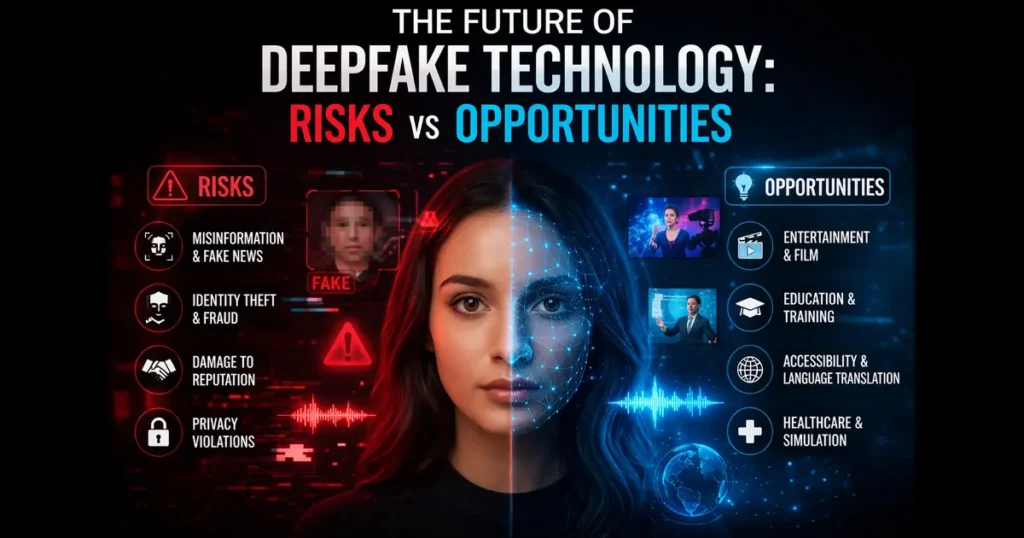
There is a moment when a technology stops being a curiosity and becomes something you have to take seriously. For deepfakes, that moment has already passed. The future of deepfake technology is not some distant scenario being debated in research labs — it is actively reshaping fraud, entertainment, healthcare, politics, and personal safety right now, in real time.
The numbers alone tell a story that should make anyone pay attention. Deepfake files surged from roughly 500,000 in 2023 to an estimated 8 million by 2025 — a staggering 1,500% increase in just two years. In the United States alone, deepfake-related losses from fraud and scams hit $1.1 billion in 2025, up from $360 million the year before. That is not gradual growth. That is an explosion.
Yet to frame deepfakes as purely a threat would be incomplete and unfair. The same underlying technology enabling financial fraud is also being used to train surgeons, help patients understand complex procedures, and advance drug discovery. The challenge for individuals, businesses, and governments is figuring out how to contain the damage while keeping the doors open for legitimate innovation.
This post breaks it all down — where deepfake technology stands right now, what the next few years will look like, the very real risks you need to understand, and the genuine opportunities that are easy to overlook.
What Deepfake Technology Actually Is (And How Far It Has Come)
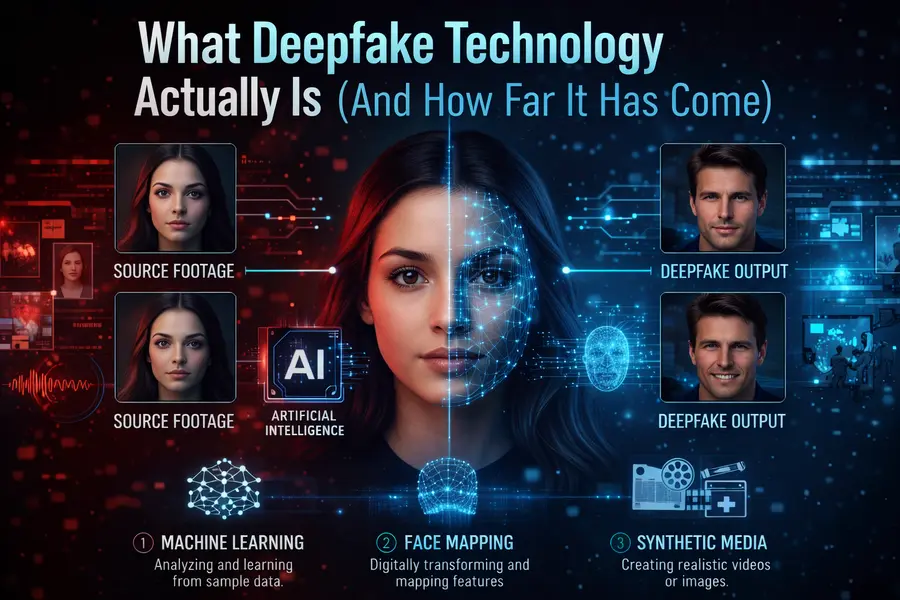
A deepfake is synthetic media — video, audio, or images — generated using artificial intelligence, typically built on a framework called Generative Adversarial Networks (GANs). Two neural networks work against each other: one creates fake content, and the other evaluates it, pushing quality higher with each iteration until the output is nearly indistinguishable from real footage.
The technical barriers that once made deepfakes the exclusive domain of well-funded studios have mostly collapsed. Today, a convincing 60-second deepfake video can be created in under 25 minutes at zero cost using freely available tools. Voice cloning — one of the most dangerous applications — now requires as little as 20 to 30 seconds of audio to generate a convincing replica of someone’s voice, complete with their natural pauses, emotional inflection, and accent.
This shift is critical. It used to take expertise, time, and money to produce a believable fake. Now it takes an internet connection and a few minutes of someone’s publicly available audio or video. Social media, podcasts, interviews, and webinars have handed bad actors an endless training library.
What makes 2026 particularly concerning, according to researchers at the University at Buffalo’s Media Forensic Lab, is that deepfakes are moving toward real-time synthesis — interactive AI-driven personas that can react to people live during a video call. This is no longer pre-rendered video. It is a synthetic participant who looks like your colleague, your boss, or a government official, responding to your questions in the moment.
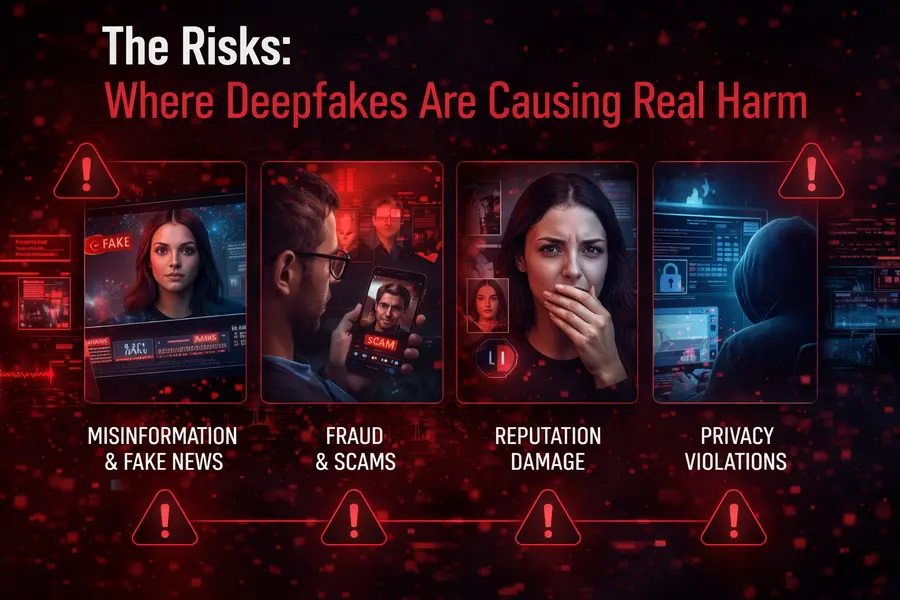
The Risks: Where Deepfakes Are Causing Real Harm
Financial Fraud and Corporate Scams
The financial toll has moved well beyond theoretical concern. In Q1 2025 alone, deepfake-enabled fraud resulted in over $200 million in losses. By Q2, that figure climbed to $347 million — with the average deepfake fraud incident costing around $500,000.
One of the most effective attack vectors is what cybersecurity professionals call the “CEO scam” — a deepfake video or voice call impersonating a senior executive, directing an employee to transfer funds to a fraudulent account. These attacks work because they exploit trust, and deepfakes make that trust much easier to manufacture.
Deepfake-as-a-Service (DaaS) platforms made things significantly worse in 2025. These are ready-to-use subscription services offering voice cloning, face swapping, and persona simulation — no technical skills required. In Singapore, attackers using DaaS tools successfully impersonated executives and directed employees to transfer millions in fraudulent payments. In India, similar synthetic identity schemes were used to bypass Know Your Customer (KYC) verification checks.
Nearly 60% of US companies reported increased fraud losses between 2024 and 2025, with AI-powered deepfakes listed as a major driver. And Gartner has predicted that by 2026, 30% of enterprises will no longer consider standalone identity verification reliable in isolation — which is a significant admission from one of the world’s leading technology research firms.
Identity Theft and Hiring Fraud
People are increasingly using deepfake technology to get hired under false identities. This is not a fringe problem. In 2024, the US Justice Department alleged that over 300 companies had unknowingly hired impostors connected to North Korea, who used deepfakes during video interviews and managed to funnel over $6.8 million back to foreign actors. They were not just fraudsters looking for paychecks — some were positioned to steal intellectual property and compromise internal systems.
Non-Consensual Intimate Imagery
This remains one of the most devastating personal harms enabled by deepfake technology. Research consistently shows that 96 to 98% of deepfake content online is sexually explicit, with nearly all victims being women. This is not a marginal issue. AI-generated explicit images of Taylor Swift reached 47 million views before they were removed from major platforms. In South Korea, approximately 297 deepfake sex crime cases were reported in just seven months of 2024 — nearly double 2021 figures.
Political Manipulation and Election Interference
Between mid-2023 and mid-2024, political deepfakes were documented across 38 countries in 82 verified cases. During the 2024 US presidential primary, a political consultant used AI to create a robocall impersonating President Biden, encouraging New Hampshire Democrats not to vote. Politicians were impersonated 56 times in the first quarter of 2025 alone.
The scale of potential disruption here is difficult to overstate. A single convincing deepfake of a world leader can spread across social media in hours — long before fact-checkers can issue corrections, long before most people have seen any rebuttal.
The Detection Problem
Human detection of high-quality deepfake videos sits at just 24.5% accuracy. People mistake AI-generated voices for real ones about 80% of the time in short clips. Even advanced multi-modal detection systems achieve only 65% accuracy with widely available tools, though controlled research conditions can push that to 94–96%. The gap between what attackers can produce and what defenders can reliably catch remains significant.
The Opportunities: Where Deepfakes Are Doing Real Good
This is where the narrative gets genuinely complicated — and where most coverage falls short. The same technology being weaponized for fraud has meaningful, constructive applications that are already improving lives.
Healthcare and Medical Training
Hospitals and research institutions are using deepfake technology to build synthetic patient datasets that preserve clinical detail while protecting individual privacy. Training a diagnostic AI to recognize rare tumors or anomalies is extremely difficult when positive training samples are scarce. Synthetic medical images generated through GAN systems can fill those gaps without exposing actual patient data — a breakthrough for both AI accuracy and compliance with privacy regulations like HIPAA.
Researchers have also used deepfake-derived systems to improve physician empathy training. A team at Taipei Medical University created facial emotion recognition videos that morphed actual patient expressions to help doctors better read emotional states during consultations. The system achieved a detection rate of over 80% on real-world data — a tangible improvement in clinical communication.
For patient education, deepfake tools allow hospitals to generate personalized explainer videos — in a patient’s native language, with lip-sync matched to the audio — that walk individuals through complex post-operative procedures or treatment plans. In telehealth settings, a doctor speaking English can be AI-dubbed in real time for a non-English-speaking patient, with synchronized lip movements that make the exchange feel natural and comprehensible.
Drug discovery is another area where the technology is making a measurable difference. Platforms like Pharma.AI are using AI systems — including deepfake-adjacent generative models — to design molecules for potential disease treatments and predict clinical trial outcomes, significantly compressing the development timeline.
Film, Entertainment, and Accessibility
The entertainment industry has embraced synthetic media for legitimate purposes: digitally aging actors for long-running franchise films, preserving the likeness of deceased performers, and dubbing content across languages with accurate lip synchronization. Streaming platforms including Netflix are already using AI-dubbing tools to expand content accessibility globally.
These applications have a direct accessibility benefit for audiences with language barriers or hearing impairments. A documentary series dubbed into 15 languages with synchronized facial expressions reaches a fundamentally different and larger audience than one with text subtitles alone.
Education and Personalized Learning
Deepfake technology is being explored in classrooms to create historically immersive experiences — interactive simulations where students can “speak” with historical figures or explore events in first-person formats that static textbooks cannot replicate. Done responsibly, with clear disclosure and educational framing, this kind of application can significantly deepen engagement and retention.
Corporate Training and Simulation
Companies are using synthetic media to produce scalable training content without the logistical burden of repeated video production. Safety training videos, customer service simulations, and compliance walkthroughs can be personalized, localized, and updated without reshoots. This reduces cost and increases the frequency with which training content can be refreshed to stay current.
The Regulatory Response: Where Laws Stand in 2026
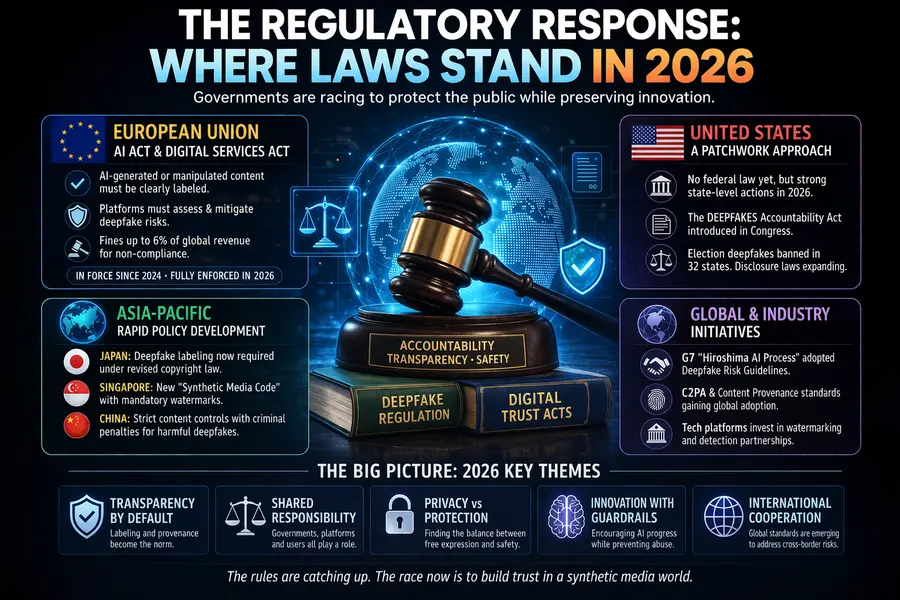
The legal landscape has moved faster than almost anyone anticipated. As of early 2026, 47 US states have enacted laws targeting AI-generated synthetic media — with 82% of those laws passed in just the last two years.
The most significant federal action is the TAKE IT DOWN Act, signed by President Trump on May 19, 2025. It passed the House 409-2 and cleared the Senate unanimously — a level of bipartisan support that is rare by any measure. The law criminalizes the knowing publication of non-consensual intimate imagery including AI-generated deepfakes, and requires covered platforms to remove reported content within 48 hours of a valid notice, with platforms required to be compliant by May 2026.
At the state level, 28 states now have laws specifically addressing deepfakes in political communications, requiring disclaimers on AI-generated political content. Tennessee’s ELVIS Act (Ensuring Likeness, Voice, and Image Security) explicitly grants individuals property rights over their own voice and likeness. California, despite controversies around specific bills being struck down or vetoed, has enacted 24 AI-related laws across 2024 and 2025.
Internationally, the EU AI Act includes transparency rules for synthetic media set to take full effect in August 2026. Penalties for violations can reach €35 million or 7% of global annual revenue, whichever is higher. The UK has gone further in some respects, criminalizing the creation of sexually explicit deepfakes — not just their distribution — with penalties of up to two years in prison.
These regulatory frameworks signal a clear direction of travel: governments around the world are moving toward mandatory content labeling, traceable metadata, mandatory takedown timelines, and criminal liability for harmful synthetic media. The question is whether enforcement can keep pace with the technology’s evolution.
What the Next 3–5 Years Actually Look Like
Several trajectories are already visible for the future of deepfake technology, based on current research and market data.
Detection will shift from human judgment to infrastructure. Simply looking harder at pixels is no longer a viable strategy. The meaningful defenses will be at the infrastructure level — cryptographic provenance standards, media signed at the point of creation, and multimodal forensic tools that analyze temporal coherence rather than just visual artifacts. The Coalition for Content Provenance and Authenticity (C2PA) framework is already building toward this.
The deepfake detection market will continue growing rapidly. Analysts expect this market to rise from $5.5 billion in 2023 to $15.7 billion by 2026 — a 42% annual growth rate. This is investment flowing into a problem that is recognized as urgent across government, finance, healthcare, and media.
Real-time deepfakes will arrive at scale. The frontier is shifting from pre-rendered clips to live synthesis. Entire video-call participants may be rendered synthetically in real time, with voices, faces, and mannerisms adapting dynamically to conversation prompts. This will require authentication systems that verify identity continuously throughout a call, not just at the point of login.
Europol estimates that 90% of online content may be synthetically generated by 2026. This is a staggering projection, and even if the actual figure falls well short of that, the directional implication is clear: the default assumption that digital media is authentic is already outdated and will become increasingly untenable.
Regulation will proliferate but remain fragmented. The patchwork of state laws in the US, EU frameworks, and varying international standards creates genuine compliance complexity for any organization operating across borders. Expect increasing pressure for international harmonization, particularly around mandatory watermarking standards and labeling requirements.
How to Protect Yourself and Your Organization
Understanding the threat environment is the first step toward meaningful protection. Here is what actually works:
For individuals: Be skeptical of unexpected requests — even from familiar faces or voices — to send money, share credentials, or take urgent action. Verify through a separate channel (call a known number, not the one in the message). Limit the amount of audio and video of yourself that is publicly accessible, and review your social media privacy settings. Remember that voice cloning requires as little as 20 seconds of audio.
For businesses: Implement multi-factor verification for any financial authorization process — a single video or voice call should never be sufficient authorization for a fund transfer. Establish code words or challenge phrases for high-value requests. Invest in AI-detection tools, and ensure staff receive regular training. Only 13% of companies currently have anti-deepfake protocols in place — this is a significant vulnerability gap that needs to close.
For platforms and developers: Comply ahead of the TAKE IT DOWN Act deadlines, implement content provenance tools, and adopt the C2PA specification for signing synthetic media at the point of creation. The FTC has enforcement authority over platforms that fail to comply, and that authority will be exercised.
The Bigger Picture
Geoffrey Hinton, widely regarded as the godfather of modern AI, said in late 2025 that the technology will make healthcare and education dramatically better — but that “along with these wonderful things comes some scary things and I don’t think people are putting enough work into how we can mitigate those scary things.”
That is probably the most honest framing of where things stand. The future of deepfake technology is not purely dystopian or purely optimistic. It is genuinely dual-use — and the outcome depends heavily on the choices made by regulators, technology companies, educators, and individuals over the next few years.
The people who will fare best are those who understand the technology clearly, approach digital media with calibrated skepticism, and advocate for the kind of infrastructure-level protections that make the internet trustworthy again. Ignoring the problem entirely or panicking without direction both lead to the same place: vulnerability.
What you do with that understanding — that is where the real work begins.
Key Takeaways
- Deepfake files grew from 500,000 in 2023 to approximately 8 million by 2025, with annual volume growth near 900%
- US deepfake fraud losses reached $1.1 billion in 2025, nearly tripling from the previous year
- Voice cloning now requires only 20–30 seconds of audio; humans mistake AI voices for real ones about 80% of the time
- The deepfake detection market is projected to grow from $5.5 billion to $15.7 billion by 2026
- 47 US states have enacted deepfake legislation, with the federal TAKE IT DOWN Act setting a nationwide baseline
- Positive applications in healthcare, medical training, drug discovery, education, and accessibility are real and growing
- The meaningful line of defense is shifting from human perception to infrastructure-level authentication and provenance standards
Disclaimer
This article is intended for informational and educational purposes only. The statistics, data points, and regulatory details cited reflect publicly available information as of March–April 2026 and may change as laws evolve and new research emerges. Nothing in this post constitutes legal, financial, or cybersecurity advice. Readers are encouraged to consult qualified professionals before making decisions based on the information presented here. All outbound links are provided for reference; we are not affiliated with or endorsed by any of the linked organizations.
Also Read
How AI Is Rewriting the Rules of Student Learning