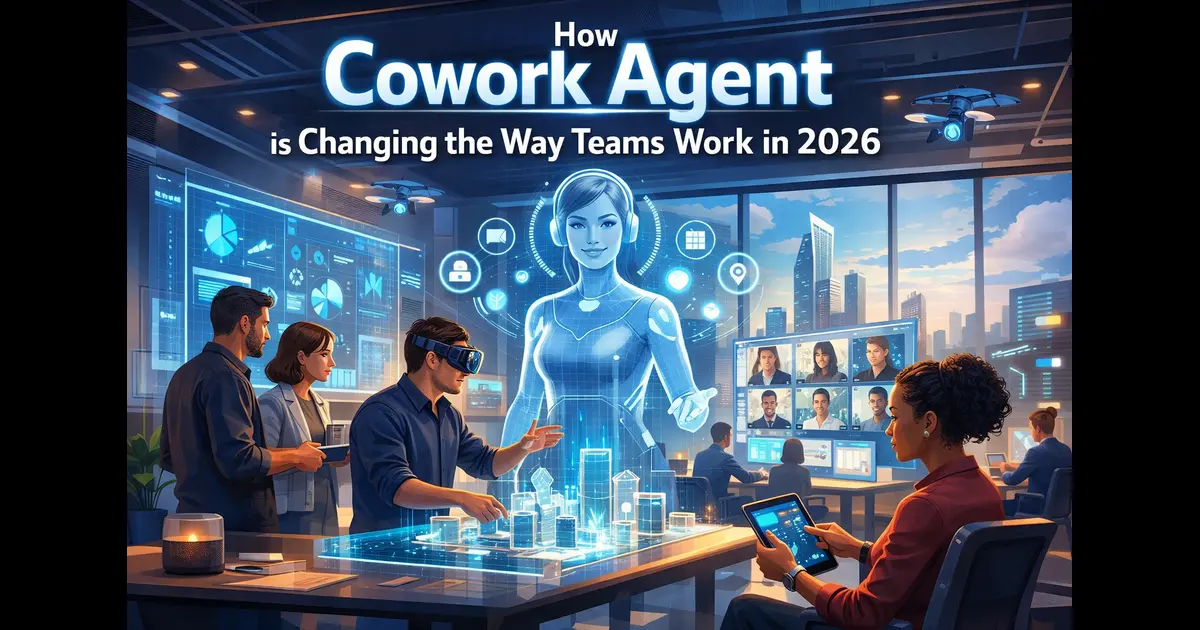
How Cowork Agent is Changing the Way Teams Work in 2026
There’s a moment every knowledge worker knows well — the 3 PM inbox avalanche, the pile of unread research documents, the meeting notes that never quite turn into action items. For years, AI tools promised to fix this. Most of them just added another tab to manage. Then came Cowork.
How Cowork Agent is changing the way teams work in 2026 isn’t a small story. It’s the story of AI finally crossing a threshold — from a tool that tells you what to do, to one that actually does it. Launched by Anthropic in January 2026, Claude Cowork entered the market quietly but landed loudly. Within weeks, SaaS stocks were shaking, Microsoft had announced its own Cowork-powered product, and enterprise leaders were scrambling to understand what an “agentic AI” actually meant for their teams. Several months in, the picture is much clearer — and more compelling.
What Exactly Is Cowork, and Why Is Everyone Talking About It?
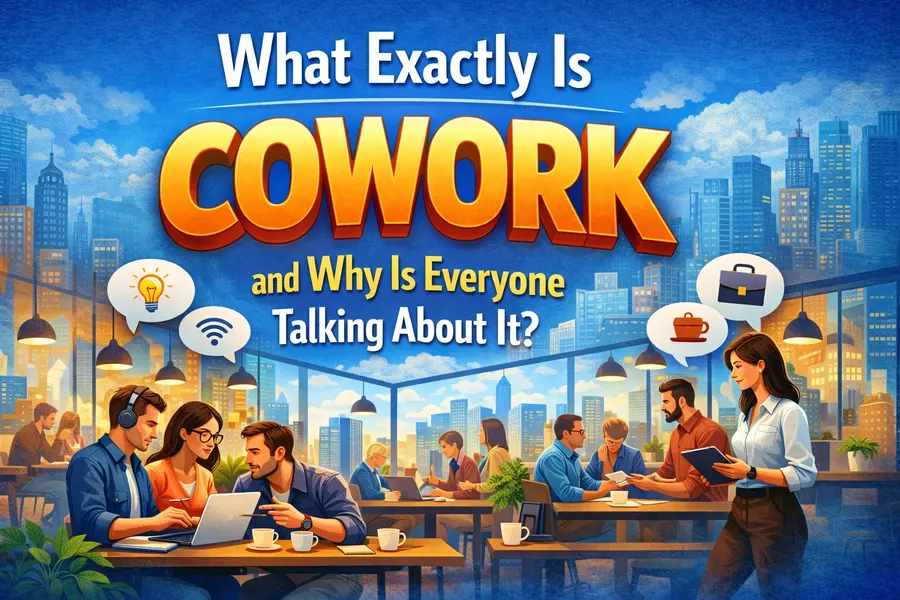
Before getting into what Cowork does for teams, it’s worth understanding what makes it different from the AI tools that came before.
Most AI assistants — including early versions of Claude — operate on a prompt-and-response basis. You ask a question. The AI answers. You take that answer and go do the work yourself. It’s useful, but it’s fundamentally still your work.
Cowork breaks that model. As Anthropic describes it, the product is designed so Claude “doesn’t just answer questions, but actually does the work alongside you.” That’s not marketing language — it’s a functional description of how the system works.
When you open Cowork in the Claude desktop app, you grant it access to specific folders on your machine. You describe a goal — say, “compile these 40 research PDFs into a briefing document sorted by theme, then export a summary spreadsheet.” Cowork plans the task, decomposes it into steps, executes each one, and delivers finished outputs. You can walk away while it works.
That shift — from reactive assistant to autonomous executor — is what’s generating all the noise.
The Architecture Behind the Magic
Understanding why Cowork works so well requires a quick look under the hood, because the engineering here is genuinely interesting.
The Folder-Permission Model
Cowork operates through a folder-permission system. Users explicitly grant read, write, and create access to specific directories. Claude can’t touch anything outside those boundaries. This isn’t just a safety feature — it shapes how users think about working with the tool. You’re essentially handing Cowork a desk drawer and telling it, “everything you need is in here.”
Sub-Agent Coordination
For complex tasks, Cowork doesn’t work sequentially through every step. It spawns multiple Claude instances — sub-agents — that execute independent subtasks concurrently and then aggregate their results. If you ask it to analyze 30 client folders and produce individual summary reports for each one, it’s not doing them one by one. It’s doing them in parallel, which dramatically cuts the time required for large-scale document work.
Built on Claude Code, Built by Claude Code
Here’s a detail that tells you a lot about where AI development is in 2026: Anthropic built Cowork on the same agent architecture as Claude Code — and according to DataCamp’s detailed breakdown, the team used Claude Code itself to build Cowork in roughly one and a half weeks. An AI built by an AI. It’s either poetic or mildly unsettling, depending on your perspective.
Plugins and the MCP Connector Ecosystem
Cowork integrates with external tools through Anthropic’s Model Context Protocol (MCP) and a growing library of connectors. By February 2026, the catalog already included integrations with Slack, Google Drive, DocuSign, Salesforce, Notion, Asana, Box, Canva, and dozens of others. AWS Marketplace, Honeycomb for observability, Fellow.ai for meeting insights — the list keeps growing.
The plugin layer is where things get especially interesting for teams. Rather than each user manually configuring their connectors, admins can bundle tools, knowledge bases, and workflow instructions into a single “plugin” and deploy it across an entire organization. From day one, every employee in a department gets a version of Cowork that already knows their tools, their processes, and their data.
How Cowork Agent Is Changing the Way Teams Work in 2026: Department by Department
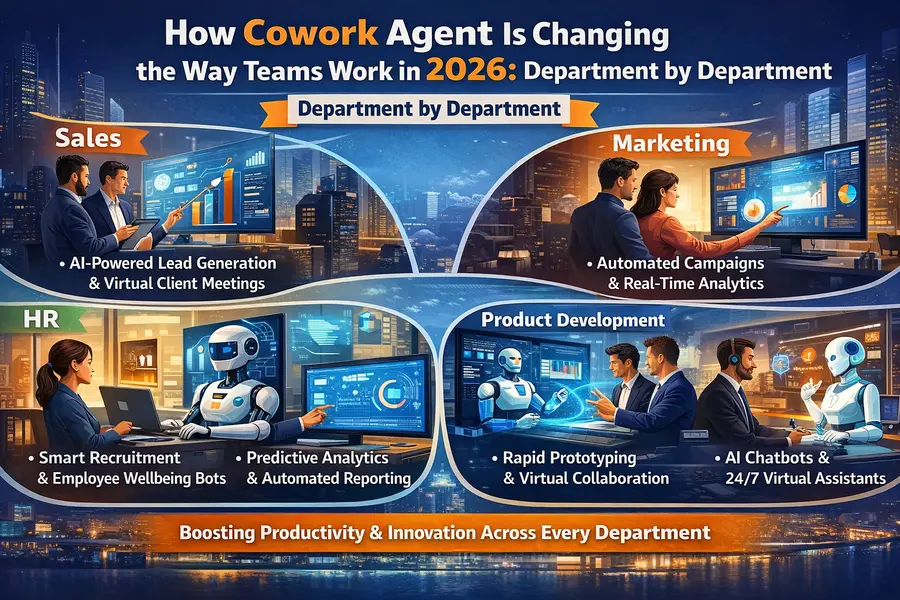
The real question isn’t whether Cowork is impressive in demos. It’s whether it actually changes how real teams operate on a Tuesday afternoon. Based on documented use cases, early adopter reports, and Anthropic’s own enterprise briefings, the answer is yes — and it’s happening across functions, not just in tech.
Legal and Research Teams
Legal was one of the first industries to feel the tremors. When Anthropic released the initial batch of Cowork plugins in early February 2026, stock prices of legal information software providers dropped noticeably — a market signal that investors viewed agentic AI as a genuine threat to tools built around manual legal research.
The reason is straightforward. Legal work is research-heavy, document-intensive, and highly structured — exactly the kind of work Cowork handles well. A legal team can feed Cowork a folder of contracts, ask it to extract specific clauses, flag non-standard language, and produce a comparative summary spreadsheet. What once took a paralegal a full day takes Cowork under an hour.
HR and People Operations
At Anthropic’s enterprise briefing in February 2026, their own HR team demonstrated how Cowork transformed performance review workflows. One specific example: a team built a Cowork skill around a complex performance review spreadsheet with seven competency facets and branching logic based on employee level and role. The result was an interactive guided experience that would previously have required engineers to build a custom React application. Cowork delivered it in 45 minutes.
Non-technical HR professionals who spent hours manually compiling data from surveys, interviews, and performance records can now describe what they need and let Cowork structure the outputs.
Sales and Business Development
Sales teams are using Cowork to cut the time between “meeting happened” and “follow-up sent.” Given a folder of meeting transcripts or call notes, Cowork identifies action items, drafts follow-up emails, updates relevant documents, and saves everything in an organized directory — without the sales rep lifting a finger beyond the initial instruction.
The time savings compound quickly. If a rep has 15 client calls per week and spends 20 minutes on post-call admin for each one, that’s five hours every week spent on work that Cowork can handle in the background.
Finance and Operations
Finance teams at Anthropic’s internal demo on February 24 showed how Cowork integrates with their reporting workflows. For operations teams, the biggest win tends to be in recurring processes — monthly reporting cycles, vendor data consolidation, file organization after project completion. These are tasks that are low-skill but high-volume, and they’re exactly what Cowork was designed to absorb.
One striking data point from enterprise AI research: companies using agentic AI in operations workflows have seen claim processing times drop from an average of 3.4 days to 2.1 days, with error rates in document processing falling from 7% to 3%. While those numbers aren’t Cowork-specific, they reflect what happens when autonomous agents replace manual verification steps.
The Microsoft Factor: Cowork Goes Enterprise
If Anthropic’s launch of Cowork in January 2026 was a proof of concept, Microsoft’s announcement in March 2026 was the validation.
On March 9, 2026, Microsoft announced Copilot Cowork — built in direct collaboration with Anthropic and using the same agentic harness as Claude Cowork. The product runs in the cloud inside Microsoft 365’s infrastructure, rather than locally on a user’s device, and draws on a user’s full enterprise data graph: Outlook emails, Teams conversations, SharePoint files, Excel workbooks, and calendar history.
This is a meaningful architectural distinction. Anthropic’s Cowork is personal and local — powerful for individual workflows but constrained by what lives on your machine. Microsoft’s version is organizational and cloud-native — it can coordinate workflows that span entire departments, grounded in months of enterprise communication and document history.
Microsoft’s Jeff Spataro described Anthropic’s product as “a fantastic tool” that “demonstrates the value of agentic capabilities” but noted its limitations in large enterprise environments where data governance and cloud security are non-negotiable. Copilot Cowork is currently in research preview with select enterprise customers, with broader access planned through the Frontier program.
The pricing tells the story of enterprise ambition: Copilot Cowork requires a $30 per user per month license, and Microsoft’s new M365 E7 bundle — which includes Cowork, Agent 365, and a full enterprise AI stack — is priced at $99 per user per month.
What Makes Cowork Different From Other AI Tools in 2026?
It’s a crowded market. Microsoft Copilot, Google’s Gemini for Workspace, various AI agents built on open frameworks — teams have options. So what specifically sets Cowork apart?
Depth Over Breadth
Unlike tools that try to do a little bit across every workflow, Cowork goes deep on task execution. The architecture is designed for complex, multi-step, multi-file operations that run to completion without constant human input. A six-week review by Hackceleration found that users routinely saved 6 to 8 hours per week on administrative work — not by using Cowork for everything, but by delegating specific high-volume tasks to it.
Consistency and Reliability
Comparative reviews in early 2026 consistently note that Cowork produces more reliable, consistent outputs than faster competitors like Grok Agent. For professional contexts where accuracy matters more than speed — legal documents, financial reports, executive briefings — that consistency has real value. Cowork rarely hallucinates, and its outputs require less editing than those from tools optimized for speed.
The Plugin/Skills Architecture
The ability for organizations to build and distribute custom plugins is genuinely differentiated. A company can create a “Sales Specialist” plugin that bundles their CRM data, their pitch templates, their call recording summaries, and their competitive intelligence — then deploy it to every sales rep instantly. From the first conversation, Cowork behaves like a specialist who already knows the business.
Skills created for Cowork also aren’t locked to Claude’s ecosystem. According to Anthropic’s Agent Skills documentation, the skill format works across AI platforms that adopt the standard, which reduces vendor lock-in concerns for enterprise buyers.
Honest Limitations: What Cowork Still Can’t Do Well
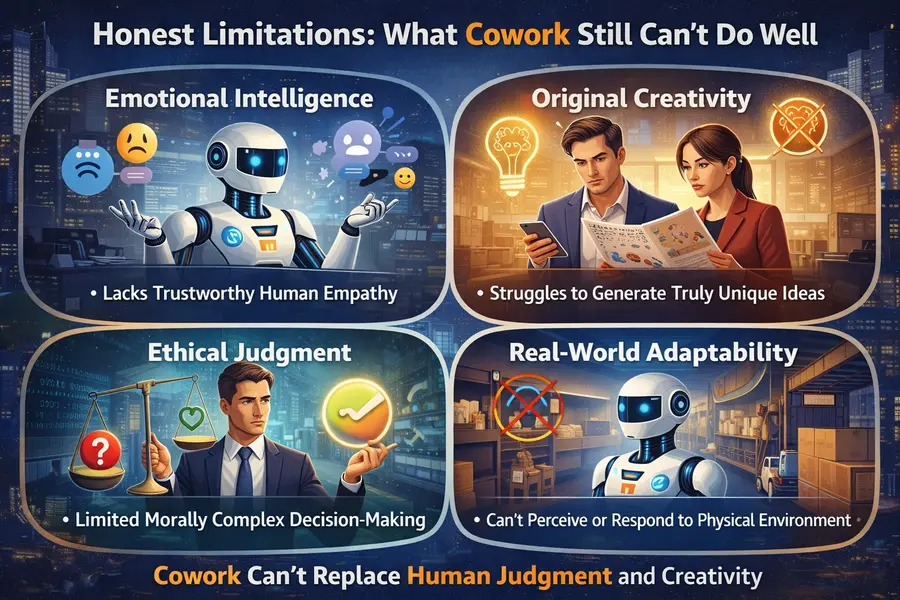
No product review is complete without this section, and the limitations here are real enough to matter for some teams.
It’s still in research preview. Anthropic is explicit that agent safety is still in active development. Users should maintain backup procedures before granting directory access — early users on GitHub reported instances where Cowork consumed files unintentionally during testing.
Microsoft 365 integration is limited on the Anthropic version. The desktop Cowork product does not connect to Outlook, OneDrive, or Microsoft Teams. If your organization lives in the Microsoft stack, you’re either waiting for Copilot Cowork or using workarounds.
Compliance and regulated industries must wait. Anthropic explicitly states that Cowork should not be enabled for HIPAA, FedRAMP, or FSI-regulated workloads. Cowork activity is also not captured in audit logs, compliance APIs, or data exports for Team and Enterprise plans — a gap that security-conscious organizations will notice.
It consumes more capacity than standard chat. A single complex Cowork session can consume the equivalent of 50 to 100 standard Claude messages. Teams on lower-tier plans may hit usage limits faster than expected.
Sessions don’t sync across devices. Conversation history is stored locally, so there’s no continuity if you switch machines. For teams working across multiple devices, this creates friction.
The Bigger Picture: AI That Works Instead of Advises
Zoom out and what you see in 2026 is a fundamental transition in how teams relate to AI. The consulting era of AI — where the model gives you advice and you execute — is giving way to a delegation era, where you describe outcomes and AI delivers them.
Insight Partners published a roundtable in April 2026 noting that “the shift from building to managing the full agent lifecycle — optimizing, securing, and governing in production — is where the work now lives.” That’s exactly right. The early question was whether agents could work. The current question is how to deploy, govern, and measure them at scale.
Salesforce’s Agentic Enterprise Index found the top three areas where AI agents are currently delivering value: customer service, internal business automation, and sales. These aren’t experimental use cases — they’re live deployments at major organizations, and they’re producing measurable cycle time reductions and cost savings.
Industry data suggests AI is expected to augment 30 to 50 percent of daily work activities in knowledge roles. That’s not replacement. It’s reallocation — moving human attention away from file sorting and report compilation and toward the judgment, creativity, and relationship work that machines still can’t replicate.
Getting Started: Practical Guidance for Teams Considering Cowork
If you’re evaluating Cowork for your team, here’s what the evidence actually supports:
Start with high-volume, repeatable tasks. File organization, report generation from raw notes, data extraction from documents — these are where Cowork’s ROI is clearest and fastest.
Don’t expect magic on day one. Like any new tool, Cowork rewards teams that invest time in setting up good folder structures and clear task instructions. Vague prompts produce vague outputs. Specific, well-scoped goals produce finished deliverables.
Pro plan handles most knowledge work. At $20 per month, Claude Pro includes Cowork access. For typical teams not processing massive document volumes daily, the Pro plan covers 80 percent of use cases. Max ($100-200/month) is justified if you’re running complex, high-frequency operations.
Build plugins for your domain. If you’re deploying Cowork to a team, invest in building a domain-specific plugin. The difference between generic Cowork and a customized “Finance Team Specialist” plugin is the difference between a capable generalist and a trained collaborator who already knows your workflows.
Keep humans in the loop for high-stakes decisions. Cowork is designed to show you what it plans to do before taking significant actions. Don’t disable these checkpoints. The value is in autonomous execution of routine work, not in removing human oversight from consequential decisions.
Conclusion: This Is What the Shift Actually Looks Like
The phrase “AI is changing work” has been overused for years. Most of the time, it meant “AI is changing a few tasks for a few people with the patience to figure it out.” Cowork is something different.
For the first time, teams across legal, HR, finance, sales, and operations have access to an AI that can be genuinely delegated to — not just consulted. The architecture is solid, the use cases are documented, and the enterprise ecosystem is already forming around it.
The limitations are real, the pricing isn’t trivial, and the governance questions are still being worked out. But the direction is clear. How Cowork Agent is changing the way teams work in 2026 isn’t a hypothetical anymore. It’s happening in real organizations, on real projects, every day.
The teams that figure it out first will have a productivity advantage that compounds over time. The question isn’t whether to pay attention to this — it’s how fast you can move.
Disclaimer
This blog post is intended for informational purposes only. The information presented here is based on publicly available sources and data accurate as of April 2026. Product features, pricing, and availability of Claude Cowork and related tools may change over time. We are not affiliated with Anthropic or any of the companies mentioned in this article. Readers are encouraged to visit official sources for the most current and accurate information before making any purchasing or business decisions.
🔗 Related Articles You Should Read
-
What Is TurboQuant? A Complete Beginner’s Guide
Learn how TurboQuant improves AI performance by reducing memory usage and boosting speed.
-
The Future of Deepfake Technology: Opportunities & Risks
Explore how AI-generated media is evolving and why it’s becoming harder to detect.
-
How AI Is Rewriting the Rules of Student Learning
Discover how AI tools are transforming education, learning habits, and student productivity.
About the Author