
If you’ve been looking for a way to build real income online without years of design school or a professional camera setup, learning how to earn money with AI-generated images is one of the most practical opportunities available right now. The market isn’t hypothetical — it’s already massive and still accelerating.
According to current market data, the global AI-powered image generation tool market was valued at $9.1 billion in 2025 and is projected to grow at a CAGR of 40.5% through 2035. Meanwhile, 20% of Americans already used AI to generate images or videos as of 2024, and that number has climbed considerably in 2026. Businesses, marketers, content creators, and agencies are all consuming AI-generated visuals at a scale that traditional photography simply can’t keep up with.
This guide breaks down exactly how to monetize that demand — which platforms pay the most, which tools give you the best results, and what strategies are actually working right now in April 2026.
What’s Changed in 2026 (And Why It Matters)
Before diving into strategy, it’s worth understanding how the landscape has shifted. The platform policies around AI content have evolved significantly. Adobe Stock remains the clearest path for contributors, fully accepting AI-generated images with proper disclosure. Vecteezy offers one of the most generous commission rates at 50%. Creative Fabrica has emerged as a powerhouse for pattern sets and clip art bundles.
On the other hand, Shutterstock no longer accepts AI-generated content submitted by external contributors — they now run their own internal AI image generator. Getty Images similarly maintains its ban on AI submissions due to unresolved copyright concerns.
The copyright picture also got clearer in early 2026. The U.S. Copyright Office has confirmed that purely machine-generated images without meaningful human creative input cannot be copyrighted. However, images where you’ve made substantial creative choices — through prompting, curation, post-editing, and style direction — can qualify for protection. This matters practically: it means owning a distinctive style and process is your competitive moat, not just the raw output.
5 Proven Ways to Earn Money with AI-Generated Images
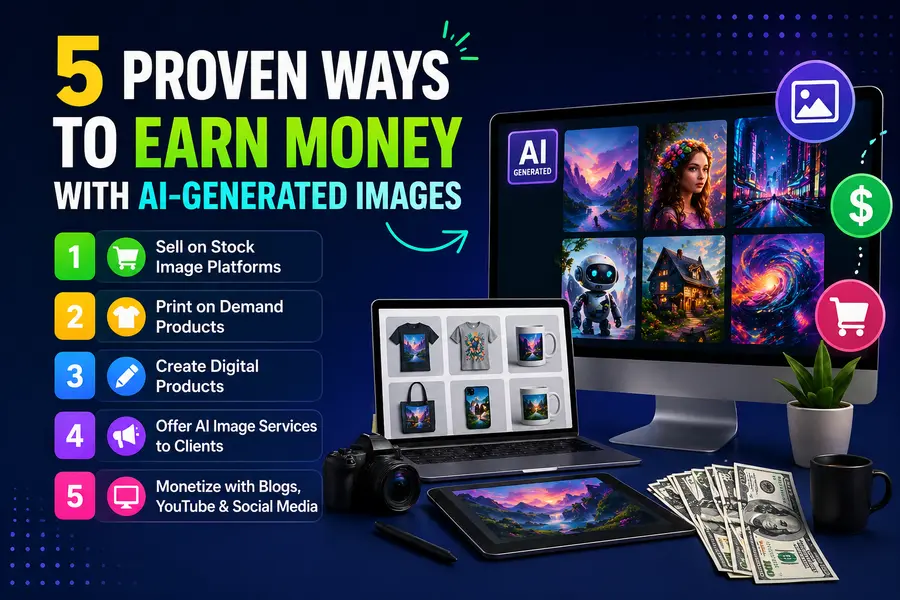
1. Sell on Stock Photo Platforms
This is the most reliable passive income path. You generate images once, upload them, and earn royalties every time someone licenses them. No customer service, no fulfillment — just recurring income from a growing library.
The best platforms right now:
- Adobe Stock — The #1 destination for AI contributors. Pays 20–33% royalties on standard licenses and up to 60% on extended licenses. Accepts AI content as long as it’s labeled “Generative AI” during upload. Commercial-ready images — business concepts, technology themes, diverse lifestyle photography — sell consistently here. Aim to upload 20–30 images per week to build momentum.
- Vecteezy — Actively welcomes AI content and offers a 50% commission rate, the highest among major stock platforms. A strong complement to Adobe Stock, particularly for vector-style and illustrative work.
- Creative Fabrica — Operates on a subscription model where buyers pay monthly for unlimited downloads, and you earn based on download frequency. If you can produce themed AI art sets — seasonal clip art, seamless patterns, SVG bundles — this platform rewards high-volume uploaders with compounding passive income.
- Wirestock — Functions as a distribution layer rather than a direct marketplace. Upload once, and Wirestock submits your images to multiple platforms including Adobe Stock, Alamy, and Depositphotos. They take a 15% commission but handle keyword optimization and submission management. Monthly earnings typically range from $50 to $1,500 depending on volume and quality.
Platform earnings comparison at a glance:
| Platform | Commission Rate | AI Content? | Best For |
|---|---|---|---|
| Adobe Stock | 20–33% (up to 60%) | ✅ Yes | Business, lifestyle, tech visuals |
| Vecteezy | 50% | ✅ Yes | Illustrations, vectors |
| Creative Fabrica | Per-download (subscription) | ✅ Yes | Clip art, patterns, SVG sets |
| Wirestock | ~85% (after 15% fee) | ✅ Yes | Multi-platform distribution |
| Getty Images | N/A | ❌ No | N/A |
What sells: Clean business illustrations, technology concepts, diverse people in professional settings, seasonal content, and abstract backgrounds consistently outperform purely artistic work on stock platforms. Think about what a marketing team at a mid-sized company would search for on a Tuesday afternoon — that’s your target.
2. Print-on-Demand Products
You don’t need inventory. You don’t need to ship anything. Print-on-demand services like Redbubble, Merch by Amazon, Printful, and Society6 let you upload designs to physical products — t-shirts, mugs, phone cases, wall art, tote bags — and take a cut every time someone orders.
AI image generation fits this model perfectly. You can spin up 50 variations of a concept — retro travel poster styles, botanical illustrations, minimalist typography designs — in the time it would take a traditional designer to finish one. The economics improve dramatically when you find a design that connects.
What works in 2026:
- Niche targeting — Instead of generic art, go deep on specific communities. Vintage-style national park designs for hikers. Cottagecore botanical prints for home decor enthusiasts. Retro gaming aesthetics for millennial buyers.
- Trend timing — AI tools let you produce trend-relevant designs fast. A viral aesthetic can be turned into 20 product variations within a day.
- Collections over singles — A cohesive collection of 10–15 related designs builds a brand identity and increases the chance that a buyer purchases multiple items.
A single viral design on Redbubble can generate $1,000+ monthly. More realistically, a consistent portfolio of 200–300 designs produces a stable $300–800/month of largely passive income.
3. Sell AI Prompts
This one surprises people, but it’s real: the most strategic creators in 2026 don’t just sell images — they sell the processes that produce the images.
PromptBase is the primary marketplace for this. A well-crafted stock photography prompt with specific style cues, lighting direction, and subject details sells for $2–$10 per transaction. The key insight: once you write a great prompt, you’ve created a reusable asset with near-zero marginal cost. Top sellers on PromptBase report earning $500–$2,000 per month from prompt libraries alone.
Etsy and Gumroad are equally viable for bundling prompts into paid guides or themed packs. A “100 Midjourney prompts for e-commerce product photography” guide, priced at $15–$25, can sell continuously to new buyers discovering it through search.
The smartest strategy is layered: use your best prompts to generate images for stock platforms, then sell the prompts themselves on PromptBase. You’re monetizing the same creative work twice.
4. Offer AI Image Services to Businesses
Not everyone wants to learn prompt engineering. Small businesses, local brands, and entrepreneurs need custom visuals but can’t afford agency rates or don’t have the patience for DIY tools. That gap is your freelancing opportunity.
What businesses will pay for in 2026:
- Product mockups and e-commerce visuals — AI can generate professional product-on-surface shots, lifestyle context images, and background variations without a photo studio
- Social media content packages — Recurring monthly deliveries of 20–30 branded social images
- Blog and article illustrations — Content teams need custom visuals that aren’t generic stock photos
- Brand concept exploration — Founders and designers use AI to rapidly visualize brand directions before committing to full design work
Freelance rates for AI image services range from $30–$150/hour depending on complexity and your positioning. On platforms like Fiverr and Upwork, productized AI art packages — 10 social media graphics for $150, for example — perform well and convert better than hourly billing.
The advantage of service work is immediate cash flow. Unlike stock platforms that build slowly over months, a freelance client can pay you within a week of finding you.
5. Build an Audience and Monetize Through Content
This is the highest-ceiling path but the slowest to start. If you document your process — the prompts you use, the niches you target, the platforms you prefer, the techniques for fixing AI artifacts — you build an audience of people who want to learn what you know.
That audience becomes monetizable through:
- YouTube AdSense — Tutorial channels covering Midjourney, Adobe Firefly, and Stable Diffusion consistently attract large audiences
- Newsletter subscriptions — A weekly roundup of AI image tips, prompt ideas, and platform updates
- Courses and workshops — A structured course on “building a passive income stock photo portfolio with AI” can sell for $97–$297
- Affiliate revenue — Tools like Midjourney, Adobe Creative Cloud, and Canva all have affiliate programs
This path compounds. A YouTube video published in January keeps earning in December. A well-written course sells to new students for years.
The Best AI Tools for Making Money with Images in 2026

Your tool choice directly affects the quality and commercial viability of your output. Here’s an honest breakdown:
Midjourney v7/v8 — Still the gold standard for artistic and editorial aesthetics. Produces the most distinctive, visually compelling images. Ideal for print-on-demand, editorial stock, and creative projects. Starts at $10/month, and commercial rights are included.
Adobe Firefly — The safest legal choice for commercial stock work. Trained exclusively on licensed Adobe Stock content and public domain images. Includes a commercial indemnification guarantee, which means if a copyright claim ever arises, Adobe covers it. Built into Adobe Creative Cloud, making post-processing seamless. Ideal for Adobe Stock contributors specifically.
Flux 2 (Black Forest Labs) — Leads on pure photorealism in 2026. Exceptional skin texture rendering, lighting simulation, and detail accuracy. The tool of choice when you need images that are indistinguishable from professional photography. Particularly strong for lifestyle and people-focused stock content.
DALL-E 3 (via ChatGPT) — Excels at following specific, complex instructions precisely. When you need exact compositional control — a specific number of people, a particular layout, specific objects — DALL-E 3 delivers more reliably than competitors. Included with ChatGPT Plus at $20/month.
Stable Diffusion (open source) — Free, locally runnable, and infinitely customizable. The ceiling is high for technical users who want complete control. The learning curve is steeper, but the zero-cost operation makes it attractive for high-volume production.
What Actually Sells: Niche Strategy
The most common mistake beginners make is producing random images across wildly different styles and subjects. Stock platforms and print-on-demand algorithms both reward specialization.
High-performing niches right now:
- Inclusive business imagery — Diverse professionals in modern workplace settings remain perpetually in demand. Businesses actively seek representation they can’t always find in traditional stock libraries.
- Technology concepts — AI, cybersecurity, data visualization, fintech, and cloud computing themes are bought by B2B content teams constantly.
- Wellness and mental health — Calm, serene imagery representing mindfulness, therapy, journaling, and self-care has seen sustained demand growth.
- Sustainable living — Clean energy, urban gardens, eco-friendly products, and climate-conscious lifestyle imagery speaks to a growing market segment.
- Seasonal and holiday content — Predictably purchased on a recurring annual cycle. A library of well-produced Christmas, Easter, or Halloween content earns every year.
Pick one or two niches and build 100+ images before expanding. Consistency in style and subject matter builds a brand identity within the platform algorithm and makes your portfolio more compelling to buyers.
Legal and Disclosure Requirements You Need to Know
Every major platform in 2026 requires disclosure of AI-generated content. This isn’t optional — failing to label properly results in rejections and can get your account suspended.
On Adobe Stock, you must check the “Generative AI” box during upload. On Etsy, you must mention AI generation in your listing description. On Gumroad, clear disclosure in your product description is expected.
Beyond platform compliance, avoid these legal pitfalls:
- Don’t generate images that closely mimic specific living artists’ styles
- Avoid any recognizable real person’s likeness without explicit consent
- Stay away from branded elements — logos, product designs, recognizable buildings with trademark implications
- Don’t mimic trademarked characters or IP from games, films, or franchises
When in doubt, Adobe Firefly is the most legally conservative choice due to its indemnification policy.
Building a Multi-Stream Strategy
The most financially resilient approach in 2026 isn’t picking one platform — it’s layering multiple income streams from the same creative work.
Here’s how the smartest AI image creators structure their income:
- Generate a library of images in a specific niche using Flux 2 or Midjourney
- Upload to Adobe Stock and Vecteezy for passive royalty income
- Use Wirestock to distribute broadly across additional platforms
- Upload best designs to Redbubble and Merch by Amazon for print-on-demand
- List the prompts on PromptBase or bundle them into a Gumroad product
- Document the process on YouTube or a blog to build an audience and affiliate income
Each layer compounds the others. Your YouTube tutorial drives traffic to your Gumroad prompt packs. Your Gumroad audience discovers your stock portfolio. Your stock earnings fund better tools, producing higher-quality images, which generate more sales.
Realistic Earnings Expectations
Let’s be direct about what to expect:
Month 1–3: Mostly setup and learning. You’ll earn little to nothing from stock platforms while your library grows. Freelance services can generate income faster — your first client can pay you within weeks.
Month 4–6: A stock portfolio of 300–500 images across Adobe Stock and Vecteezy can generate $100–$400/month. This grows as your library expands and your metadata improves.
Month 6–12: With consistent uploads (50+ images/week) and a diversified strategy, $500–$1,500/month becomes realistic. A breakout print-on-demand design or a viral Gumroad prompt pack can spike this higher unpredictably.
Year 2+: Creators who stayed consistent report $2,000–$5,000/month from stacked passive streams. The compounding effect of a large, well-optimized library becomes significant at this stage.
Getting Started This Week
You don’t need to wait for perfect conditions. Here’s a practical first week:
- Choose your tool — Start with Adobe Firefly if you’re targeting Adobe Stock (it’s the safest legal choice), or Midjourney if you want the best artistic output
- Pick a niche — Choose one underserved category you can produce 50+ images in
- Create a contributor account on Adobe Stock — Complete the W-8BEN tax form if you’re outside the US
- Generate and upload your first 20 images — Focus on quality over quantity initially
- List your prompts on PromptBase — Even your early prompts have value to someone else starting out
Learning how to earn money with AI-generated images isn’t a get-rich-quick scheme, but it’s also not a pipe dream. The market infrastructure is real, the demand is documented, and the tools are accessible. The creators earning meaningful income in 2026 aren’t doing anything magical — they’re showing up consistently with a clear niche strategy, treating their AI image business with the same discipline they’d apply to any other creative business.
The gap between people who dabble and people who earn is simply consistency and a willingness to learn from what the data tells them. Start small, track what sells, and build from there.
Final Thoughts
The window to build real income with AI-generated images is open right now — but it won’t stay this uncrowded forever. The creators who move early, pick a niche, and stay consistent are the ones building libraries that pay them months and years down the line.
You don’t need to master every platform or every tool at once. Pick one monetization path, execute it well, and add layers as you grow. The infrastructure is already there — stock platforms, print-on-demand services, prompt marketplaces — all waiting for quality content to fill them.
The only thing that separates someone earning $50/month from someone earning $2,000/month in this space is time in the game and a willingness to learn from the data. Start today, stay consistent, and let the compounding do its work.
Disclaimer
This article is for informational purposes only. Earnings figures mentioned are estimates based on publicly available data and community reports — individual results will vary depending on effort, niche, tools used, and market conditions. Platform policies regarding AI-generated content change frequently; always verify current contributor guidelines directly on each platform before uploading or selling. This post does not constitute legal or financial advice. For copyright-related concerns specific to your situation, consult a qualified legal professional.