Everyone has used ChatGPT or at least heard of it. Millions of people fire it up daily to write emails, debug code, plan trips, or just have someone to talk to at 2 AM. But here’s the thing — most people only know the surface story. The true story behind ChatGPT is far messier, far more human, and far more fascinating than the polished press releases ever let on.
We’re talking about a nonprofit that quietly became one of the most valuable companies on Earth. A co-founder who was fired by his own board and rehired five days later. A billionaire partner who walked out because of a power dispute. And a chatbot that nobody inside the company actually expected to become a cultural phenomenon overnight.
Let’s get into it.
It Started as a Nonprofit — With a Counterintuitive Goal
OpenAI was founded in December 2015 by a group of tech luminaries including Sam Altman, Greg Brockman, Ilya Sutskever, Wojciech Zaremba, John Schulman — and yes, Elon Musk. You can read the original founding intent on OpenAI’s About page. The founding mission was explicitly not about profit. The organization was set up as a nonprofit research lab, and the stated goal was to develop artificial general intelligence in a way that would benefit all of humanity rather than concentrate power in the hands of a few corporations.
The irony? It was founded because the founders were afraid of what Google might do with AI. The thinking was simple: if powerful AI was coming regardless, better to have an open, safety-focused lab at the frontier than to cede the entire field to profit-driven giants.
Musk’s involvement was central in those early days. He contributed heavily to the initial $1 billion pledge that got OpenAI off the ground. But by 2018, things had already started fracturing. Discussions about who would run the for-profit division — which the founders knew they’d eventually need — broke down. Musk left the board that year.
His departure would set the stage for one of the most bitter feuds in Silicon Valley history.
The Elon Musk Break — And Why It Still Matters in 2026
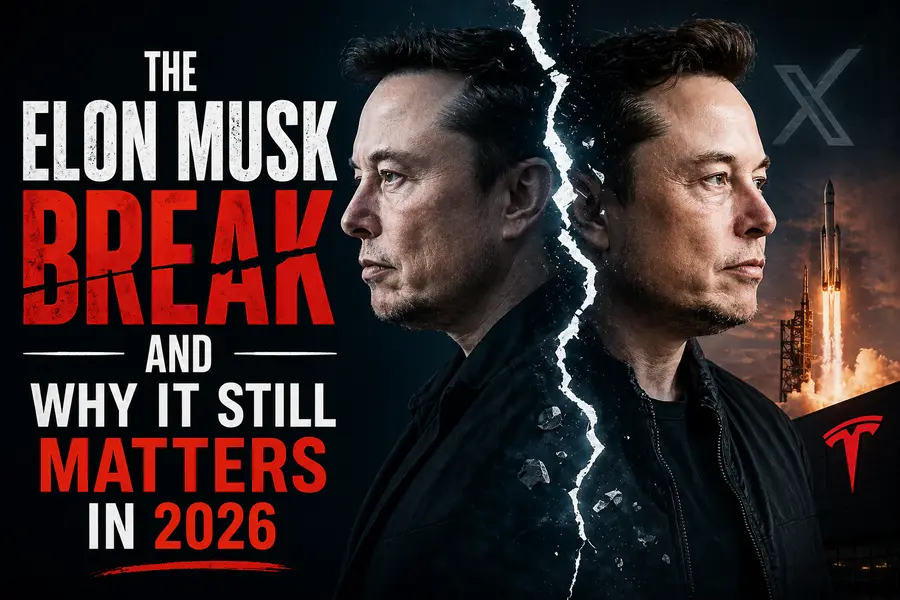
Musk didn’t just quietly walk away. For years after his departure, he was vocal about what he believed OpenAI had become. He argued that the company, which he had helped name and launch, had drifted entirely from its founding principles.
“OpenAI was created as an open source nonprofit company to serve as a counterweight to Google,” he wrote publicly, “but now it has become a closed source, maximum-profit company effectively controlled by Microsoft. Not what I intended at all.”
That tension exploded into full legal warfare. As of late April 2026, Musk is actively in court against OpenAI and Sam Altman, with his lawyers arguing that Altman and others “enriched themselves” through the for-profit conversion in ways that “breached the very basic principles on which the charity was founded.”
OpenAI’s position is that turning to private capital was simply unavoidable — that training frontier AI models requires infrastructure so expensive that no nonprofit structure could sustain it. Both arguments have merit, and the case is still unfolding as of this writing.
What makes this story genuinely important is that the lawsuit cuts to the heart of what AI development actually is in 2026: an extraordinarily expensive, commercially intense industry that can no longer afford to be purely altruistic, even when it wants to be.
The Microsoft Deal That Changed Everything
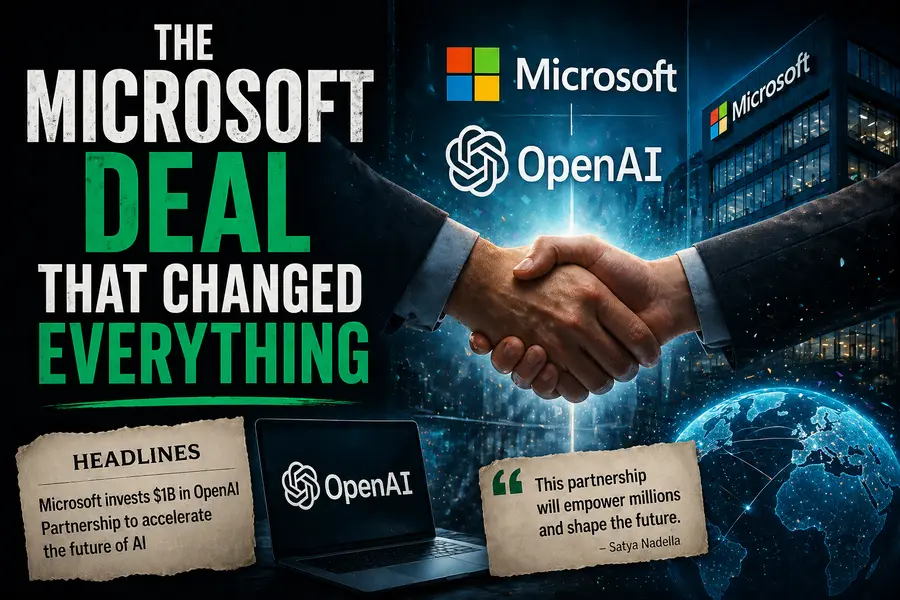
After Musk’s departure, OpenAI needed funding — serious, sustained, billion-dollar funding. Enter Microsoft. The partnership that followed is now described as one of the most consequential in tech history.
Microsoft made a multibillion-dollar investment in OpenAI, giving the company access to vast Azure cloud computing resources needed to train increasingly powerful models. In exchange, Microsoft got preferential access to OpenAI’s technology for its products — Bing, Office, Azure AI, and eventually Copilot.
What’s rarely discussed is how dependent this relationship made OpenAI on a single corporate partner. A nonprofit mission, now running on Microsoft’s cloud, selling subscriptions and API access, with its CEO appearing on CNBC, was a fundamentally different creature from what was founded in 2015.
The commercial flywheel was spinning fast, and it only accelerated when ChatGPT launched.
ChatGPT’s Launch: Nobody Expected It to Work This Well
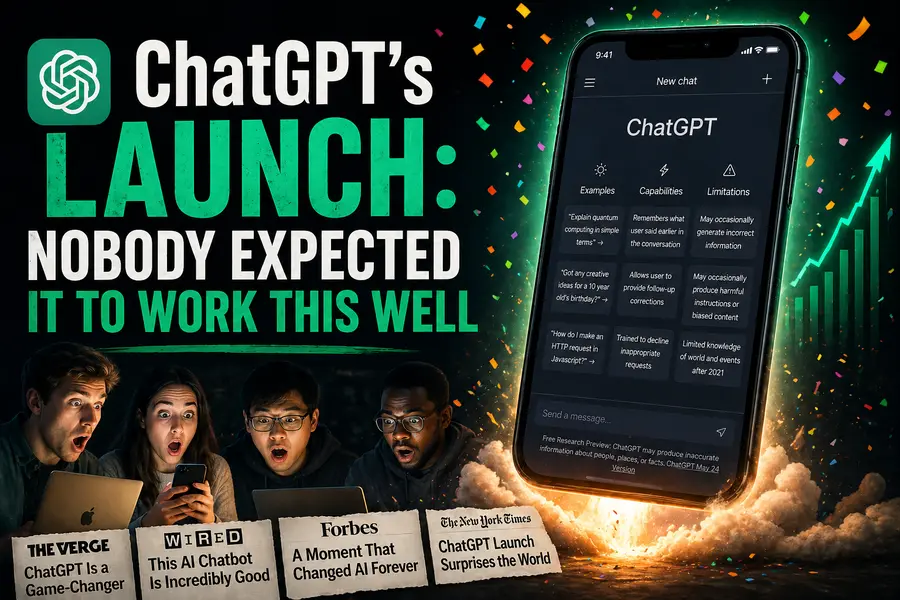
Here’s the part the official story glosses over entirely. When OpenAI released ChatGPT on November 30, 2022, they launched it with zero fanfare. No press event. No splashy keynote. The team internally called it a “research preview” — essentially a public beta meant to collect feedback. MIT Technology Review’s inside oral history captures exactly how unprepared everyone was.
Sandhini Agarwal, who works on policy at OpenAI, said it plainly: “We didn’t want to oversell it as a big fundamental advance.”
Liam Fedus, one of the scientists who worked on ChatGPT, was equally candid: “We were definitely surprised how well it was received.”
John Schulman said he was checking Twitter for days after launch and found “this crazy period where the feed was filling up with ChatGPT screenshots.” He expected it to gain a following, but not at that scale.
In other words: the team that built ChatGPT did not think they had built a viral mega-product. They thought they had built a useful research tool. The market disagreed spectacularly.
ChatGPT hit one million users in five days. It reached 100 million users within two months — the fastest any internet application had ever grown. For context, TikTok took nine months to hit that milestone. Instagram needed two and a half years.
The Secret Technical Ingredient: RLHF
Most people know ChatGPT is built on a large language model. Fewer people know the specific technique that made it feel dramatically more useful than anything before it: Reinforcement Learning from Human Feedback (RLHF).
The underlying model — GPT-3.5 — was already a powerful text predictor. But raw language models tend to be erratic. They don’t naturally align with what humans actually find helpful, truthful, or harmless. RLHF fixed this.
Here’s how it worked in simple terms:
- Human trainers ranked different model responses from best to worst
- A “reward model” learned what humans preferred
- The chatbot was then trained using reinforcement learning to optimize for that reward signal
The result was a model that didn’t just predict text — it predicted good responses. Coherent, polite, helpful, contextually aware responses. That’s why talking to ChatGPT felt so different from earlier chatbots. It wasn’t just more powerful under the hood; it was trained to be useful to actual humans.
This technique was not invented by OpenAI. The roots go back to academic research years earlier. But OpenAI was the team that figured out how to scale it into a product, and that made all the difference.
The Boardroom Coup of November 2023
If the story ended at explosive growth, it would be remarkable enough. But 2023 brought something that would have seemed like fiction: OpenAI’s board fired Sam Altman.
On November 17, 2023, the OpenAI board issued a terse statement saying Altman was not being “consistently candid” with the board and removed him as CEO. Within hours, the AI industry was in chaos. Greg Brockman, OpenAI’s president and co-founder, resigned in solidarity.
What followed was five days of extraordinary behind-the-scenes drama. Microsoft, which had bet its enterprise AI strategy on OpenAI, immediately offered to hire Altman. Nearly 700 of OpenAI’s roughly 770 employees signed an open letter threatening to quit and follow Altman to Microsoft unless the board reversed course.
The board reversed course. Altman returned as CEO. Most of the board members who had voted to fire him were gone within days.
The true story behind ChatGPT includes this pivotal moment — because it revealed just how fragile the governance structure was at the world’s most consequential AI company. A nonprofit board had tried to assert control over a company that had grown so large, so fast, that the commercial and human forces inside it simply overwhelmed that authority.
The Numbers Behind the Machine (April 2026 Data)
By early 2026, the scale of what OpenAI has built is almost hard to comprehend:
- 900 million weekly active users on ChatGPT as of February 2026
- ~$20 billion in annualized revenue — up from roughly $3.4 billion in 2023
- $8.5 billion in losses in 2025, with projected losses of $14 billion in 2026
- $830 billion valuation at its latest funding round — potentially the most valuable private company in history
- Over $40 billion raised in total funding
- The Stargate Project, a $500 billion infrastructure commitment for AI computing announced with government backing
The gap between revenue growth and profitability is the defining tension of OpenAI’s current chapter. Training frontier models is extraordinarily expensive. The compute costs required to run ChatGPT at global scale, let alone to keep training more powerful models, devour revenue almost as fast as it comes in.
In January 2026, OpenAI began testing advertisements in its free tier — a move that would have seemed unthinkable in 2022, and one that drew immediate criticism from users who feared the product was becoming more like Google Search.
GPT-5 and the New Era of AI Agents
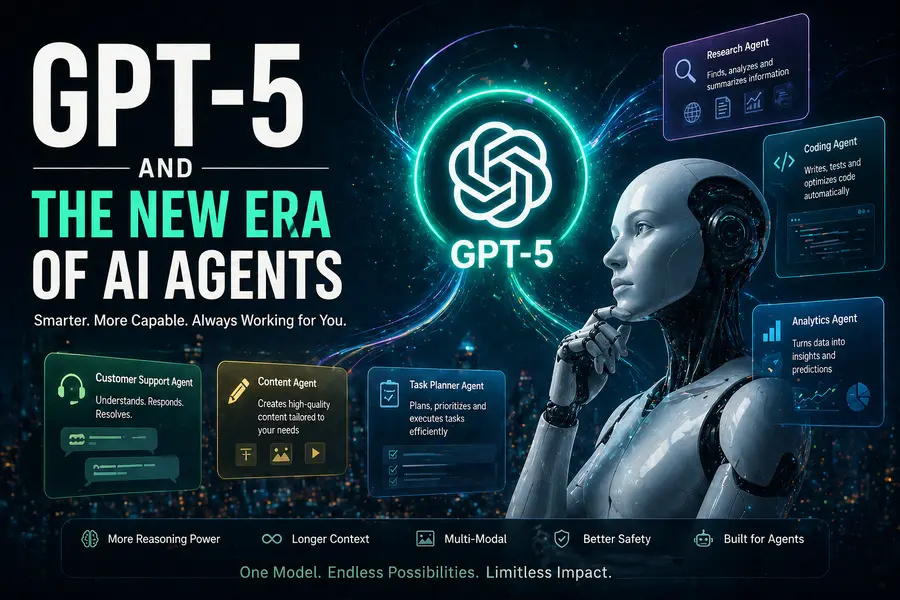
The story doesn’t end at ChatGPT. In August 2025, OpenAI launched GPT-5, which represented what the company described as a shift in approach — prioritizing algorithmic efficiency over raw scale. GPT-5.1 followed in November 2025, and GPT-5.3-Codex launched in February 2026 as a specialized coding variant.
What’s changed is that ChatGPT is no longer primarily a chatbot. It’s becoming a platform for autonomous AI agents — software that can take actions in the world on your behalf, not just answer questions. OpenAI partnered with Stripe in September 2025 to enable purchases directly through ChatGPT. In January 2026, ChatGPT Health launched as a dedicated health-focused conversation layer. ChatGPT for Education is rolling out to countries as a specialized product.
The company is no longer in the chatbot business. It’s in the infrastructure business — building the operating layer for AI-powered work, health, commerce, and education.
What the Official Narrative Misses
Here’s what most coverage of ChatGPT leaves out:
It was almost not built at all. The path from GPT-1 in 2018 to ChatGPT in 2022 involved enormous uncertainty, failed experiments, and multiple pivots. The nonprofit structure nearly collapsed under the weight of compute costs before the capped-profit model was introduced in 2019.
The safety concerns were real, and still are. OpenAI’s own researchers have consistently raised red flags about deploying powerful models too quickly. The policy team was actively trying to figure out how to reduce harm even as the commercial pressure to ship was enormous. That tension has never fully resolved.
The competitive landscape forced the timeline. ChatGPT launched partly because OpenAI knew Google was closing in. When ChatGPT went viral, Google internally sounded a “code red” alarm, recognizing that conversational AI threatened its core search business. The arms race that followed — Gemini, Copilot, Claude, Grok — was shaped by competitive fear as much as genuine readiness.
The human cost is substantial. Training large AI models requires enormous amounts of human-labeled data, including content moderation work that involves reviewing disturbing material. Reports have documented difficult working conditions for some of the contractors involved in this process.
Why This Story Matters Beyond the Hype
The true story behind ChatGPT isn’t really a story about a chatbot. It’s a story about what happens when a small group of people genuinely believe they are working on the most transformative technology in human history — and have to figure out, in real time, how to handle the power that comes with that.
The founders who wanted to counter Google have created something that makes Google nervous. The nonprofit mission that was meant to keep AI open has produced a closed system valued at nearly a trillion dollars. The research tool nobody expected to go viral now has 900 million weekly users and a pending $14 billion annual loss.
None of it went according to plan. And that’s precisely why the story is so worth understanding.
ChatGPT didn’t emerge from a clean corporate strategy executed with discipline. It came from competing ideologies, enormous ambition, genuine scientific breakthroughs, failed governance, unexpected virality, and the strange dynamics of building something you can’t fully control.
That’s the actual story. And it’s far more interesting than the version where a tech company built a clever product and everyone loved it.
The Road Ahead: Where ChatGPT Goes From Here
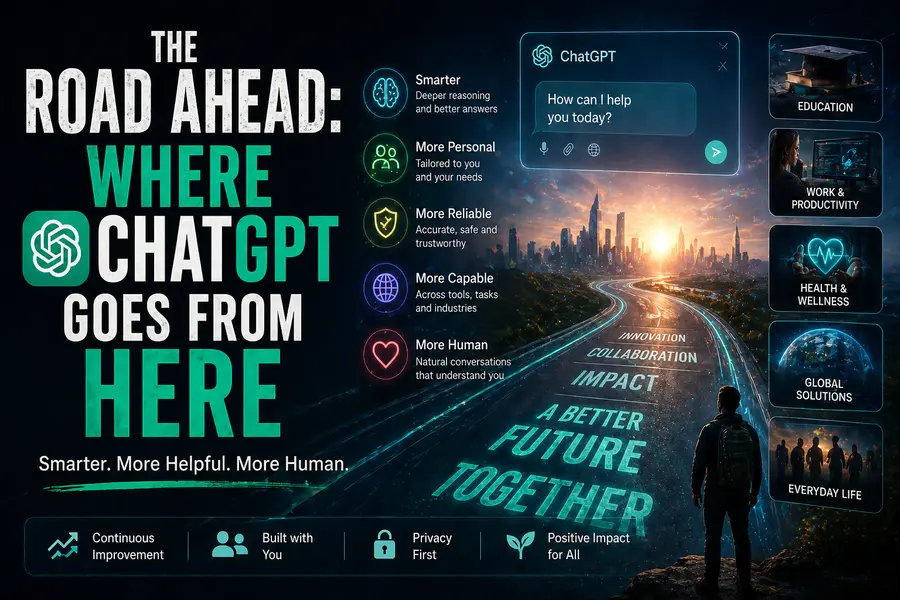
With the Musk lawsuit still in active trial as of April 2026, OpenAI’s corporate restructuring still incomplete, and the company burning cash at a rate that would alarm any conventional investor, the next chapter is genuinely uncertain.
What’s clear is that ChatGPT is now embedded deeply enough in global workflows — in education, healthcare, software development, customer service, and daily personal use — that its continued existence as a dominant platform is not seriously in question.
What is in question is whether the version that reaches a billion users will still carry any meaningful trace of the mission that sparked its creation: AI that genuinely benefits humanity, developed carefully, shared openly.
The true story behind ChatGPT is still being written. And if the first three years are any guide, whatever comes next will probably surprise everyone — including the people building it.
Disclaimer
The information provided in this article is for general informational and educational purposes only. While every effort has been made to ensure accuracy using publicly available data as of April 2026, details surrounding OpenAI and ChatGPT may change rapidly. This post does not represent the views of OpenAI or any affiliated organization. Readers are encouraged to verify any time-sensitive information through official sources before making decisions based on this content.