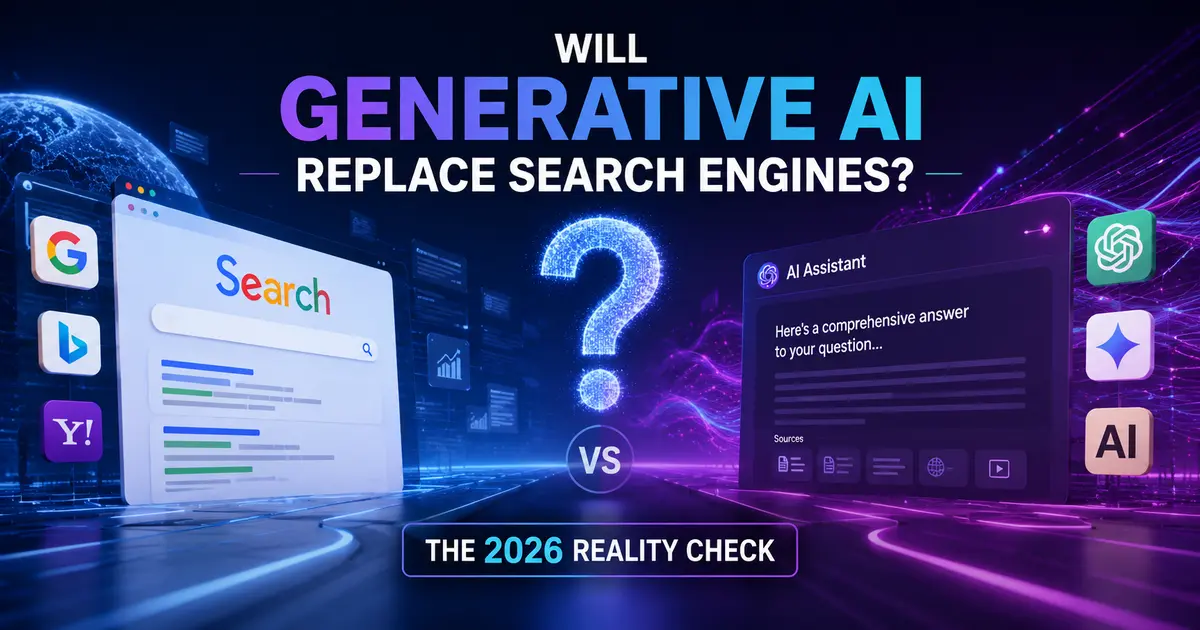
There’s a question that’s been quietly keeping marketers, publishers, and everyday internet users up at night: Will generative AI replace search engines entirely?
It’s not a wild hypothetical anymore. In May 2026, the shift is already happening — just not in the clean, dramatic way that tech headlines tend to promise. The truth is messier, more interesting, and honestly more useful to understand if you’re a business, a content creator, or just someone who Googles things every day.
This post digs deep into where things actually stand. We’ll look at the latest data, compare how these platforms really work, and give you a straight answer on whether Google and traditional search are heading toward extinction — or something else entirely.
The Numbers Tell a Complicated Story
Let’s start with the headline stat everyone’s citing. Gartner predicted that traditional search engine volume would fall by 25% by 2026 as AI-powered “answer engines” absorbed more queries. That number has largely held up — and in some content categories, the traffic losses have been even steeper.
But here’s what the single-stat story misses: Google still holds roughly 80% of global query volume across all device types, according to StatCounter and Similarweb 2026 data. That share remains stable on transactional, navigational, and local queries. The disruption is concentrated — heavily — on informational queries. The kind where someone wants to learn something, research a topic, or get a quick explanation.
That’s exactly where generative AI tools have moved in fast.
As of January 2026, ChatGPT leads the AI search market with 60.7% share, followed by Google Gemini at 15.0% and Microsoft Copilot at 13.2%. Perplexity holds 5.8% and Claude 4.1%. Together, the top three command nearly 89% of the AI search space — a market that’s scaling at a pace that was nearly impossible to predict even two years ago.
ChatGPT now registers 5.4 billion global monthly visits and processes 2 billion queries daily, making it the 5th most visited website on the entire internet. For comparison, Bing gets 1.9 billion monthly visitors. That gap is no longer easy to explain away.
How We Actually Search Has Changed
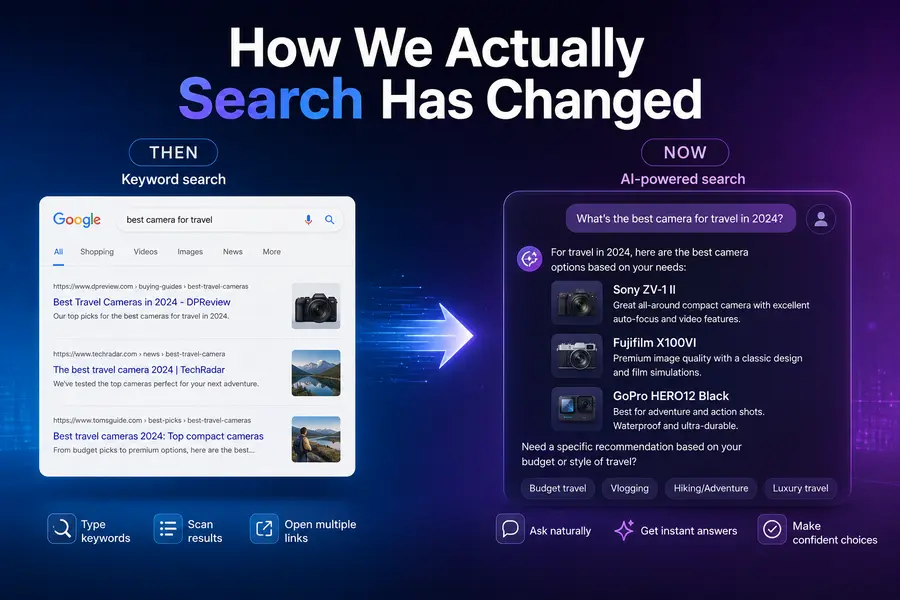
The question “will generative AI replace search engines” assumes these are two separate lanes. In 2026, that boundary is blurring fast — and often by Google’s own design.
Deloitte’s February 2026 research found something revealing: daily use of generative AI within search — where a search query yields an AI-synthesized summary — is 300% more common than usage of any standalone AI tool. By mid-2026, Deloitte forecasts that more adults will have generated a search overview (72%) than have ever used a standalone generative AI app (61%). The AI isn’t replacing the search box. It’s being embedded inside it.
Google’s own response to this moment has been two-pronged: AI Overviews (integrated into standard Google SERPs) and AI Mode (a full-page conversational experience powered by Gemini). AI Overviews now appear in roughly 15–20% of all Google searches and in 57% of long-tail queries. AI Mode, while still not universal, is growing in adoption.
Here’s where it gets sobering for traditional SEO: across all Google searches, 43% now end without any click to an external website. When Google’s AI Mode is active, that number jumps to 93%. Nearly every query resolved in AI Mode stays inside Google’s walled garden. No click, no visit, no traffic.
Generative AI vs. Search Engines: A Direct Comparison
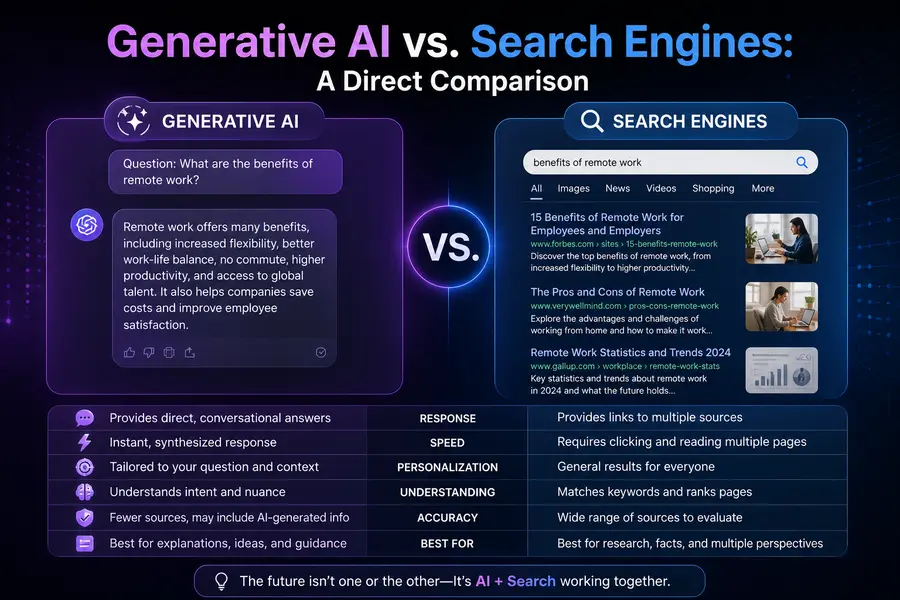
| Feature | Traditional Search (Google) | Generative AI (ChatGPT, Perplexity) |
|---|---|---|
| Query Type Strength | Navigational, transactional, local | Informational, research, multi-step |
| Result Format | Ranked list of links | Conversational, synthesized answers |
| Citation / Sources | Links to websites | Inline citations (Perplexity) or limited links |
| Real-Time Data | Yes, fully indexed | Varies — Perplexity is real-time; ChatGPT is selective |
| Zero-Click Rate | ~34–43% | ~93% in AI Mode; varies by platform |
| Conversion Quality | ~2.8% average | ~14.2% for AI search traffic |
| Ad Model | Mature, proven | Emerging — ChatGPT launched ads Feb 2026 |
| Trust Level | Established | Growing, but 63% of users distrust AI ads |
| User Base (2026) | Billions globally | ChatGPT: 883M monthly users (Jan 2026) |
| Best For Brands | Local, e-commerce, branded queries | Research, product discovery, B2B awareness |
The Platforms Are Not the Same — And That Matters
One of the biggest mistakes people make when asking “will generative AI replace search engines” is lumping all AI tools into one category. ChatGPT, Perplexity, and Google’s AI surfaces behave very differently — and reward different content strategies.
ChatGPT: The Brand Consensus Engine
With over 883 million monthly users as of January 2026 and an estimated 80.49% share of the AI chatbot market, ChatGPT has become the default research starting point for a massive and growing audience. For 65.5% of queries, ChatGPT doesn’t even search the web — it responds entirely from training data. This means brand presence in ChatGPT isn’t about ranking; it’s about whether your brand’s narrative is consistently represented across the entire web over time.
ChatGPT launched its ad product in February 2026 and hit $100 million in annualized revenue within weeks — the fastest growth of any new ad platform since TikTok.
Perplexity: The Citation Transparency Play
Perplexity performs a real-time web search for every single query, drawing from multiple search APIs and synthesizing answers with inline numbered citations. Content published within the last 30 days gets cited at an 82% rate in one 2026 analysis. The platform averages 21.87 citations per response — the highest of any major AI platform — and its traffic converts at roughly 11 times the rate of traditional organic search.
Perplexity made a notable strategic decision in February 2026: it abandoned advertising entirely, citing user trust concerns. It’s now targeting $500 million in annualized subscription revenue and positioning itself as the premium, ad-free alternative.
Google AI Mode: The Reasoning Layer on Top of Search
Google AI Mode draws from the same index as traditional Google Search, which means traditional SEO fundamentals still influence AI Mode visibility — but less directly than they used to. By early 2026, only 38% of AI Overview citations came from top-10 organic results in Ahrefs data, down from 76% in mid-2025. Semantic completeness, structured data, and E-E-A-T signals now influence AI Overview selection independently of ranking position.
An important data point from an analysis of 680 million citations: only 11% of domains are cited by both ChatGPT and Perplexity. These platforms are not interchangeable. Winning in one doesn’t guarantee visibility in another.
What’s Actually Being Disrupted
The clearest disruption is in informational content. Non-branded informational query traffic has dropped 15–30% across content sites year over year, according to Search Engine Land reporting based on Similarweb panel data. For e-commerce, the loss is smaller — around 5–15%.
But here’s what makes 2026 genuinely interesting: AI search traffic converts dramatically better than traditional organic. AI search traffic converts at 14.2% compared to Google’s 2.8%. Pages cited in AI Overviews earn 35% more organic clicks than non-cited competitors on the same results page. Visitors arriving from Perplexity convert at roughly 11 times the rate of traditional organic search visitors.
This asymmetry matters enormously. A smaller volume of AI-driven visits can offset a much larger loss of traditional organic traffic — if your brand is being cited.
The problem: most brands aren’t being cited. Research by BrightEdge and Ahrefs shows that roughly 40–55% of ChatGPT and Perplexity citations flow to fewer than 1,000 domains. Citations are highly concentrated on authority sources — Reddit, Wikipedia, Stack Overflow, and major news outlets dominate.
The “Hybrid Journey”: What Real Users Are Actually Doing
Perhaps the most underreported story of 2026 is the hybrid search journey.
While 60% of users find AI-generated answers clearer and more useful than traditional search results, a significant 85% still verify those answers on Google. The typical path looks something like this:
- Discovery phase (AI): User asks ChatGPT or Perplexity a broad question — “Best project management tools for remote teams?”
- Verification phase (Google): User takes the specific recommendation and searches Google for reviews, pricing, and comparisons.
This two-step behavior means that AI visibility now feeds Google search demand. If your brand isn’t mentioned in the AI discovery phase, users may simply never search for you in Google at all. The funnel has acquired a new top layer — and it’s generative AI.
42% of people now prefer using AI chatbots over a search engine for multi-step research. Hybrid search journeys — where users move between Google and ChatGPT — now make up 18% of all sessions. Among Gen Z and Millennials, AI tool usage rates exceed 70%.
Will Generative AI Replace Search Engines? The Real Answer
No — not in the way the question implies. But it’s also not not replacing them. What’s actually happening is more like a reorganization of intent.
Google remains dominant for transactional, local, navigational, and e-commerce queries — the kinds of searches that end in a purchase, a phone call, or a direction. For these queries, traditional search is deeply entrenched and AI tools are still catching up. As of early 2026, Google’s share of global search traffic remains above 80%, and it’s still growing on local and shopping queries specifically.
What generative AI is replacing — rapidly and irreversibly — is the first stop for curious humans. The person who used to type a question into Google, scan five blue links, and read three articles? Many of them now type the same question into ChatGPT and get a synthesized answer in seconds. The informational query is shifting platforms.
The market bears this out structurally. The Global AI Search Engines Market is expected to be valued at $43.63 billion in 2025 and is projected to reach $108.88 billion by 2032, growing at a 14% CAGR. The generative AI segment is projected to dominate with a 54.2% share. North America leads with a 41.4% share — the US is both the biggest market and the fastest adopter.
Meanwhile, AI platform visits grew 28.6% between January 2025 and January 2026 in US desktop and mobile combined, according to Similarweb data.
The trajectory is clear. The question isn’t whether search is being disrupted — it is. The question is at what pace, in which segments, and for whom.
What Generative AI Still Can’t Do Well
It’s important to be honest about the real limitations of AI search tools in 2026. They’re significant.
- Hallucination remains a real problem. AI tools can present confident, well-formatted answers that are factually wrong. Google Search links to sources that can be verified; AI answers require users to do that verification themselves.
- Local search is still Google’s domain. Looking for a restaurant nearby, checking store hours, or finding a service provider in your city? Google Maps and local search results remain unmatched.
- Real-time event coverage is inconsistent. While Perplexity refreshes nearly in real-time, ChatGPT’s selective web search means breaking news and time-sensitive data can be unreliable.
- Transactional trust. When someone is ready to make a purchase, they go to Google, Amazon, or a brand’s direct website. AI platforms are still early in building the infrastructure to close transactions.
- Personalization gaps. Traditional search is shaped by your location, search history, and device context. AI search tools are only beginning to incorporate personalization at that level.
What This Means for Businesses and Content Creators
If you’re running a business, managing a brand, or creating content for the web, the shift happening right now requires a change in strategy — not a panic, but a genuine adjustment.
For informational content sites: The traffic declines are real and likely to continue. The answer isn’t to abandon content, but to optimize for AI citation — clear direct answers, structured data, topical authority, and consistent cross-web presence. Citations in AI Overviews are already showing 35% higher CTR than uncited links.
For e-commerce and local businesses: Traditional Google SEO remains your primary channel. AI disruption in transactional and local queries is the slowest-moving and least severe. Keep your Google Business Profile sharp and your product pages optimized.
For B2B brands: 73% of B2B buyers now use AI tools like ChatGPT and Perplexity in their research process. Being cited in an AI response at the discovery stage is increasingly how your pipeline begins. Invest in earned media, third-party coverage, and content that answers specific questions your buyers are actually asking.
For marketers: The discipline now being called Answer Engine Optimization (AEO) or Generative Engine Optimization (GEO) is not a replacement for SEO — it runs alongside it. The content attributes that work across Perplexity, ChatGPT, and Google AI Overviews are consistent: direct answer-first structure, factual specificity, freshness, clear authorship, and topical depth.
The Bottom Line
Will generative AI replace search engines? The honest answer is: it already has, for a specific and growing slice of human curiosity — the kind that drives research, learning, comparison, and discovery. For everything else — buying something, finding a local business, verifying a specific fact, navigating to a website — search engines remain deeply embedded.
What we’re really watching is search fragmenting into at least three distinct behaviors:
- Traditional search — navigation, local, transactions (Google’s stronghold)
- AI Overviews / AI Mode — on-SERP synthesis that’s eating organic clicks (Google’s own doing)
- Standalone AI platforms — conversational discovery and research (ChatGPT, Perplexity, Claude)
No single platform handles all three. And no one has “won” yet.
The smarter question for anyone trying to succeed online in 2026 isn’t whether to pick AI or search — it’s how to build a presence that works across the entire ecosystem before the lines get drawn more permanently. Because the one thing both the data and the behavior trends make clear is that whoever owns the discovery phase owns the customer. Right now, that phase is moving to AI — and moving fast.
Disclaimer
The data and statistics referenced in this post are sourced from publicly available reports and industry publications as of May 2026. Market figures, user numbers, and platform behaviors in the AI and search space change rapidly — some details may shift after publication. This post is intended for informational purposes only and does not constitute professional marketing, SEO, or business advice. Always verify key figures with primary sources before making strategic decisions.
Related AI Articles
-
The True Story Behind ChatGPT: How OpenAI Changed AI Forever
Discover the real history of ChatGPT, OpenAI’s rise, and how generative AI transformed the tech industry.
-
How to Earn Money With AI Generated Images in 2026
Learn practical ways to make money using AI image tools, stock platforms, freelancing, and print-on-demand.
-
Open Source vs Closed AI Debate 2026: Which Future Wins?
Explore the biggest AI debate of 2026, including transparency, innovation, privacy, and enterprise adoption.