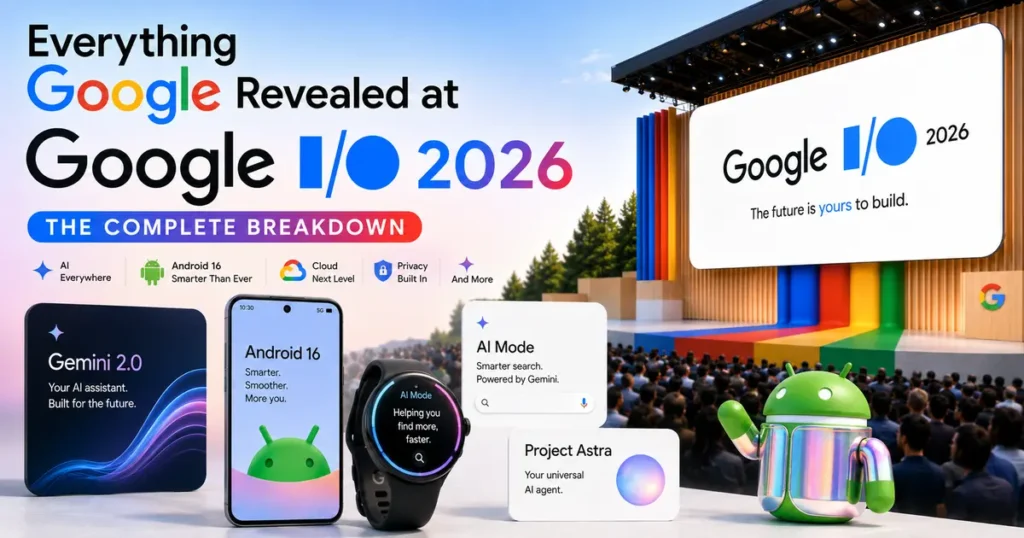
Google I/O is always one of the most anticipated events in the tech calendar, and Google I/O 2026 did not disappoint. From an entirely new AI model family to a redesigned Search experience that’s been untouched for over two decades, everything Google revealed at Google I/O 2026 signals a company that’s betting its entire future on agentic AI. Sundar Pichai took the stage to welcome what he called “the agentic Gemini era,” and after going through all 100 announcements, that description feels accurate.
Whether you’re a developer, a casual Google user, or someone who just wants to know what’s coming to your phone and apps — this guide covers everything that matters.
The Big Theme: Agentic AI Takes Center Stage
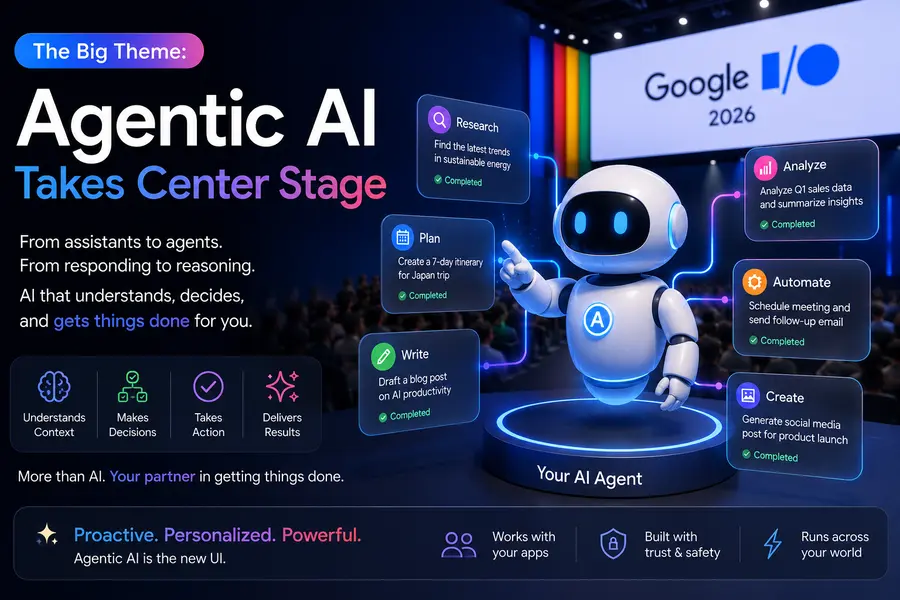
Unlike previous years where Google spread attention across hardware, software, and services somewhat evenly, Google I/O 2026 had one unmistakable thread running through it: agents. Not just smarter chatbots — actual AI agents that work autonomously in the background, take action on your behalf, and can coordinate with other agents to complete complex multi-step tasks.
This shift is significant. Google isn’t just making its products smarter; it’s fundamentally rethinking how people interact with technology. And the backbone of all of it is the Gemini model family, which got a major upgrade.
Gemini 3.5 Flash: Frontier Intelligence at Real-World Speed
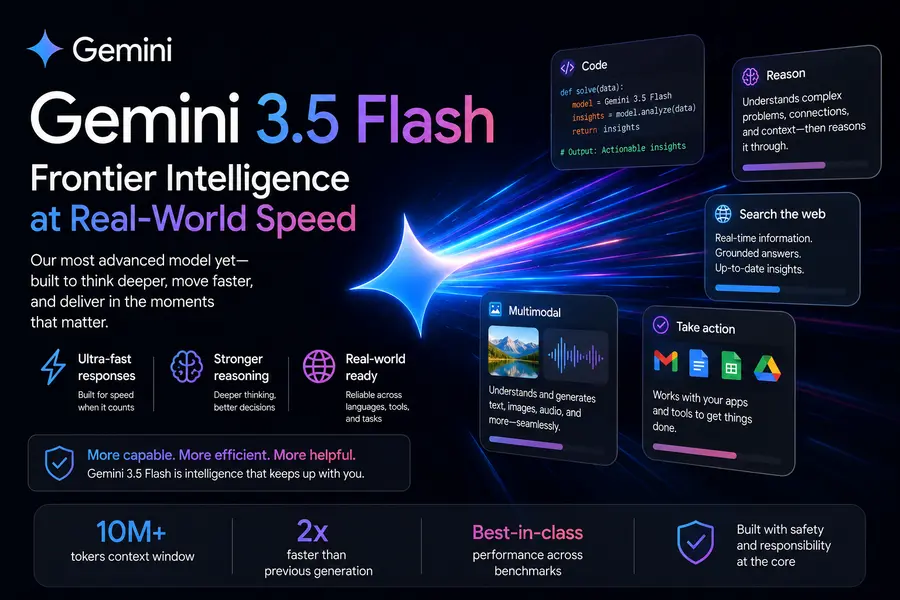
The first headline model announcement was Gemini 3.5 Flash, which is now generally available via the Gemini API, Google AI Studio, Android Studio, and the new Google Antigravity platform.
What makes 3.5 Flash interesting isn’t just raw performance — it’s the combination of speed and capability. It outperforms Gemini 3.1 Pro on challenging benchmarks including Terminal-Bench 2.1 (76.2%), GDPval-AA (1656 Elo), and MCP Atlas (83.6%). It lands in the top-right quadrant of the Artificial Analysis index, meaning you get frontier-level intelligence without sacrificing latency.
On a practical level, tasks that used to take a developer days or an auditor weeks can now be completed in a fraction of the time, often at less than half the cost of competing frontier models. The model is particularly strong at long-horizon agentic tasks — planning, building, and iterating on real-world problems like developing new applications or preparing financial documents.
Gemini 3.5 Pro is also in the works. It’s already being used internally at Google and is expected to roll out next month.
Gemini Omni: Generate Anything From Any Input
This was arguably the most visually stunning announcement of the event. Gemini Omni is a new model that can take any type of input — image, text, video, or audio — and generate rich, cohesive outputs. The initial focus is on video, and the results shown were remarkable.
What sets Omni apart from previous generative video models is its understanding of physics. It has an improved grasp of forces like gravity, kinetic energy, and fluid dynamics, which allows it to create scenes that actually feel real rather than looking like obvious AI output. Pair that with Gemini’s deep knowledge of history, science, and culture, and you get something that bridges photorealism with meaningful storytelling.
A few key details worth knowing:
- Every video created with Gemini Omni includes Google’s imperceptible SynthID digital watermark, which you can verify through the Gemini app, Gemini in Chrome, and Search.
- Gemini Omni Flash is rolling out now to all Google AI Plus, Pro, and Ultra subscribers through the Gemini app and Google Flow.
- YouTube users (18+) can access it at no cost through YouTube Shorts Remix and the YouTube Create app.
- Character consistency has been significantly improved — identity and voice are preserved across every scene in a project.
Search Gets Its Biggest Upgrade in 25+ Years
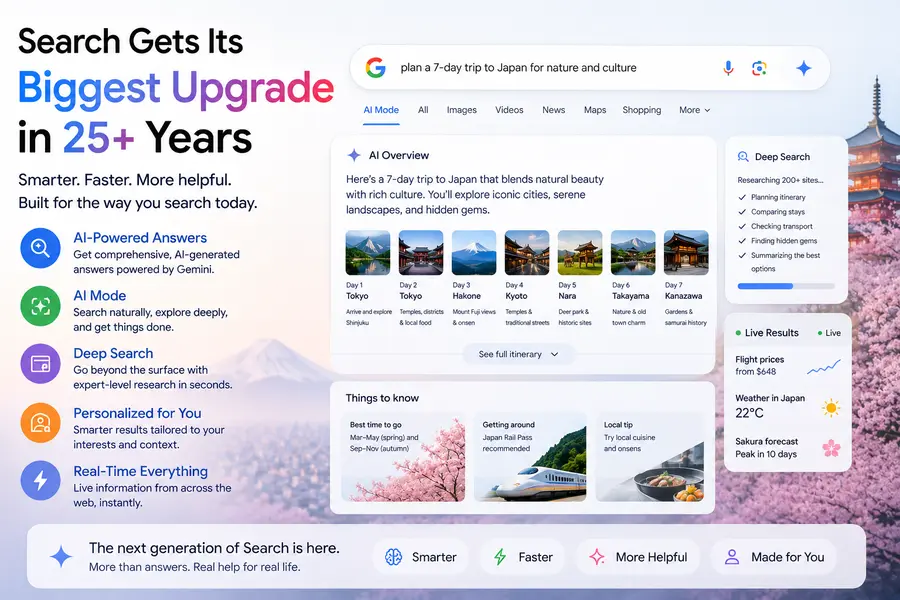
Here’s something that doesn’t happen often: Google said this is the biggest upgrade to the Search box in over 25 years. The search bar has been completely reimagined with AI at its core. You can now search using text, images, files, videos, and even Chrome tabs — and Search will reason across all of them simultaneously.
AI Mode Hits 1 Billion Users
AI Mode, Google’s most powerful AI Search experience, has now surpassed 1 billion monthly users. AI Mode queries have more than doubled every quarter since launch, and last quarter, overall Search queries reached an all-time high. Starting now, Gemini 3.5 Flash is the default model powering AI Mode globally.
Google is also merging AI Overviews and AI Mode into one seamless experience. You’ll flow naturally from a question to a search results page with an AI Overview, then into AI Mode for follow-ups — all in one continuous thread. This is live today across desktop and mobile, worldwide.
Search Agents: Always-On Background Intelligence
Google is introducing information agents built directly into Search. These agents work 24/7 in the background, monitoring topics, tasks, or projects you care about across the web — blogs, news sites, social posts, real-time finance, sports data, and more. When something relevant changes, your agent sends you an intelligent, synthesized update with the ability to take action.
You can run multiple information agents simultaneously. They’re rolling out first to Google AI Pro and Ultra subscribers this summer.
Generative UI in Search
Using the power of Google Antigravity and Gemini 3.5 Flash, Search can now build custom interfaces on the fly for your specific question. Think interactive visuals, tables, graphs, or simulations — all assembled in real time. For longer-running projects like planning a wedding or managing a home move, Search can build entire custom dashboards or trackers that you return to over time. Generative UI is rolling out to everyone this summer at no charge.
Universal Cart: Shopping Gets Smarter
Universal Cart is one of the most practical announcements for everyday users. It’s a new intelligent shopping hub that works across Search, the Gemini app, YouTube, and Gmail. Add something to your cart while browsing any of these surfaces and the cart immediately gets to work — finding deals and price drops, tracking price history, and alerting you when out-of-stock items return.
Built on Gemini models, the cart will get smarter as the underlying AI improves. It also proactively flags product incompatibilities and suggests alternatives. Because it’s built on Google Wallet, it understands your payment method perks, loyalty programs, and merchant offers, helping you choose the best way to pay.
Checkout is powered by the new Universal Commerce Protocol (UCP), which makes buying from your cart smooth — either directly on Google via Google Pay or by transferring items to the retailer’s site.
Universal Cart rolls out across Search and the Gemini app this summer, with YouTube and Gmail to follow.
The Gemini App Gets a Full Redesign
Google has completely rebuilt the Gemini experience from the ground up with a new design language called Neural Expressive. The moment you open the app, you’re greeted with fluid animations, vibrant colors, new typography, and haptic feedback.
Responses no longer come as walls of text. Instead, Gemini lays out answers in real time with interactive images you can zoom in on, timelines you can skim, and embedded visuals — all designed specifically for your question.
Gemini Spark: Your 24/7 Personal AI Agent
Gemini Spark is the standout new feature inside the Gemini app. It’s a personal AI agent that works in the background — on your phone or laptop, even when they’re turned off — to help you navigate your digital life and take action on your behalf.
Spark runs on Gemini 3.5 and the Antigravity platform. It’s designed to check with you before taking major actions, and you can turn it on or off. It’s currently rolling out to trusted testers, with a Beta coming to Google AI Ultra subscribers in the US next week. The roadmap includes the ability to text or email Spark directly, create custom sub-agents, and authorize payments within set budgets.
Daily Brief: Your Morning AI Digest
Daily Brief is a new out-of-the-box agent that works overnight to prepare you for the day ahead. It analyzes your inbox, calendar, and tasks to surface the most important things, suggests next steps, and learns your preferences over time. It’s available starting today for all Google AI subscribers (18+) in the US who have connected their Google apps.
Google Antigravity: The Developer Platform for the Agentic Era
Google Antigravity is Google’s new agent-first development platform, and it’s getting a massive expansion. The goal is to make building with AI agents accessible to anyone — from experienced engineers to people who’ve never written a line of code.
Key highlights include:
- Antigravity 2.0: A standalone desktop app for orchestrating multiple agents in parallel — one agent coding a website while another generates brand assets, for example.
- Antigravity CLI: A lightweight, terminal-native tool for creating agents instantly without a UI.
- Antigravity SDK: Programmatic access to the same agent infrastructure powering Google’s own products, with the ability to host agents on your own infrastructure.
- Managed Agents: A single API call provisions a remote Linux environment where an agent can reason, plan, browse the web, execute code, and manage files in an isolated sandbox.
Multi-day engineering efforts are collapsing into hours through the new subagent teamwork capability, currently available as an early research preview in Antigravity.
Google also announced the Build with Gemini XPRIZE Hackathon, a global competition with a $2 million prize pool — the largest ever for a hackathon — challenging developers to build real applications for the world’s most pressing problems.
Workspace Gets Smarter Across the Board
AI Inbox and Gmail Live
AI Inbox in Gmail is expanding from Ultra subscribers to all Google AI Plus and Pro subscribers in the US. It now generates personalized draft replies based on contextual information. This summer, Gmail Live arrives for Pro and Ultra subscribers, letting you talk to your inbox and ask specific queries without digging through threads.
Google Pics: Image Creation Built Into Workspace
Google Pics is a new image creation and editing tool powered by Google’s Nano Banana model. It includes object segmentation for precise edits, text editing and translation, and Workspace integrations. It’s launching now for a limited group of testers and will roll out globally to Pro and Ultra subscribers this summer.
Docs Live and Talk to Keep
Docs Live lets you create and edit Google Docs with your voice. It organizes your thoughts, structures your document, and pulls relevant details from Gmail, Drive, Chat, and the web — with your permission. Keep is also getting a voice-first upgrade, turning stream-of-consciousness voice notes into organized notes and lists. Both features arrive this summer for Pro and Ultra subscribers.
Science, Research, and Discovery
Google introduced Gemini for Science, a suite of experimental tools on Google Labs:
- Hypothesis Generation: Simulates the scientific method using a multi-agent “idea tournament” to generate, debate, and evaluate hypotheses, with citations to back every claim.
- Computational Discovery: An agentic research engine that generates and scores thousands of code variations in parallel, useful for fields like solar forecasting and epidemiology.
- Literature Insights: Searches scientific literature and structures results into searchable tables for side-by-side analysis, built with NotebookLM.
Google also launched Science Skills, integrating insights from 30+ major life science databases including UniProt, AlphaFold, and InterPro. These are available on Antigravity starting May 19.
Android XR, YouTube, and SynthID
Android XR is expanding into intelligent eyewear. Two types are coming: audio glasses that give you spoken help in your ear, and display glasses that surface information in your field of view. The first audio glasses — made with Gentle Monster, Warby Parker, and Samsung — arrive this fall, compatible with both Android and iOS.
Ask YouTube is a new conversational search experience for YouTube, letting you ask complex questions and get structured responses compiled from relevant videos and Shorts. It begins rolling out this month on desktop in the US.
On the trust and transparency front, SynthID — Google’s AI content watermarking technology — has already been used 50 million times globally. Verification is now expanding from the Gemini app to Search today, and to Chrome in the coming weeks. Google is also adding support for C2PA Content Credentials, making it easy to verify whether content is an unaltered original or has been modified by AI tools. OpenAI, Kakao, and ElevenLabs are also adopting SynthID for their own AI-generated content.
Pricing and Subscriptions
Google announced a new $100/month Google AI Ultra plan designed specifically for developers, technical leads, knowledge workers, and advanced creators. It includes 5X higher usage limits than the AI Pro plan, 20TB of cloud storage, and faster access to new features.
Google AI Pro subscribers now also get YouTube Premium Lite included at no extra charge — meaning ad-free YouTube viewing, offline downloads, and background play for most videos on the platform.
Final Thoughts
Everything Google revealed at Google I/O 2026 paints a consistent picture: the company is moving fast toward a world where AI doesn’t just assist you — it acts on your behalf, learns from context, works while you sleep, and coordinates with other agents to get complex things done. From Gemini Omni’s physics-aware video generation to Gemini Spark running tasks in the background while your phone is off, the scale of ambition here is hard to overstate.
For developers, Antigravity is the new default platform. For everyday users, the changes to Search, Gmail, and the Gemini app are going to feel immediately meaningful. And for researchers, the Gemini for Science tools could genuinely change how scientific work gets done.
It’s a lot to absorb — but that’s what Google I/O 2026 was. A lot.
Disclaimer
This article is intended for informational purposes only. All information is based on official announcements made by Google at Google I/O 2026 and is accurate as of the publication date. Product availability, features, and pricing may change over time. We are not affiliated with or endorsed by Google. All product names and trademarks mentioned are the property of their respective owners.