
If you want to understand power in 2026, stop looking at oil fields and start looking at cleanrooms in Hsinchu, Taiwan. Inside the Chip Wars, the real story isn’t just about faster smartphones or shinier laptops — it’s about which nations control the tiny slivers of silicon that now decide who wins in artificial intelligence, defense, finance, and basically every industry that touches a computer. Semiconductors have quietly become the resource that determines national power, and the fight to control their design, manufacturing, and supply chains has turned into the defining geopolitical contest of this decade.
For most of the 20th century, oil was the resource nations fought wars over, built alliances around, and used as leverage at the negotiating table. Today, that role belongs to chips. You can’t build an AI data center, a fighter jet’s targeting system, an electric vehicle, or a hospital MRI machine without semiconductors, and a shockingly small number of companies — concentrated in a handful of countries — control the entire pipeline. That concentration is exactly why the “chip war” between the United States and China has become so intense, and why it’s reshaping trade policy, corporate strategy, and even diplomacy.
This post breaks down what’s actually happening in the chip industry right now, using the latest available 2026 data, and explains why silicon has earned the comparison to oil — and in some ways, why it’s actually a bigger deal.
The Numbers Behind the Hype: How Big Is the Chip Industry Really?
Let’s start with scale, because the size of this industry is almost hard to process.
The Semiconductor Industry Association reported that global chip sales hit $791.7 billion in 2025 — the highest annual total ever recorded, up 25.6% from 2024’s $630.5 billion. That alone would be a huge headline. But 2026 has blown past even that. Quarterly sales data released by SIA showed global semiconductor sales reaching $298.5 billion in Q1 2026 alone, a 25% jump from the previous quarter, and April 2026 sales came in nearly 94% higher year-over-year. SIA now expects the industry to smash through the $1 trillion mark for 2026, with some forecasts — including a WSTS Spring 2026 projection — putting full-year growth as high as 90%, pushing sales toward $1.5 trillion.
To put that in perspective: the semiconductor industry is now approaching the scale of the global pharmaceutical market, and some analysts, including IDC, expect it to surge past $1.29 trillion this year, driven overwhelmingly by AI infrastructure spending.
Here’s the part that really tells the story, though. AI-specific chips now represent roughly half of total semiconductor revenue while accounting for less than 0.2% of unit volume shipped. In plain English: a tiny sliver of ultra-advanced chips — the kind used in AI data centers — generates almost as much money as every other chip combined, from the processor in your washing machine to the one in your car’s dashboard. That imbalance is exactly why control over advanced chipmaking has become so strategically loaded.
Why Silicon Beats Oil as a Comparison
Calling chips “the new oil” isn’t just a catchy phrase — it holds up under scrutiny, and in a few ways silicon is arguably more consequential.
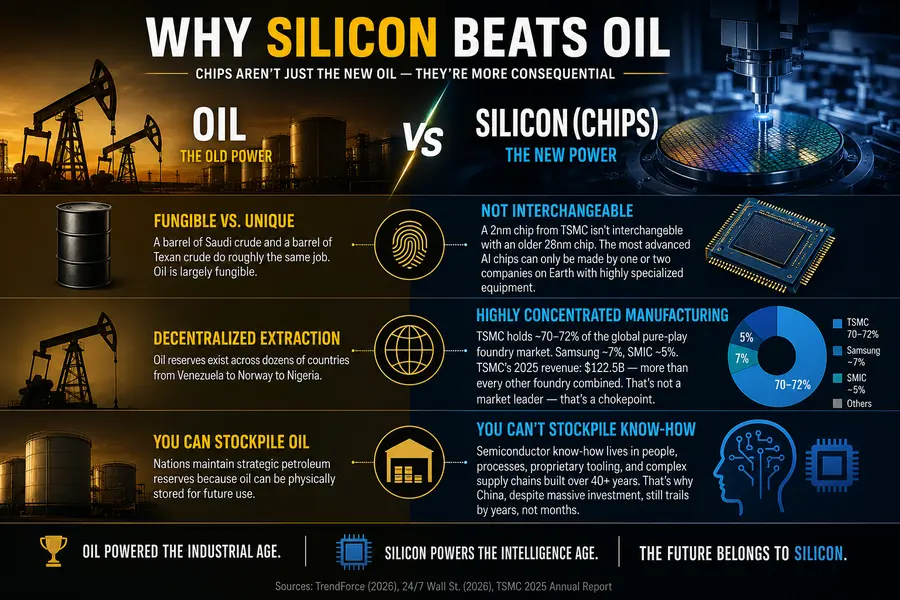
Oil is fungible. Advanced chips are not. A barrel of Saudi crude and a barrel of Texan crude do roughly the same job. But a chip built on a 2-nanometer process node from TSMC is not remotely interchangeable with an older 28nm chip from a mature-node fab. The most cutting-edge AI accelerators can only be made by one or two companies on Earth, using equipment produced by an even smaller handful of suppliers.
Extraction is decentralized. Manufacturing is not. Oil reserves exist across dozens of countries, from Venezuela to Norway to Nigeria. Advanced chip manufacturing, by contrast, is astonishingly concentrated. According to a TrendForce breakdown covered in 24/7 Wall St.’s 2026 analysis, TSMC alone commands roughly 70-72% of the global pure-play foundry market, with Samsung a distant second at around 7%, and China’s SMIC trailing at about 5%. TSMC’s revenue in 2025 hit $122.5 billion, meaning it now generates more revenue than every other foundry on the planet combined. That’s not a market leader — that’s closer to a chokepoint.
You can stockpile oil. You can’t stockpile chip know-how. Nations have strategic petroleum reserves precisely because oil can be physically stored. Semiconductor manufacturing knowledge — the specific, decades-refined processes for etching circuits at atomic scale — can’t be hoarded in a warehouse. It lives in institutional expertise, proprietary tooling, and supply chains that took 40+ years to build. That’s part of why China, despite pouring enormous state resources into catching up, still trails by years, not months.
The US-China Chip War: Where Things Actually Stand in Mid-2026
This is the part everyone’s watching closest, and the situation has shifted several times just in the past twelve months.
A Brief Timeline of Escalation
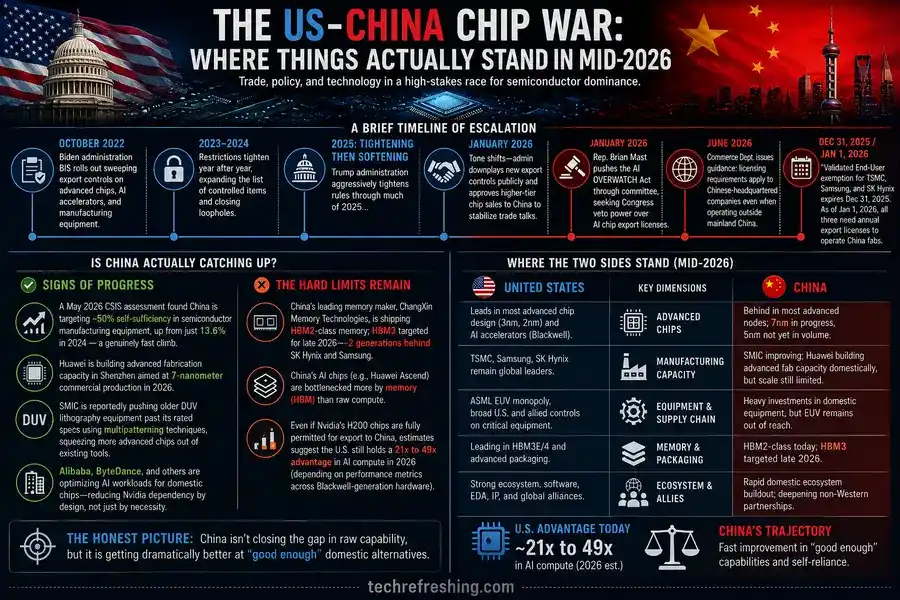
The modern chip war traces back to October 2022, when the Biden administration’s Bureau of Industry and Security rolled out sweeping export controls targeting advanced logic chips, AI accelerators, and the manufacturing equipment used to produce them. Each year since has brought tighter restrictions — until 2026, when the tone shifted noticeably.
According to reporting from the East Asia Forum, the Trump administration spent much of 2025 aggressively tightening restrictions, but in 2026 it began recalibrating — downplaying new export controls publicly while approving sales of higher-tier chips to China, largely to keep trade talks stable ahead of a planned presidential visit to Beijing. That softer posture triggered real backlash in Congress. Rep. Brian Mast pushed the AI OVERWATCH Act through committee in January 2026, an attempt to give Congress veto power over AI chip export licenses that currently sits with the Commerce Department.
Then in June 2026, the picture flipped again. The Commerce Department issued guidance affirming that its licensing requirements for advanced AI chips apply to Chinese-headquartered companies even when they operate outside mainland China — closing what critics called a major loophole that had let Chinese firms buy export-controlled Nvidia chips through offshore subsidiaries.
Meanwhile, a policy that had quietly protected foreign chipmakers expired at the start of the year. Companies like TSMC, Samsung, and SK Hynix previously held “Validated End-User” status, letting them import US-controlled manufacturing equipment into their China-based fabs without applying for individual licenses. That exemption expired December 31, 2025, meaning as of January 1, 2026, all three companies now need annual export licenses just to keep operating their existing China facilities.
Is China Actually Catching Up?
This is where the honest answer is “it’s complicated, and it depends who you ask.”
On one hand, a May 2026 CSIS assessment found that China is targeting roughly 50% self-sufficiency in semiconductor manufacturing equipment, up sharply from just 13.6% in 2024 — a genuinely fast climb. Huawei is reportedly building advanced fabrication capacity in Shenzhen aimed at 7-nanometer commercial production this year, and SMIC has apparently learned to push older DUV lithography equipment past its rated specifications using multipatterning techniques, squeezing more advanced chips out of equipment that wasn’t originally designed for it.
On the other hand, independent analysts point out that China’s homegrown AI chips, like Huawei’s Ascend line, are bottlenecked less by raw compute and more by memory — specifically high-bandwidth memory (HBM). China’s leading memory producer, ChangXin Memory Technologies, is currently only shipping HBM2-class memory, with HBM3 targeted for later this year, putting it roughly two generations behind SK Hynix and Samsung. Even in scenarios where Nvidia’s H200 chips are fully permitted for export to China, some estimates suggest the US still holds a 21x to 49x advantage in AI compute produced in 2026, depending on how you measure performance across Blackwell-generation hardware.
So the honest picture: China isn’t closing the gap in raw capability, but it is getting dramatically better at “good enough” domestic alternatives — and companies like Alibaba and ByteDance are increasingly optimizing their AI workloads specifically for Chinese-made chips, reducing Nvidia dependency by design rather than by necessity.
Who Are the Real Power Players in This Industry?
If you’re trying to understand the chip war, you need to know the handful of companies that actually hold leverage. Here’s how the landscape breaks down heading into the back half of 2026.
| Company | Role | Why It Matters | 2026 Position |
|---|---|---|---|
| TSMC (Taiwan) | Pure-play foundry | Manufactures chips for Nvidia, Apple, AMD, and 530+ other clients | ~70-72% of global foundry revenue; Q1 2026 revenue near $35.9B, up over 40% YoY |
| Nvidia (USA) | Chip designer | Dominant AI accelerator designer; sets the pace for AI compute | Central to US export control debates; H200 shipments to China repeatedly stalled |
| ASML (Netherlands) | Equipment maker | Sole global source of extreme ultraviolet (EUV) lithography machines | Chokepoint supplier; sales to China have drawn intense scrutiny |
| Samsung (South Korea) | Foundry + memory | Second-largest foundry; major HBM producer | Foundry share around 7%; foundry division reportedly still losing money |
| SMIC (China) | Domestic foundry | China’s flagship state-backed chipmaker | ~5% global foundry share; pushing DUV equipment past rated limits to approach advanced nodes |
| Huawei (China) | Chip designer + systems | Building China’s AI chip ecosystem via Ascend processors | Building 7nm fab capacity in Shenzhen; HBM memory remains a bottleneck |
| SK Hynix (South Korea) | Memory | Leading HBM supplier for AI accelerators | Alongside Samsung, roughly 1-2 generations ahead of Chinese HBM makers |
Notice something? Every single chokepoint company sits in the US, Taiwan, South Korea, or the Netherlands — democratic allies aligned, more or less, against Chinese access to leading-edge technology. That alliance structure is precisely what US policy is trying to protect, and precisely what China is trying to route around.
Why This Matters Beyond Wall Street
It’s easy to treat this as an investor story — and it absolutely is one, with the combined market cap of the top 10 global chip companies hitting $9.5 trillion by December 2025, up 181% from just two years earlier. But the implications run much deeper than stock prices.
National security. Modern military systems, from missile guidance to satellite communications, depend on semiconductors that meet strict performance and security standards. A country that can’t manufacture its own advanced chips is, in a real sense, dependent on foreign suppliers for its defense capability.
AI leadership. Whoever has the most compute can train the biggest, most capable AI models fastest. That’s not an abstract advantage — it translates into economic productivity, scientific research capacity, and military applications like autonomous systems and cyber operations. This is the single biggest reason the chip war has intensified rather than cooled off.
Everyday prices. Congestion in the chip supply chain doesn’t stay contained to servers and GPUs. Memory chip shortages have already started pushing up prices for smartphones and PCs in early 2026, according to IDC analysis, as DRAM capacity gets diverted toward AI infrastructure buildouts instead of consumer electronics.
Economic resilience. Back in 2021, Goldman Sachs estimated that chip shortages were impacting over 169 industries and could shave up to 1% off US GDP. That was during a relatively minor supply crunch. A serious disruption to Taiwan’s fabs today — whether from conflict, natural disaster, or blockade — would be an order of magnitude more damaging, given how much more AI-dependent the global economy has become.
The Oil Comparison: Where It Actually Breaks Down
To be fair to the analogy’s critics, silicon and oil aren’t perfectly identical resources, and it’s worth being upfront about where the comparison gets shaky.
- Oil is consumed. Chips are durable assets. You burn oil once and it’s gone. A chip, once manufactured, can run for years, meaning the “supply and demand” dynamics don’t map cleanly onto commodity markets.
- Oil has substitutes. Advanced chips mostly don’t. You can generate electricity from solar, wind, or nuclear instead of oil. There’s no current substitute for silicon-based logic chips at the performance levels AI training requires — though researchers, including a team at Peking University working on 2D transistor materials, are exploring alternatives that could someday bypass traditional silicon limitations entirely.
- Oil pricing is relatively transparent. Chip pricing is opaque. Crude oil trades on public exchanges with visible daily prices. Advanced chip contracts are negotiated privately between foundries and clients, often years in advance, making the market far less transparent to outside observers.
These differences don’t undercut the core argument — they actually strengthen it. Silicon is scarcer, more concentrated, and harder to substitute than oil ever was, which arguably makes it the more strategically dangerous resource to be dependent on.
What Happens Next: A Realistic Outlook
Nobody has a crystal ball here, but a few trends seem fairly durable based on the data:
- The US-allied bloc retains its lead, but the gap narrows slowly. TSMC, ASML, Nvidia, Samsung, and SK Hynix aren’t losing their technological edge anytime soon, but China’s determination to build parallel capacity means the gap will likely keep shrinking gradually rather than staying static.
- Enforcement, not new rules, becomes the primary tool. With US-China trade negotiations ongoing through 2026, expect Washington to lean more heavily on enforcing existing export controls — and using that enforcement as a bargaining chip — rather than rolling out dramatic new restrictions.
- Diversification efforts continue, but slowly. The US, EU, Japan, and India are all investing in domestic or allied fab capacity to reduce reliance on Taiwan. TSMC’s Arizona facility is a visible example, but building fab capacity takes years, and Taiwan will likely remain the center of gravity for advanced manufacturing well into the 2030s.
- Memory becomes the next battleground. With DRAM prices reportedly set to rise sharply and HBM capacity acting as a hard constraint on AI chip performance, expect the memory market — not just logic chips — to become an increasingly contested front in this rivalry.
Final Thoughts
Inside the Chip Wars, what becomes clear is that this isn’t a temporary trade dispute — it’s a structural realignment of how global power gets measured. Oil built and broke empires for a century. Silicon is doing something similar right now, except faster, with fewer substitutes, and concentrated in an even smaller number of hands. Whether you’re an investor, a policymaker, or just someone trying to understand why your next laptop costs more than expected, the semiconductor industry is worth watching closely — because for the foreseeable future, whoever controls the chips controls a disproportionate share of what happens next in the global economy.
Disclaimer
This article is based on publicly available data and industry reports as of July 2026, including figures from the Semiconductor Industry Association (SIA), TSMC, CSIS, and other cited sources. Semiconductor markets, trade policy, and export control rules change quickly — figures, forecasts, and regulations mentioned here may have shifted since publication. This content is for informational purposes only and is not financial, legal, or investment advice. Readers should verify current figures with primary sources before making business or investment decisions.