
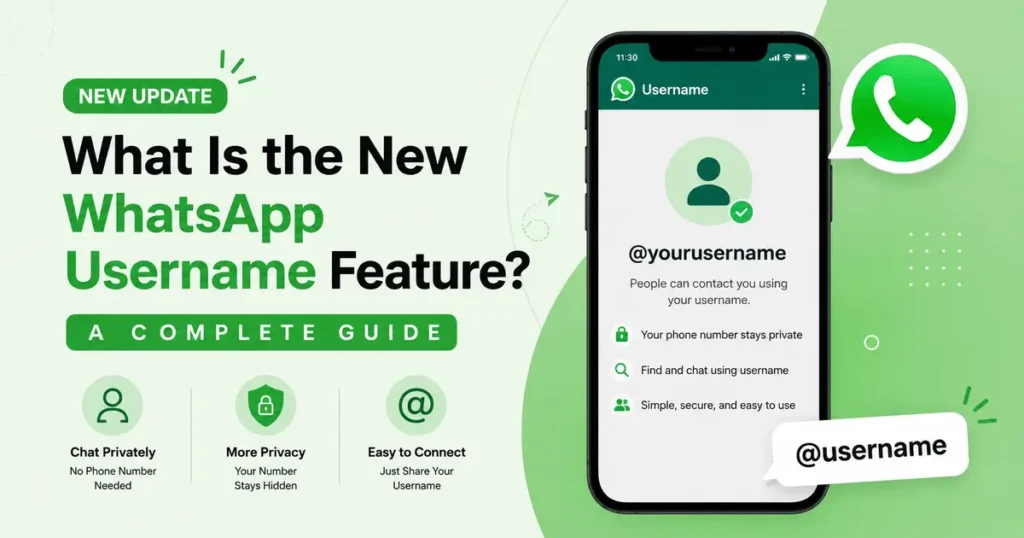
If you’ve opened WhatsApp recently and spotted a “Username” option tucked inside your account settings, you’re not imagining things. The New WhatsApp Username Feature is real, it’s rolling out right now, and it’s arguably the biggest privacy shift the app has made since end-to-end encryption became the default. For the first time in WhatsApp’s history, your phone number no longer has to be the thing you hand over to every new contact, group chat, or business you talk to.
WhatsApp officially confirmed the rollout on June 29, 2026, opening username reservations to its more than three billion users worldwide. In this post, I’ll walk you through exactly what the feature does, how it works under the hood, the rules for picking a handle, what it means for businesses, and how it stacks up against apps like Telegram and Signal that have had usernames for years. By the end, you’ll know everything there is to know about the New WhatsApp Username Feature, including a few details most articles are glossing over.
Why WhatsApp Is Doing This Now
For over a decade, your phone number has been your entire identity on WhatsApp. Every group you joined, every stranger you messaged on a marketplace listing, every new coworker you added on day one — they all got your actual, real digits. That’s a lot of trust to hand out to people you barely know.
WhatsApp’s VP of Product, Alice Newton-Rex, put it plainly in the company’s announcement: sharing a phone number with someone new “can feel like a big step” because a number is personal and tied to so many other parts of your life. Sometimes you just want to chat without handing over your digits.
There’s also a competitive angle here that WhatsApp doesn’t advertise as loudly. Telegram has offered usernames since 2013. Signal added them back in 2022. Both apps have used “you don’t need my number to reach me” as a selling point for years, and WhatsApp — despite having the largest user base of any messaging platform on the planet — was the notable holdout. The New WhatsApp Username Feature closes that gap and, according to industry reporting, was also partly a response to how RCS messaging on Android and iOS increasingly relies on flexible sender identities rather than raw phone numbers.
What the New WhatsApp Username Feature Actually Does
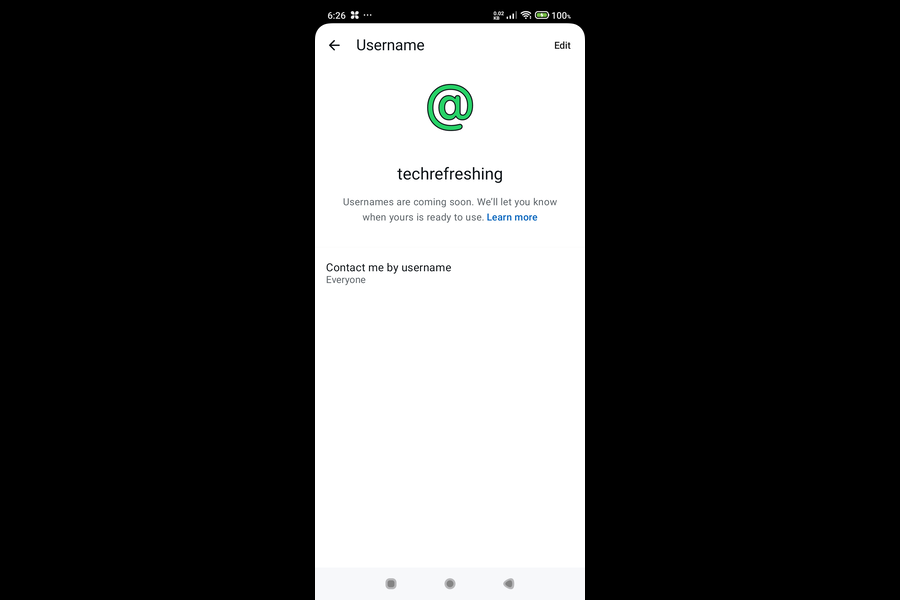
At its core, the feature adds an optional identity layer on top of your existing account. Here’s the plain-English version:
- You keep your phone number for login, account recovery, and verification — that part never goes away.
- You can additionally claim a unique @handle (a username) that you share with new contacts instead of your number.
- Once someone knows your exact username, they can find you inside WhatsApp and start a conversation — without ever seeing your phone number.
- Your number stays completely private from that new contact unless you choose to share it separately.
This isn’t a replacement for your phone number. It’s a shield in front of it. Think of it less like changing your identity and more like getting an unlisted number with a public-facing alias attached.
How to Reserve Your Username Right Now
WhatsApp opened reservations early specifically because, in the company’s words, “a lot of names overlap” across three billion users — so if you want a clean, recognizable handle, it’s worth claiming it before the wider rollout floods the system with new sign-ups.
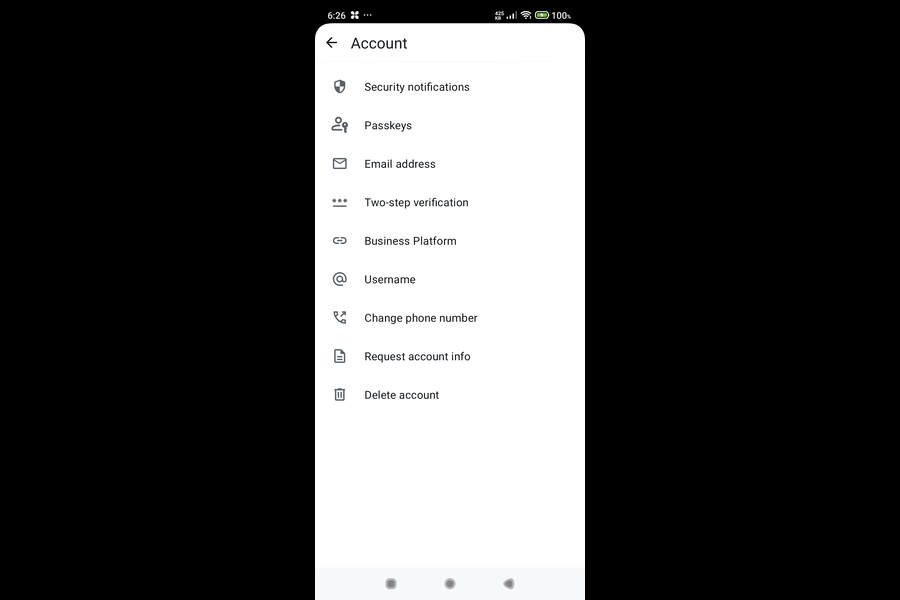
To reserve yours:
- Update WhatsApp to the latest version on Android, iOS, Windows, or the web.
- Go to Settings > Account > Username.
- Type in the handle you want and check availability.
- Confirm your reservation.
Reserving a username now doesn’t mean it goes live for everyone the moment you save it. WhatsApp is rolling the feature out in country waves over the coming months, and you’ll get an in-app notification once it’s active where you live.
The Rules: What Makes a Valid WhatsApp Username
WhatsApp has published fairly strict formatting rules to cut down on impersonation and phishing attempts. If you’re picking a handle, keep these in mind:
- Must be between 3 and 35 characters long.
- Must include at least one letter (you can’t use a username made entirely of numbers).
- Only lowercase letters, numbers, periods (.), and underscores (_) are allowed — no spaces, no capital letters, no special symbols.
- Usernames cannot start with “www.”
- Usernames cannot end in common internet domain extensions like “.com” or “.net” — this is a direct anti-phishing measure, since a username like “supportteam.com” could easily trick someone into thinking they’re talking to a real website or verified brand.
- WhatsApp is reserving certain handles outright for celebrities, public figures, and organizations to prevent squatting and impersonation before the public rollout is complete.
Beyond that, there aren’t many restrictions — you’re free to pick almost anything available, as long as it doesn’t violate WhatsApp’s broader community and business policies.
There’s No Public Directory — And That’s the Point
This is where WhatsApp’s approach genuinely differs from Instagram, Telegram, or X. On most platforms, usernames are searchable and often auto-suggested, which is great for discovery but terrible for privacy. WhatsApp has deliberately gone the opposite direction.
- There is no public directory of usernames to browse.
- There is no autocomplete or search suggestion feature.
- Someone has to already know your exact username to find and message you for the first time.
In other words, WhatsApp usernames aren’t designed to help strangers discover you — they’re designed to let you control who can reach you without exposing your number in the process. If you’ve ever used Instagram’s search bar to find someone by guessing a close variation of their handle, that experience simply won’t work here.
Username Keys: An Extra Layer of Protection
For people who want to go even further, WhatsApp is introducing an optional username key — essentially a short code that pairs with your handle. If you turn this on, someone needs to know both your username and your key before they can send you a first message. It’s a smart middle ground for people who want to share a handle semi-publicly (say, on a resume or a business card) while still filtering out random contact attempts.
WhatsApp is also pairing the username rollout with broader anti-abuse measures, including limits on how many new people a single account can message and improved detection for spam and “abuse patterns” — a clear signal the company anticipated scammers trying to exploit the new system immediately.
What Happens to Your Old Profile Name?
It’s worth clearing up a common point of confusion. WhatsApp has technically had a “profile name” field for years — the display name that shows up in group chats to people who haven’t saved your number. That’s not the same thing as this new username system.
| Feature | Old Profile Name | New Username |
|---|---|---|
| Visible to | Only people without your number saved, in groups | Anyone who knows the exact handle |
| Can be used to start a chat? | No | Yes |
| Unique across WhatsApp? | No, duplicates allowed | Yes, must be unique |
| Replaces phone number in first contact? | No | Yes |
| Searchable/discoverable | Not really | No — must be typed exactly |
The New WhatsApp Username Feature is a genuinely new identity layer, not a rebrand of something that already existed.
What This Means for Businesses on WhatsApp
If you run a business on WhatsApp — whether through the regular Business app or the WhatsApp Business API — this update is bigger than a simple profile tweak. It’s a structural change to how your customers get identified in your systems.
The Business Scoped User ID (BSUID)
Here’s the part most personal users won’t notice but every business using the API absolutely needs to understand: when a customer with a username messages your business without sharing their phone number, your webhook no longer receives their number. Instead, it receives a Business Scoped User ID (BSUID).
A few key facts about BSUIDs:
- It’s a unique identifier, up to 128 alphanumeric characters, generated by Meta for each individual user-business relationship.
- BSUIDs are scoped to a specific business portfolio — meaning only phone numbers within that same portfolio can message a given BSUID.
- It stays stable for the lifetime of that customer relationship, so you can still track repeat conversations even without a phone number.
- It’s already present in inbound webhooks as of mid-2026, regardless of whether the customer has personally adopted a username yet.
If your business relies on phone numbers as the primary key inside your CRM, support ticketing system, or marketing analytics, this is the moment to review those integrations. Meta gave businesses a clear runway — technical documentation and sample workflows have been available since late 2025, and system compatibility was expected to be sorted by June 2026, ahead of the country-by-country consumer rollout that began the same month.
Businesses Can Reuse Their Instagram or Facebook Handle
If your brand already has an established username on Instagram or Facebook, Meta is letting you claim the same handle on WhatsApp to keep things consistent. That’s a genuinely useful bit of cross-platform continuity — customers who know you as @yourbrand on Instagram won’t need to learn a new handle to find you on WhatsApp.
Practical Steps for Business Owners
- Audit any workflow, CRM, or analytics tool that currently uses phone number as the primary customer identifier.
- Start capturing and storing BSUIDs alongside (or instead of) phone numbers where relevant.
- Claim your username early — ahead of full rollout — to match your existing social handles and prevent copycats.
- Brief your support team on the fact that new inbound messages may not include a visible customer number.
- Watch for country-wave rollout notifications rather than assuming the feature is live everywhere simultaneously.
Rollout Timeline: Where Things Actually Stand
WhatsApp has been deliberately gradual with this launch, and the timeline has moved a few times as testing expanded. Based on the most recent official updates:
- Late 2025–early 2026: Developer documentation and BSUID fields made available for businesses; internal testing across Android, iOS, Windows, and web.
- April 2026: Username beta activated for a limited set of users.
- May 2026: API support added for messaging a BSUID directly.
- June 29, 2026: Public reservation phase opened globally — anyone can now reserve (not yet fully use) a username.
- Coming months: Gradual, country-by-country activation, with in-app notifications letting users know when the feature goes fully live in their region.
WhatsApp hasn’t published a hard finish date for the global rollout, only saying it will happen “over the coming months.” If you don’t see the username option working fully yet — even after reserving one — that simply means your country’s wave hasn’t landed.
How WhatsApp Usernames Compare to Telegram and Signal
It’s fair to ask: if Telegram and Signal have had this for years, is WhatsApp just catching up, or did it actually build something better? The honest answer is a bit of both.
Telegram usernames are fully searchable and discoverable by design — that’s part of what makes Telegram feel more like a social network than a private messenger. Anyone can search for your handle and find you, which is great for public figures and communities but not ideal if you value obscurity.
Signal usernames, introduced in 2022, work similarly to what WhatsApp is now doing: you get a handle to share instead of a number, and there’s no public directory. Signal’s version was built with privacy as the singular focus from day one.
WhatsApp’s approach lands closer to Signal’s model than Telegram’s — no directory, no autocomplete, exact-match only — but adds the optional username key as an extra gate that neither competitor currently offers in quite the same form. Given WhatsApp’s scale, this non-discoverable design is probably the right call; a searchable directory of three billion people would be a spam and stalking nightmare.
What the New WhatsApp Username Feature Doesn’t Fix
It’s worth being upfront that this update, welcome as it is, doesn’t resolve everything people associate with WhatsApp privacy. Reports around the launch have pointed out that the feature doesn’t touch the separate, ongoing dispute over how WhatsApp’s abuse-reporting system works — specifically, that when a user reports a message, that message and a handful of preceding messages in the same chat can be decrypted and reviewed by a moderation team. That’s a completely separate issue from usernames, but it’s a useful reminder that “phone number privacy” and “message content privacy” are two different promises, and this update only addresses the first one.
Usernames also won’t stop someone who already has your number from finding you the old way, and they don’t retroactively hide your number from contacts you’ve already exchanged it with. This is a forward-looking privacy tool, not a way to erase your digital footprint.
Should You Set Up a Username Right Now?
If you value privacy when meeting new people — at events, in marketplace groups, in professional settings — reserving a username the moment it’s available in your country is a low-effort, genuinely useful move. A few quick recommendations:
- Reserve a handle that matches your existing social media presence if you want to stay recognizable.
- Turn on a username key if you plan to share your handle in semi-public places like a resume or LinkedIn bio.
- Businesses should treat this as an infrastructure update, not just a cosmetic one, and get BSUID handling sorted before full rollout reaches their customer base.
- Don’t rush to pick something you’ll regret — usernames are meant to be a stable, long-term identity, not a throwaway tag.
Final Thoughts
The New WhatsApp Username Feature is one of those updates that sounds small on the surface — “you can now use a handle” — but actually rewires a fundamental piece of how billions of people communicate. For individuals, it finally closes a privacy gap that Telegram and Signal users have enjoyed for years. For businesses, it introduces a real structural shift in customer identification that’s worth getting ahead of before the wider rollout reaches your market.
Whether you’re an everyday user who’s tired of handing your number to strangers, or a business owner untangling phone-number-based CRM workflows, now is the time to reserve your handle, understand the new rules, and get familiar with how the New WhatsApp Username Feature will change the way you connect on the world’s biggest messaging app.
Disclaimer
WhatsApp’s username rollout is happening in phases, and details may change as the feature reaches more countries. Availability, rules, and timelines mentioned here are accurate as of the publish date — always check the official WhatsApp app or WhatsApp’s Help Center for the latest information specific to your account and region.