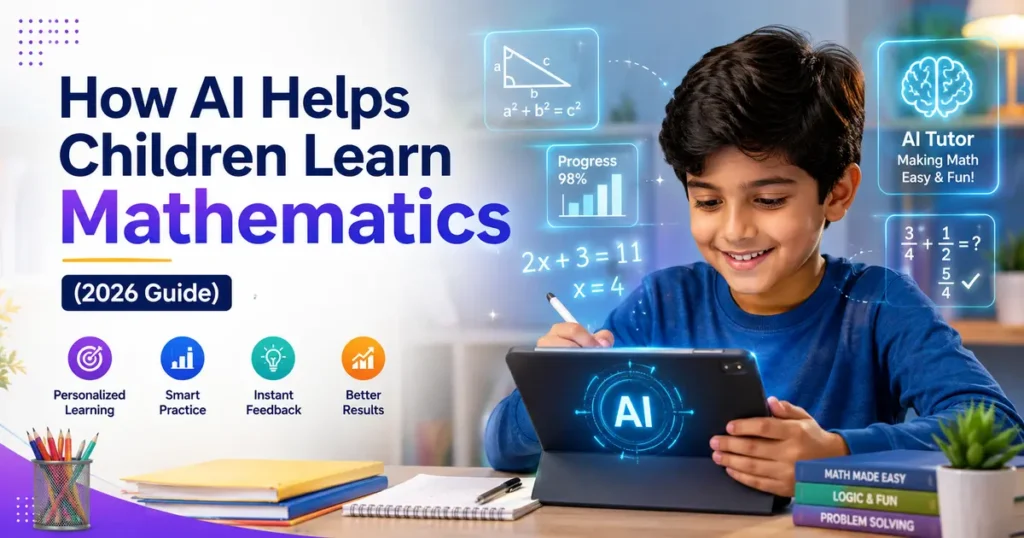
Math homework used to mean one parent, one kitchen table, and a lot of frustrated sighing on both sides. That picture is changing fast. Walk into almost any elementary or middle school classroom in the U.S. today and you’ll find kids working through fraction problems with a tablet that talks back, nudges them toward the right method, and never once rolls its eyes when they ask the same question three times. That’s the short version of how AI helps children learn mathematics — it gives every child something a packed classroom rarely can: constant, patient, one-on-one attention.
But is it actually working, or is this just another shiny EdTech trend that fades in a few years? The newest data suggests something more durable is happening. In June 2026, the National Assessment of Educational Progress released its long-term trend results and found that average math scores for 9-year-olds actually rose compared to 2022, reversing several years of pandemic-era decline — a rare bright spot after nearly a decade of flat or falling national math performance. Researchers and educators are increasingly pointing to adaptive, AI-assisted learning tools as one of several factors behind that turnaround, alongside renewed state investment in math instruction.
This guide breaks down exactly how AI helps children learn mathematics in 2026, what the latest research and adoption data actually show, which tools are worth your time, and where AI still falls short of a real, caring teacher.
Why Math Struggles Have Become a National Conversation
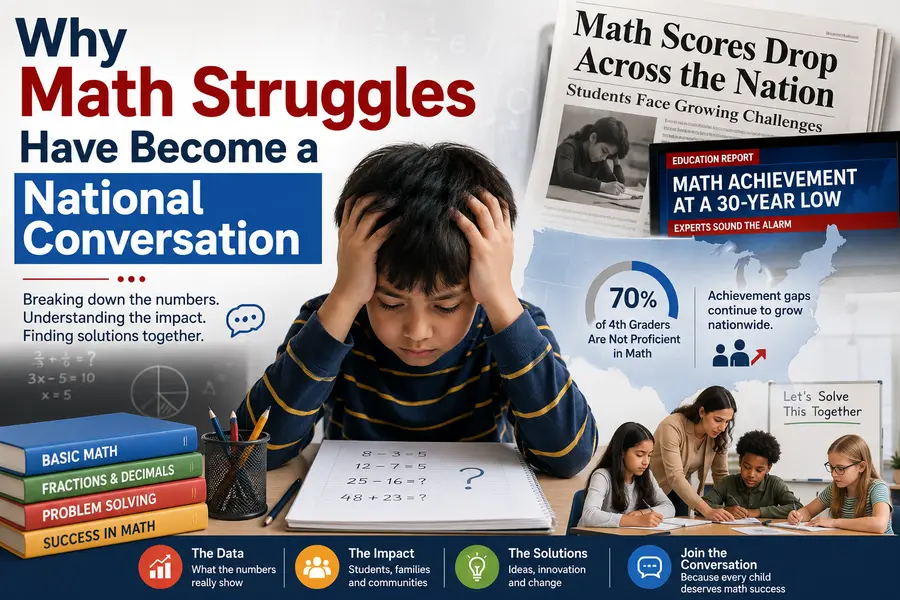
Before getting into the tech, it helps to understand why this topic matters right now. The picture isn’t uniformly rosy. While 9-year-olds showed gains in the 2025 long-term trend assessment, 13-year-olds did not, a gap researchers attribute partly to disrupted elementary years during the pandemic. On the international stage, the 2022 PISA assessment placed U.S. students 27th out of 81 participating countries in math, with roughly a third classified as low performers.
States have responded with real money and policy. In 2025 alone, state legislatures generated an estimated $76 million in new funding directed at math instruction, reaching more than 3.9 million students, with a meaningful share going toward adaptive AI-supported platforms.
What “AI in Math Education” Actually Means
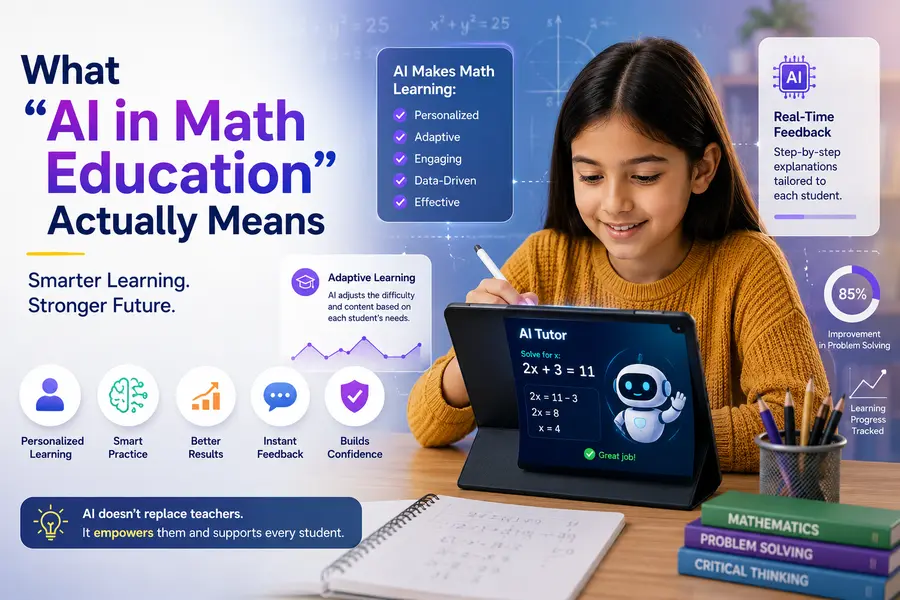
“AI tutor” gets thrown around loosely, so let’s be specific. In 2026, the tools showing up in classrooms and living rooms generally fall into a few categories:
- Adaptive practice platforms (like DreamBox and IXL) that adjust question difficulty in real time based on how a child answers
- Conversational AI tutors (like Khan Academy’s Khanmigo) that walk a child through a problem using dialogue instead of just marking answers right or wrong
- Diagnostic and mastery-mapping systems (like Squirrel AI) that break math into thousands of micro-skills and pinpoint exactly which one a child hasn’t mastered yet
- AI-powered homework helpers that explain the “why” behind a method rather than just supplying the final number
Each of these does a slightly different job, but they share a common thread: they replace generic, one-size-fits-all worksheets with something that responds to the individual kid in front of it.
How AI Helps Children Learn Mathematics: The Core Mechanisms
1. Real-Time Personalization
A human teacher can’t rewrite a lesson plan mid-sentence for 25 different students. An adaptive AI system can. If a child breezes through two-digit subtraction, the system quietly skips ahead. If they stumble on regrouping, it slows down, offers a visual model, and tries a different explanation before moving on. This is the single biggest reason people cite when explaining how AI helps children learn mathematics — it removes the guesswork of “is this too easy or too hard” and replaces it with continuous calibration.
2. Immediate, Judgment-Free Feedback
Traditional homework often means a child practices a mistake twenty times before a teacher catches it the next morning. AI tutors flag errors the moment they happen and explain what went wrong, which prevents bad habits from calcifying. Because the feedback comes from software rather than a peer or a parent who’s already stressed about dinner, many kids report feeling less embarrassed about getting things wrong — which matters enormously for math anxiety.
3. Breaking Skills Into Micro-Concepts
Systems like Squirrel AI map math into thousands of granular sub-skills rather than broad units like “fractions” or “geometry.” That granularity lets the platform pinpoint the exact micro-concept a student hasn’t mastered — say, converting mixed numbers before adding them — instead of re-teaching an entire chapter the child mostly already understands. In multi-region deployments tracked through 2025 and into 2026, students who used Squirrel AI for six months or more showed an average gain of roughly 1.2 grade levels in math proficiency.
4. Socratic Dialogue Instead of Answer-Dumping
One of the more meaningful shifts in 2026 tools is a move away from simply handing a child the answer. Khan Academy’s Khanmigo, which now serves roughly 8 million students, is built to ask guiding questions rather than solve the problem outright, closer to how a good tutor works a student through reasoning. Internal impact reporting from Khan Academy points to roughly a 15% improvement in math scores among regular users, and a 2026 pilot spanning 15,000 students across 200 schools found that kids who used Khanmigo for at least 30 minutes a week gained the equivalent of two to three extra weeks of traditional instruction over the study period.
5. Reducing Math Anxiety Through Low-Stakes Practice
Because an AI tutor doesn’t sigh, doesn’t compare a child to their older sibling, and never runs out of patience, many children are simply more willing to attempt hard problems in front of it. That willingness to try — rather than freeze up — is a huge part of building math confidence, and confidence is one of the strongest predictors of long-term math achievement.
6. Freeing Up Teachers for the Human Parts of Teaching
This piece gets underreported. When AI handles repetitive drilling and error-checking, teachers get time back for what software can’t do: reading a child’s frustration and building the relationship that keeps a struggling student from giving up. A peer-reviewed randomized controlled trial published in Scientific Reports found students using an AI tutor outperformed peers in a traditional active-learning classroom, and did it faster — a median of 49 minutes on task versus 60 minutes for the in-class group.
The Latest 2026 Data on AI and Math Learning
Here’s a snapshot of where things stood heading into mid-2026:
- U.S. students’ AI usage across all learning contexts jumped from roughly 66% in 2024 to about 92% in 2025
- Adaptive learning platforms are associated with an average outcome improvement of around 23%, based on research aggregated by McKinsey and RAND
- 57% of K-12 districts now have formal AI usage policies, up sharply from just 18% in 2024
- 72% of K-12 teachers believe AI has the potential to deliver genuinely personalized learning at scale
- The global AI-in-education market, valued at roughly $5.9 billion in 2024, is projected to reach north of $32 billion by 2030, with math and STEM tools representing a large share of that growth
- Personalized learning outcomes increase by an estimated 54% when AI-driven tools are part of the instructional mix, according to industry-aggregated research
Put together, the direction of travel is clear even if individual numbers vary by source: adoption is accelerating, district policy is catching up, and the outcome data — while still early in places — is trending positive rather than neutral.
Comparison: Leading AI Math Learning Tools in 2026
| Tool | Best For | Core Approach | Reported Outcome Data | Typical Cost |
|---|---|---|---|---|
| Khanmigo (Khan Academy) | K-12, Socratic-style tutoring | Conversational AI that guides reasoning instead of giving answers | ~15% math score improvement; 23% faster algebra mastery in SRI International efficacy research | Free for many U.S. schools; low-cost subscription for families |
| Squirrel AI | Middle/high school, granular skill-gap remediation | Micro-concept diagnostic mapping and adaptive sequencing | ~1.2 grade-level gain after 6+ months of use | ~$50–75 per student annually (school licensing) |
| DreamBox Learning | Elementary math, engagement-first design | Game-based adaptive lessons that adjust difficulty in real time | Cited among adaptive platforms with ~23% average outcome improvement | School-district licensing (varies by contract) |
| IXL Learning | Comprehensive K-12 practice and diagnostics | Skill-level diagnostics with continuous practice recommendations | Widely used for progress monitoring; strong district adoption data | Family plans typically $10–20/month |
| Photomath / similar homework helpers | Step-by-step problem walkthroughs at home | Scan-and-solve with explanation of method | Popular for homework support; best paired with guided practice, not standalone learning | Free tier with paid explanation upgrades |
A quick way to think about the differences: Khanmigo and similar conversational tutors are strongest for building understanding through dialogue, Squirrel AI and DreamBox are strongest for closing specific skill gaps efficiently, and homework-helper apps are best used as a support tool rather than a primary teaching method, since leaning on instant answers too heavily can undercut the productive struggle that actually builds math skill.
Pros of AI-Assisted Math Learning
- Personalized pacing — no child is held back or left behind by a fixed classroom schedule
- Instant feedback that catches errors before they become habits
- Judgment-free repetition, which lowers anxiety around getting things wrong in front of peers
- Detailed progress data for parents and teachers, showing exactly which skills need attention
- Scalability — a single well-designed platform can support personalized instruction for millions of students at once
- Time savings for teachers, who can redirect effort toward mentoring and relationship-building
- Availability outside school hours, useful for families without access to affordable private tutoring
Cons and Limitations Worth Knowing
- Emotional read is still weak. Research comparing human and AI tutors found human tutors interpret a student’s emotional state with roughly 92% accuracy, while even advanced AI tutoring systems currently manage around 68%. A frustrated child who shuts down doesn’t always get caught by software.
- Overreliance risk. Some researchers estimate that close to 30% of students risk becoming overly dependent on AI assistance, using it to get to an answer rather than to build understanding.
- Access inequality. Urban schools are roughly 14% more likely than rural schools to have formal AI policies and infrastructure in place, meaning the benefits aren’t distributed evenly yet.
- Data privacy concerns. Parents are understandably cautious about how much data platforms collect on young children, and district policies vary widely in how that data is protected.
- Quality varies enormously between products. A polished interface doesn’t guarantee sound pedagogy — some apps are essentially digital flashcards dressed up as “AI.”
- It’s a supplement, not a substitute. The OECD’s 2026 digital education report found that when students used general-purpose AI chatbots without a specific pedagogical design, initial performance gains disappeared or even reversed once the AI support was taken away during exams — a strong signal that AI needs to build real skill, not just produce good-looking homework.
How Parents Can Use AI to Support Math Learning at Home
You don’t need a classroom license to benefit from this shift. A few practical starting points:
- Pick tools built specifically for math pedagogy, not general-purpose chatbots repurposed for homework help. Purpose-built tools are far more likely to reinforce real understanding.
- Watch for the “answer-grabbing” pattern. If your child opens a homework app and immediately screenshots the answer without reading the explanation, that’s a sign the tool is being used as a shortcut rather than a teacher.
- Ask the app to explain, not just solve. Most good AI math tools have a “show your work” or step-by-step mode — use it every time.
- Keep sessions short and frequent rather than long and rare. The research on Khanmigo, for example, found meaningful gains from as little as 30 minutes a week of consistent use.
- Stay involved. Check the progress dashboards most platforms offer. They’re genuinely useful for spotting a skill gap before it snowballs into “I’m just bad at math.”
- Don’t remove human practice entirely. Mental math, times tables, and estimation still benefit from old-fashioned repetition and conversation, especially for younger kids building number sense.
What Teachers Are Seeing in Classrooms
Teachers who’ve integrated AI tools report a consistent theme: the technology works best as a co-pilot, not an autopilot. It’s excellent at drilling, diagnosing gaps, and freeing up class time for group problem-solving and discussion — the parts of math education where kids actually learn to reason, not just calculate. Where it falls short is reading the room. A student who’s quietly disengaging because of something unrelated to the math itself — a bad morning, a fight with a friend — still needs a teacher to notice.
That balance seems to be the emerging consensus among education researchers in 2026: AI is a powerful multiplier for personalized practice and mastery tracking, but the human relationship between a child and their teacher remains the part that keeps kids motivated to keep trying.
Frequently Asked Questions
Does AI actually improve math scores, or is this overhyped?
The data leans positive, though results vary by tool and by how it’s implemented. Multiple studies — including SRI International’s research on Khanmigo and controlled trials published in Scientific Reports — show measurable gains, particularly in mastery speed and time-on-task efficiency. The caveat is that gains hold up best when the AI is paired with good teaching, not used as a total replacement for it.
At what age should a child start using AI math tools?
Most well-designed platforms are built for elementary-age children and up, typically starting around age 6–7 once basic number sense is established. Younger children generally benefit more from hands-on, human-guided number play before introducing screen-based tools.
Is AI math tutoring safe from a privacy standpoint?
Look for platforms that are COPPA-compliant and transparent about data use — most major school-adopted tools like Khan Academy meet this standard, but always check a specific app’s privacy policy before letting a child use it independently.
Can AI replace a human math tutor completely?
Not reliably yet. AI is excellent at pacing, repetition, and diagnostics, but it still lags well behind humans at reading emotional cues and providing the kind of encouragement that keeps a discouraged child going.
The Bottom Line
So, how AI helps children learn mathematics really comes down to three things: it personalizes the pace of learning, it catches mistakes before they become habits, and it gives teachers back the time to do what only humans can — build the relationships and confidence that keep kids willing to try. The 2026 data, from NAEP’s encouraging long-term trend results down to platform-specific efficacy studies, suggests this isn’t just marketing hype. It’s a genuine shift in how personalized instruction can scale.
That said, AI works best as part of a bigger picture — alongside good teachers, engaged parents, and a healthy amount of old-fashioned practice. Used that way, it’s one of the most promising tools we’ve had in decades for closing the gaps that have quietly widened in American math education. Used carelessly, as a shortcut to skip the hard parts of thinking, it can do the opposite. The difference isn’t the technology itself — it’s how thoughtfully families and schools choose to use it.
Disclaimer
This article is for informational purposes only and reflects publicly available data as of July 2026. Statistics, product features, and pricing may change; please verify current details with the respective platforms before making decisions. This content does not constitute educational, medical, or professional advice, and results with any learning tool can vary by child.