

If you’ve been following the AI space this year, June 9, 2026 was a date worth circling. That’s when Anthropic quietly crossed a threshold that most AI insiders didn’t expect for another year — dropping its most powerful model into the hands of the general public. After months of locking the Mythos-class architecture behind closed doors, the company finally released Claude Fable 5, a version of that same frontier technology wrapped in safety guardrails and made accessible to developers, businesses, and everyday users.
This Anthropic Claude Fable 5 review digs into what that actually means — not just the headline benchmarks, but the real-world performance, the pricing trade-offs, the limitations you won’t see in press releases, and ultimately whether this model is worth your time and money. Whether you’re a solo developer building agentic workflows, a product team evaluating your next LLM stack, or simply someone who uses AI daily and wants the best tool available, this breakdown is for you.
What Is Claude Fable 5?
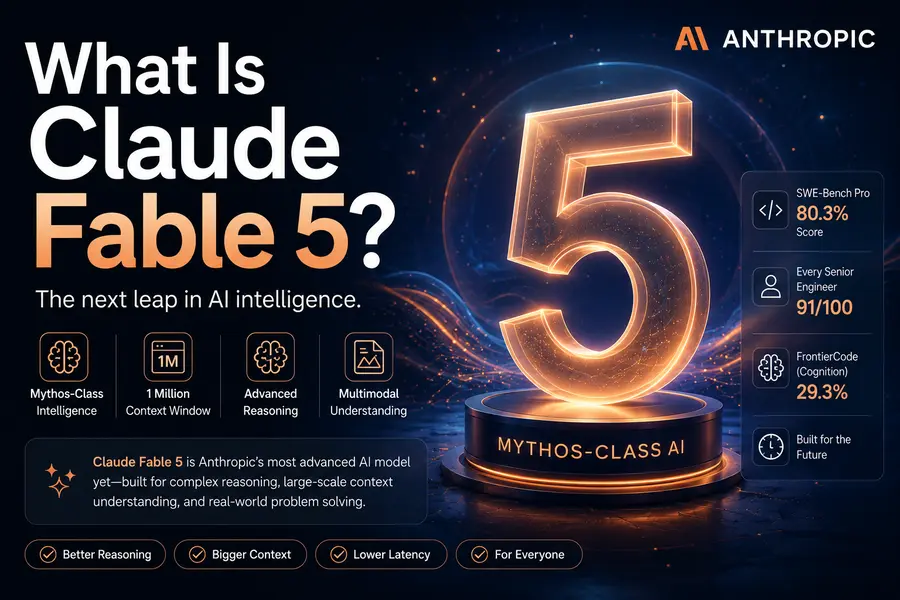
To understand Fable 5, you first need to understand what “Mythos-class” actually means inside Anthropic.
Back in April 2026, Anthropic quietly launched the original Claude Mythos model through something called Project Glasswing — a restricted program for cybersecurity defenders, critical infrastructure providers, and a handful of trusted research organizations. The reasoning was straightforward: the model was so capable in sensitive domains like cybersecurity, biology, and chemistry that Anthropic didn’t feel comfortable releasing it to the general public without additional guardrails.
Claude Fable 5 is the public-safe version of that same underlying model. It shares the identical architecture as Claude Mythos 5, with one key difference: Fable 5 runs safety classifiers on top of it. When those classifiers flag a query as potentially high-risk — say, something touching on offensive cybersecurity or biological synthesis — the request doesn’t get answered by Fable 5. It falls back to Claude Opus 4.8 instead. Anthropic says this fallback fires in fewer than 5% of sessions on average, which means for the overwhelming majority of use cases, you’re getting the full Mythos-tier experience.
The launch also came with a companion release: Claude Mythos 5, the version with certain safeguards lifted, remains restricted to Glasswing partners and approved biomedical researchers. Fable 5 is what the rest of us get.
Key Specifications at a Glance
| Feature | Claude Fable 5 |
|---|---|
| Release Date | June 9, 2026 |
| Model Tier | Mythos-class (above Opus) |
| Context Window | 1 Million Tokens |
| Maximum Output | 128K Tokens |
| API Model String | claude-fable-5 |
| Input Pricing | $10 per million tokens |
| Output Pricing | $50 per million tokens |
| Cached Input Discount | 90% Off |
| Modalities | Text, Image, Documents (PDF, Charts, Diagrams) |
| Reasoning Support | Yes (Extended Thinking) |
| Data Retention | 30 Days (Mandatory for All Traffic) |
| Subscription Availability | Pro, Max, Team & Enterprise (Usage Credits Required After June 23) |
What Makes Claude Fable 5 Different From Opus 4.8?
Most Claude users have spent the past year working with Opus 4.8 — a genuinely capable model that handles complex tasks well. So the obvious question is: how much of an actual upgrade is Fable 5?
The short answer: a lot, especially for demanding work.
Coding and Software Engineering
This is where Fable 5’s lead is hardest to ignore. On SWE-Bench Pro — the benchmark that evaluates models on real GitHub engineering tasks rather than synthetic puzzles — Fable 5 scores 80.3%, compared to Opus 4.8’s 69.2%. That’s an 11-point gap, which is significant at this level of competition.
The more compelling evidence comes from real deployments. Stripe tested Fable 5 on a 50-million-line Ruby codebase and completed a full codebase-wide migration in a single day. Their engineering team estimated the same work would have taken more than two months by hand. That’s not a benchmark number — that’s production reality.
Analytics company Hex reported that Fable 5 was the first model to achieve a 90% score on their core analytics benchmark, which focuses on complex long-running analytical tasks.
Long-Horizon and Asynchronous Work
This is the capability shift that matters most if you’re building agents or running extended workflows. Previous Claude models required frequent human check-ins to stay on track over long tasks. Fable 5 is specifically designed for jobs that run for hours, not seconds — complex code refactoring, deep research synthesis, multi-file document review.
The model can plan its approach, check its own progress against the goal, and course-correct mid-task without waiting for another instruction. That autonomous loop is what makes it fundamentally different from earlier generations.
Vision Capabilities
Fable 5 raises the bar on vision considerably. It can extract precise data from dense scientific figures, rebuild a web application’s source code from screenshots alone, and interpret complex diagrams and charts embedded in PDFs. Anthropic demonstrated this with a striking example: earlier Claude models needed custom harnesses and helper tools to navigate Pokémon FireRed. Fable 5 completed the game using only raw game screenshots, with no maps, navigation aids, or supplemental game-state information.
For practical work in finance, legal, architecture, and scientific research — where dense document-heavy tasks are the norm — this is a meaningful capability jump.
Benchmark Comparison: Claude Fable 5 vs. GPT-5.5 vs. Gemini 3.1 Pro
Here’s how Fable 5 stacks up against its closest competitors as of June 2026, based on Anthropic’s published benchmark table and third-party testing:
| Benchmark | Claude Fable 5 | GPT-5.5 | Gemini 3.1 Pro | Claude Opus 4.8 |
|---|---|---|---|---|
| SWE-Bench Pro | 80.3% | 58.6% | 54.2% | 69.2% |
| Every Senior Engineer | 91/100 | 62/100 | N/A | ~70/100 |
| FrontierCode (Cognition) | 29.3% | 5.7% | N/A | N/A |
| Context Window | 1M Tokens | 200K Tokens | 1M Tokens | 200K Tokens |
| Input Pricing (per 1M Tokens) | $10 | $5 | ~$2 | $5 |
| Output Pricing (per 1M Tokens) | $50 | $30 | ~$7 | $25 |
A few things worth noting about this table. First, on pure coding benchmarks, Fable 5’s lead over GPT-5.5 is substantial — the 21.7-point gap on SWE-Bench Pro is larger than the gap between GPT-5.5 and Gemini 3.1 Pro. Second, Gemini 3.1 Pro is dramatically cheaper and makes sense for high-volume, budget-sensitive work. Third, GPT-5.5 holds competitive ground on agentic coding tasks via its Codex CLI harness, so the picture isn’t one-sided.
The bottom line: Fable 5 leads on hard, long-horizon coding and reasoning tasks. If that’s your primary use case, the premium is genuinely defensible. For routine summarization, classification, or high-volume data pipelines, cheaper models remain the smarter choice.
Pricing: Is Claude Fable 5 Worth the Cost?
This is where things get nuanced, and where it pays to think carefully rather than just reading the launch announcement.
API Pricing:
- $10 per million input tokens
- $50 per million output tokens
- 90% discount on cached input tokens still applies
- Batch API available at $5/$25 (async processing)
That’s exactly double Claude Opus 4.8’s pricing. And it’s worth being clear-eyed about what that means for different users.
For developers and enterprises building complex tools: The math works if Fable 5 completes tasks significantly faster, with fewer iterations, and with higher accuracy than Opus 4.8. On long-horizon coding and agentic tasks, independent benchmarks support that claim. For surgical, high-stakes use — architecture reviews, debugging sessions, complex migrations — the ROI is real.
For routine or high-volume tasks: This is where the premium gets harder to justify. If you’re running RAG pipelines, summarization tasks, customer support workflows, or classification at scale, the performance delta likely doesn’t offset the 2x cost increase.
Subscription access: Through June 22, 2026, Fable 5 was included at no extra cost on Pro, Max, Team, and seat-based Enterprise plans — though it depleted usage credits at roughly double the rate of Opus 4.8. After June 23, continued use requires usage credits at standard API rates. Anthropic has said it intends to restore Fable 5 as a standard subscription feature when capacity allows, but hasn’t committed to a timeline.
The smart approach for most teams: route complex, high-value tasks to Fable 5, and keep Opus 4.8 or smaller models handling the volume work. The two-tier stack is fast becoming the default in mid-2026.
Safety Architecture: How Anthropic Made Mythos Safe for the Public
The safety engineering behind Fable 5 is worth understanding, especially if you work in regulated industries or sensitive domains.
Fable 5 runs a set of cybersecurity and biology classifiers that screen queries in real time. When a classifier triggers, the query doesn’t get refused outright — it’s quietly rerouted to Claude Opus 4.8, which provides a safe answer. Anthropic reports this fallback fires in fewer than 5% of sessions on average, and after initial backlash over the handoff being invisible, the company updated the behavior on June 11 to make fallbacks transparent: users now see a clear notification when their request has been routed to Opus 4.8, and API users receive a refusal reason code.
Before launch, Anthropic ran an external bug bounty program that produced no universal jailbreaks across more than 1,000 hours of testing, followed by additional red-teaming with external organizations.
The Data Retention Issue You Need to Know About
This is the part of the Fable 5 story that got less attention in launch coverage, but matters considerably for enterprise and regulated users.
All traffic on Mythos-class models — including Claude Fable 5 — is subject to mandatory 30-day data retention. This applies to every platform where Fable 5 is available: Claude.ai, the API, Amazon Bedrock, and third-party integrations. Critically, it also overrides any previous zero data retention (ZDR) agreements enterprises may have had with Anthropic. Under this policy, every prompt you send and every response you receive is retained for 30 days for safety monitoring purposes.
Anthropic has stated that this data will not be used to train new Claude models and will be deleted after 30 days in almost all cases. But the policy has created real friction. Microsoft reportedly limited internal employee use of Fable 5 due to concerns about confidential information being subject to the retention window.
What this means practically:
- Legal, healthcare, and finance teams handling sensitive or privileged information need to review their data governance policies before using Fable 5
- Existing zero-retention contracts with Anthropic do not extend to Fable 5
- For regulated industries (HIPAA, SOC 2, GDPR), work with your compliance team before routing sensitive data through this model
- Routing confidential workloads through Claude Opus 4.8 — which can operate under zero-retention agreements — remains an option
Pros and Cons
What Works Well
- Best-in-class coding performance — the SWE-Bench Pro lead over GPT-5.5 and Gemini is substantial and holds up in real-world deployments
- Genuinely autonomous on long tasks — designed for multi-hour, multi-step work without constant human supervision
- 1 million token context window — allows entire codebases, long legal documents, and extended research sessions to stay in context
- Advanced vision capabilities — understands complex charts, diagrams, and nested visuals in PDFs with a level of precision previous models lacked
- Transparent safety fallbacks — after the post-launch update, users and developers know when Opus 4.8 is answering instead
- Available in Claude Code — accessible directly from the CLI and Claude Code for web
What to Watch Out For
- Mandatory 30-day data retention — a hard constraint for enterprise and regulated use cases with no workaround
- Pricing is steep for volume work — $10/$50 per million tokens is double Opus 4.8, and the premium only makes sense on genuinely complex tasks
- Subscription access is metered — the free window through June 22 is gone; usage credits now required
- Geographic availability issues — access for non-US users was suspended on June 12, 2026 following a US government export control directive; check current availability before building
- Sensitive domain fallbacks are real — users in cybersecurity, biology, and chemistry will occasionally hit Opus 4.8 substitutions, which may affect workflow consistency
Who Should Use Claude Fable 5?
Best fit:
- Software engineers and teams running complex, long-horizon coding tasks — large migrations, multi-file refactors, end-to-end feature implementation
- Research teams processing dense, document-heavy workflows involving PDFs, scientific figures, and multi-source synthesis
- Product and AI teams building autonomous agents where extended, unsupervised task execution is the goal
- Legal and knowledge-work professionals with non-sensitive documents who benefit from the 1M context window and precise document understanding
Probably not the right fit:
- High-volume, cost-sensitive applications where Gemini 3.1 Pro or Claude Haiku 4.5 handles the job adequately
- Teams handling highly sensitive, regulated, or confidential data that cannot be subject to 30-day retention
- Users outside the US until geographic access is fully restored
- Casual AI users who don’t regularly hit the limits of current models — Opus 4.8 remains excellent and substantially cheaper for everyday tasks
How to Access Claude Fable 5
Getting started is straightforward if you’re in the US:
Via API: Use the model string claude-fable-5. Grab an API key from the Claude Console and authenticate as you would for any other Claude model. Standard API documentation applies.
Via Claude.ai: Fable 5 is selectable in the model picker on Pro, Max, Team, and Enterprise plans (usage credits required post-June 22).
Via Claude Code: Run /model fable in Claude Code v2.1.170 or later. Note that effort defaults to high, which is token-intensive.
Via third-party platforms: Available on Amazon Bedrock, Microsoft Foundry (Azure), GitHub Copilot, and Google Vertex AI, though access may vary by region.
Current Access Status: What You Need to Know Right Now
This section matters more than any benchmark number in this review. Before you build anything around Claude Fable 5, you need to understand where things stand as of mid-June 2026.
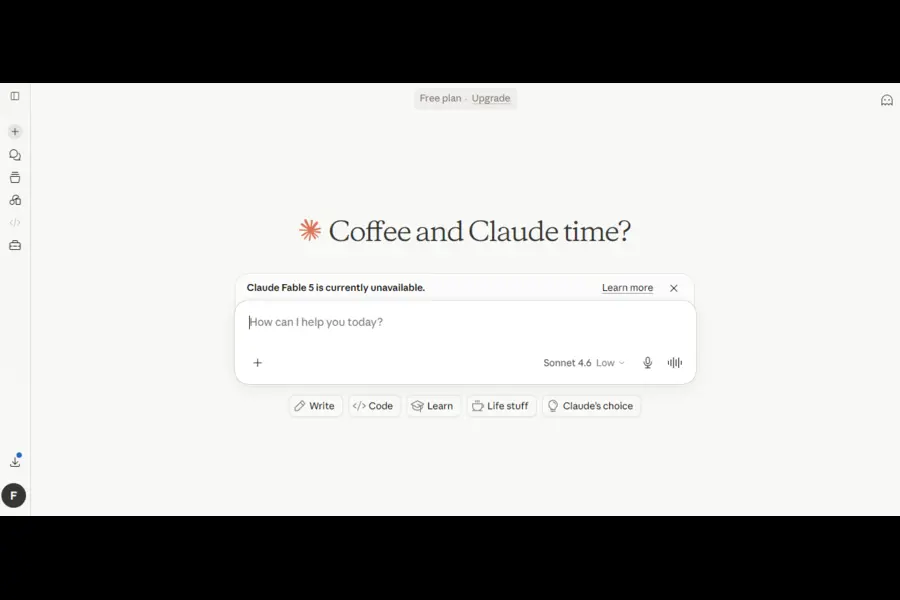
The Government Suspension (June 12, 2026)
Three days after launch, Anthropic received a directive from the US government — citing national security authorities — ordering the suspension of all access to Fable 5 and Mythos 5 for any foreign national, whether inside or outside the United States. The scope of the order is notably broad: it applies to foreign nationals living in the US, and even to foreign national employees inside Anthropic itself. The practical result is that Anthropic has disabled Fable 5 and Mythos 5 for all customers globally to ensure compliance. All other Anthropic models, including Opus 4.8, Sonnet 4.6, and Haiku 4.5, remain unaffected.
Anthropic’s Position
Anthropic has been unusually direct in its public response. The company stated it received the government directive at 5:21pm ET on June 12, and that the letter provided no specific details of the national security concern. The company’s understanding is that the government believes it became aware of a method of bypassing — or “jailbreaking” — Fable 5.
Anthropic reviewed the alleged jailbreak and pushed back publicly. The company stated that the potential jailbreak essentially amounts to asking the model to read a specific codebase and identify software flaws — capabilities that are available in other publicly deployed models, including OpenAI’s GPT-5.5. Anthropic’s position is that no universal jailbreak (one that broadly bypasses safeguards across a wide range of capabilities) has been found, and that the company had been transparent at launch that perfect jailbreak resistance is not achievable for any model provider today.
The company is complying with the directive while simultaneously contesting it. In Anthropic’s own words: “We disagree that the finding of a narrow potential jailbreak should be cause for recalling a commercial model deployed to hundreds of millions of people.”
What This Means for Users and Developers
Immediately: Fable 5 and Mythos 5 are unavailable worldwide as Anthropic works through the compliance process. There is no committed restoration date.
For existing workflows: Any integrations or agents built on claude-fable-5 will need to be rerouted to Opus 4.8 or another available model until access is restored. Anthropic has confirmed all other models continue to operate normally.
For new builds: Do not architect production systems around Fable 5 as the primary model right now. Build with Opus 4.8 as the core and design for Fable 5 to be swappable in when access resumes.
For enterprise customers: Anthropic has apologized for the disruption and stated it believes the suspension is a misunderstanding. The company says it is working to restore access as soon as possible, but has made no commitment on timing.
This situation is evolving. Check anthropic.com/news for official updates before making deployment decisions.
Conclusion
The Anthropic Claude Fable 5 review comes down to this: Anthropic has done something genuinely significant here. It took a model class that was previously locked away for security reasons and made it available to the public — not by weakening it, but by building a thoughtful safety layer around it. For software engineers, researchers, and teams running long, complex, autonomous workflows, the capability step-up is real and defensible at the price point.
That said, the story has taken an unexpected turn. Just three days after launch, a US government export control directive forced Anthropic to suspend access to Fable 5 and Mythos 5 globally. Anthropic has publicly contested the reasoning, calling it a misunderstanding, and is working to restore access — but as of this writing, the model is not available to anyone, anywhere. If you’re evaluating Fable 5 for your stack right now, Claude Opus 4.8 is the right fallback, and you should design your integrations to be model-swappable.
When access does return, the calculus is clear: use Fable 5 where it earns its premium — hard tasks, long tasks, tasks where getting it right the first time matters. Keep Opus 4.8 or smaller models handling the volume. The 30-day data retention policy remains a real constraint for enterprise users, and the pricing demands a disciplined routing strategy.
The capability is genuinely impressive. The situation around access is genuinely complicated. Keep an eye on Anthropic’s official news page for restoration updates.
Disclaimer
This article is for informational purposes only. Pricing, model availability, geographic access restrictions, and product features are subject to change by Anthropic at any time. This review reflects publicly available data as of June 15, 2026. Nothing in this post constitutes legal, compliance, or professional advice. Readers should verify current terms with Anthropic before making purchasing or deployment decisions.
Related Articles
Exploring digiKam 9.1.0: New Tools Every Photographer Should Know
Discover the latest AI-powered editing tools, workflow improvements, and photo management features introduced in digiKam 9.1.0.
AI / BusinessWhy Every Startup Needs an AI Strategy in 2026
Learn how startups can use AI to improve efficiency, reduce costs, and build sustainable competitive advantages.
AI / MediaHow AI Is Changing Journalism and Media in 2026
Explore how AI is transforming newsrooms, content creation, fact-checking, audience engagement, and media workflows.