

Let’s cut to the chase. If your startup doesn’t have a clear AI strategy heading into the second half of 2026, you’re not just missing a trend — you’re handing your competitors a structural advantage that compounds every single quarter. Why every startup needs an AI strategy isn’t a theoretical question anymore. The data makes it uncomfortably clear. And the gap between startups that treat AI as a real operational priority and those still running “AI pilots” is growing faster than most founders realize.
This post breaks down exactly what’s happening in the market right now, why an AI strategy matters more than ever, and how to build one that actually moves the needle.
The 2026 Startup Landscape Is Brutally Bifurcated
Here’s the uncomfortable truth about the current funding environment: money is flowing, but it’s flowing to a very small group.
In Q1 2026 alone, venture capital hit $297 billion — and AI captured 81% of that record funding. But rather than a rising tide lifting all boats, what’s actually happening is capital concentration at a scale nobody really predicted two years ago.
The VC opportunity set is effectively bifurcated, with strong, often AI-driven companies attracting capital while all others struggle. AI startups are commanding significantly higher valuations and round sizes across all stages, with the US accounting for 85% of global AI funding and 53% of AI deals.
Translation: if you’re building a SaaS product, a fintech tool, or a consumer app in 2026 without a credible AI strategy embedded in your pitch and your product, you’re increasingly invisible to the investors who matter.
Fintech, consumer, and enterprise SaaS startups now face increasing pressure to demonstrate AI-native capabilities or risk being shut out of follow-on funding.
That’s not speculation — that’s the operating reality for founders raising right now.
What “AI Strategy” Actually Means for a Startup

There’s a lot of hand-waving around this term. Let’s be specific about what an AI strategy is not: it’s not signing up for ChatGPT Plus, adding “powered by AI” to your landing page, or letting your engineers experiment with LLMs for a quarter.
A real AI strategy for a startup in 2026 means three concrete things:
- Identifying the 2–3 highest-leverage workflows where AI creates a defensible operational advantage
- Connecting AI outputs directly to business metrics — revenue, retention, cost per acquisition, churn
- Building data infrastructure that improves your AI capabilities over time, creating a flywheel competitors can’t easily replicate
The companies getting real results have CEOs and senior leadership teams actively choosing where AI goes — identifying the two or three workflows where the payoff will be largest and putting focused investment behind those specifically. Not a hundred small experiments. A few serious bets, made deliberately.
This is where most early-stage startups get it wrong. They treat AI as an IT decision when it’s actually a business strategy decision.
The Numbers Don’t Lie: AI-Native Startups Are Winning
Faster Growth With Fewer People
Trailblazing AI-native startups are achieving unprecedented growth efficiency by solving specific underserved problems with proprietary AI, embedding AI into workflows, and delivering simple, intuitive user experiences that drive rapid adoption, habitual use, and measurable business impact.
This isn’t just a feel-good narrative. These startups grow and get to profitability quickly by focusing on fewer employees with significant ownership, choosing technology-agnostic full-stack engineers and generalists who can quickly adapt to new AI tools — an approach that allows companies to scale efficiently with fewer resources.
Think about what that means competitively. A 12-person AI-native startup can operate at the output level of a 40-person traditional one. When you’re burning runway and racing to product-market fit, that efficiency gap is existential.
The Revenue Equation
AI-powered subscription apps generate 41% more revenue per customer — a compelling number for any founder thinking about unit economics and LTV. The AI advantage isn’t just in building the product faster; it’s in monetizing it more effectively too.
AI-native startups reach $30M ARR faster than traditional ones, and those unable to leverage AI to reduce unit operational costs will subtly lose competitiveness quarter after quarter.
“Subtly” is the key word there. It doesn’t feel catastrophic on day one. It feels like your sales cycle is just a bit longer than competitors’. Your support costs are a little higher. Your engineers take a bit more time to ship features. And then one day, your competitor announces a round at a valuation you can’t explain — and you realize the gap became a chasm while you were running pilots.
Five Specific Reasons Your Startup Needs an AI Strategy Right Now
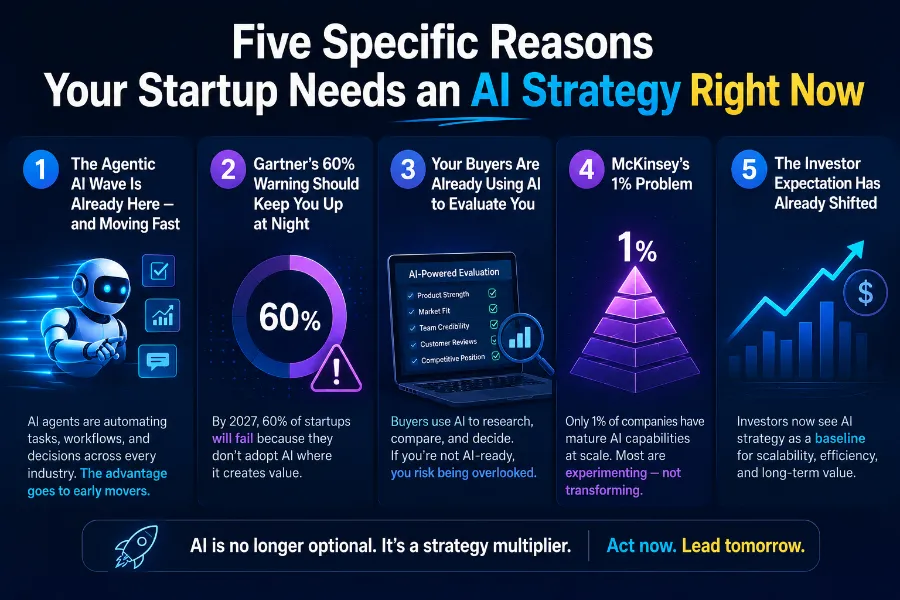
1. The Agentic AI Wave Is Already Here — and Moving Fast
If you think AI is still about chatbots and autocomplete, you’re about 18 months behind the curve.
Forty percent of enterprise applications will be integrated with task-specific AI agents by the end of 2026, up from less than 5% in early 2025, according to Gartner. That’s not a gradual shift — that’s a near-vertical adoption curve.
As of May 2026, LangChain found that 57.3% of surveyed agent builders already had agents in production entering 2026. Customer service is the most common primary use case at 26.5%, followed by research and data analysis at 24.4%, and internal workflow automation at 18%.
For startups, this creates two risks. First, your enterprise customers are beginning to expect AI-native integrations from the tools they buy. Second, if you’re not using agents internally, your competitors who are will ship features and close deals faster than you can respond.
2. Gartner’s 60% Warning Should Keep You Up at Night
Here’s the statistic that gets quietly ignored in most AI enthusiasm pieces: Gartner predicts that through 2026, organizations will abandon 60% of AI projects due to insufficient data quality.
That’s the real strategic risk for startups. Not that AI doesn’t work — it’s that AI only works when you’ve done the unsexy foundational work first. Clean data pipelines. Structured workflows. Clear success metrics. If your AI strategy is “we’ll figure it out as we go,” you’re almost certainly in the 60% that wastes budget and time.
The implication is clear: an AI strategy isn’t just an ambition statement. It’s an operational plan that starts with data governance and infrastructure, not model selection.
3. Your Buyers Are Already Using AI to Evaluate You
A 2026 study from Gartner shows that the average B2B buying committee now involves 11 stakeholders, and 77% of them complete significant research before ever engaging with a vendor. A meaningful portion of that research is now AI-assisted — buyers using tools like Perplexity, ChatGPT, and Gemini to shortlist vendors before a human ever picks up the phone.
That timeline might feel distant, but the early movers are being set now. If your go-to-market, your content, and your product positioning aren’t optimized for AI-driven discovery, you’re becoming progressively harder for your own customers to find.
4. McKinsey’s 1% Problem
McKinsey’s 2025 State of AI report found that 88% of organizations are using AI in at least one business function. Yet only 1% of organizations consider their AI strategies mature.
That’s a jarring gap. Broad adoption, almost no strategic depth. For startups, this is simultaneously a warning and an opportunity. The warning: don’t mistake tool usage for strategy. Adding AI to your stack is table stakes, not competitive advantage. The opportunity: if you’re in the rare group that builds genuine AI maturity early, you occupy a position that’s extremely hard for latecomers to replicate.
McKinsey found that only about 20% of organizations achieve enterprise-level impact from AI. The difference between that group and everyone else isn’t the sophistication of the tools they’re using — it’s the clarity of who owns the direction and the discipline to stay focused.
Ownership and focus. Two things every startup founder controls from day one.
5. The Investor Expectation Has Already Shifted
Enterprise buyers who once signed pilot contracts to avoid falling behind are now auditing every AI expenditure against clear profit-and-loss metrics. Startups pitching basic LLM wrappers face increasing skepticism, while those demonstrating 40% cost reductions or 300% output gains are capturing attention.
The “AI-washing” era is over. Sophisticated investors — and increasingly, sophisticated customers — can tell the difference between a startup that has woven AI into its actual business model and one that bolted a GPT integration onto a slide deck.
AI startups now command average valuations 3.2x higher than traditional tech companies. But that premium is increasingly reserved for startups with genuine AI differentiation, not just AI adjacency.
What a Practical AI Strategy Looks Like for Early-Stage Startups
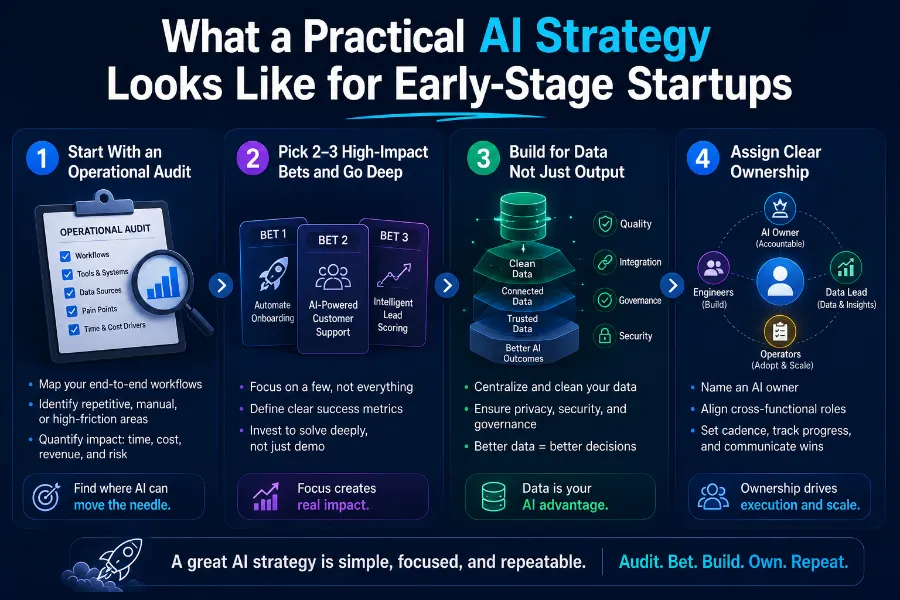
This doesn’t have to be complicated. The most effective startup AI strategies in 2026 tend to follow a simple pattern.
Start With an Operational Audit
Before you touch a single AI tool, map every repeatable workflow in your business. Customer support conversations. Lead qualification. Content production. Code review. Onboarding sequences. Investor updates.
For each one, ask: What’s the current cost in time and money? What’s the error rate? How does this scale as we grow?
This gives you a prioritized list of where AI intervention creates real leverage — not just where it’s interesting or technically cool.
Pick 2–3 High-Impact Bets and Go Deep
The most successful startups pick 2–3 high-impact AI use cases and execute relentlessly, rather than getting distracted by shiny objects.
For most B2B startups right now, the highest-ROI bets fall into a few buckets:
- AI-assisted sales outreach — McKinsey found that AI-enabled sales teams close deals 10 to 15% faster than teams relying on manual processes and report 20% higher customer satisfaction scores at the point of first contact.
- Agentic customer support — reduces cost per ticket dramatically while maintaining quality at scale
- AI-powered product development — around 30% of code at Microsoft and Google is AI-generated in 2026, and startups with smaller engineering teams can capture similar leverage
Build for Data, Not Just Output
The startups that will have durable AI advantages in 2028 are the ones collecting and structuring proprietary data right now. Every customer interaction, every product usage pattern, every support ticket — these become training signals that make your AI systems better over time in ways that competitors can’t easily copy.
This is why Scale AI was valued above $29 billion after Meta’s 2025 investment — the business isn’t just about labeling data, it’s about owning the infrastructure layer that makes AI trustworthy at scale. Your startup equivalent is whatever proprietary data moat you can start building today.
Assign Clear Ownership
The true differentiator by 2026 won’t be AI investment, but enterprise-scale AI adoption — how deeply AI is integrated into decision-making and human workflows. A lack of strategic adoption will relegate AI initiatives to perpetual pilots.
Someone on your founding team needs to own this. Not as a side project, not as a committee — one person who is accountable for AI strategy, tracks outcomes, and has authority to make decisions.
Common Mistakes Startups Make With Their AI Strategy
Mistake 1: Confusing tool adoption with strategy. Giving everyone on your team a Cursor subscription is a start. It’s not a strategy.
Mistake 2: Skipping the data infrastructure step. AI without clean, well-structured data is just expensive noise. If your data is a mess, fix that before you spend another dollar on model APIs.
Mistake 3: Chasing the newest model instead of deepening the use case. The companies winning with AI in 2026 aren’t constantly switching models. They’ve picked their stack and gone deep on implementation quality.
Mistake 4: Not measuring AI impact at all. If you can’t tell whether your AI initiatives are improving retention, reducing CAC, or speeding up time-to-ship, you’re running blind. Define metrics before you deploy.
Mistake 5: Treating AI ethics and compliance as an afterthought. Article 10 of the EU AI Act makes data collection, preparation, annotation, and labeling part of high-risk AI compliance from August 2, 2026. If you’re building for European customers, compliance isn’t optional — and building for it from the start is significantly cheaper than retrofitting.
The Competitive Clock Is Ticking
Here’s the part most AI strategy articles skip: the window to build a genuine first-mover advantage is finite, but it’s still open.
The knowledge of how to use these tools is spreading, the tools themselves are improving, and the distance between companies using AI well and those still debating whether to start is only going one direction.
That’s not doom — it’s urgency. The good news for startups is that incumbents are slow. They have technical debt, political inertia, and layers of approval that make rapid AI deployment genuinely hard. A 15-person startup with a clear strategy and clean data infrastructure can outmaneuver a 500-person company in specific domains — and that window is very much open right now.
By 2030, 60% of organizations achieving successful differentiation with AI will be led by executives who prioritize mastery of human relational skills. Gartner’s framing here is important: AI amplifies human judgment — it doesn’t replace it. The startups winning in 2026 are the ones combining sharp AI execution with founder intuition about customers, markets, and timing that no model can replicate.
Conclusion: Strategy First, Tools Second
Why every startup needs an AI strategy isn’t about following a trend — it’s about recognizing that the business environment has structurally changed. The capital markets have changed. Customer expectations have changed. The operational leverage available to small, focused teams has changed in ways that would have been science fiction five years ago.
The startups that thrive from here aren’t the ones with the most sophisticated AI stack. They’re the ones that chose their bets deliberately, built the data foundations first, measured obsessively, and treated AI as a core business function rather than a side experiment.
The question in 2026 isn’t whether your startup needs an AI strategy. It’s whether you’ll build one before your competitors do — or spend the next three years trying to catch up.
Start with the operational audit. Pick your two bets. Own the data. Measure everything. That’s it. That’s the strategy.
Disclaimer
The information in this article is for general informational purposes only and does not constitute financial, legal, or business advice. While we’ve made every effort to ensure the accuracy of the data and statistics referenced, market conditions, funding figures, and industry trends can change rapidly. Always verify information with original sources before making strategic or investment decisions. The views expressed are those of the author and do not represent any affiliated organization.