
Walk into almost any data center on Earth and you’ll find Linux quietly running the show. Walk into almost any living room, office cubicle, or college dorm, and you’ll find Windows or macOS on the screen instead. That contradiction is one of the strangest stories in modern computing, and it’s the reason so many people search for why Linux dominates servers but not desktop PCs every year. The same operating system that powers nearly every website you visit, every cloud instance your favorite app runs on, and literally 100% of the world’s fastest supercomputers, still can’t crack even 4% of the desktop market. This isn’t a technical failure. It’s a story about incentives, habits, hardware relationships, and what “good enough” means to different types of users.
I’ve spent years switching between Windows, macOS, and various Linux distributions for both personal projects and production server work, and the gap between how Linux behaves in each environment is night and day. Below, I’ll break down the actual 2026 numbers, explain the mechanics behind each side of this split, and give you a realistic picture of where things stand — and where they might be heading.
The Numbers Tell the Story
Let’s start with hard data, because the scale of this split is genuinely wild once you see it side by side.
On the server and infrastructure side, Linux isn’t just winning — it’s basically unopposed:
- 100% of TOP500 supercomputers run Linux, a streak unbroken since November 2017. The June 2026 list is topped by LineShine, installed at the National Supercomputing Centre in Shenzhen, hitting 2.198 exaflops on the Linpack benchmark, with El Capitan at Lawrence Livermore National Laboratory close behind at 1.809 exaflops.
- Google Cloud reports roughly 91.6% of its virtual machines run Linux.
- AWS EC2 instances are about 83.5% Linux-based.
- Even Microsoft Azure, on Microsoft’s own cloud platform, runs an estimated 61.8% Linux virtual machines — a telling detail, since it means Microsoft’s own customers prefer Linux for their cloud workloads even while running Windows on their laptops.
- 72.6% of Fortune 500 companies run mission-critical workloads on Linux.
- Kubernetes production adoption sits at roughly 82%, and around 96% of production clusters run on a Linux node OS.
- Server OS estimates for 2026 put Linux somewhere between 45% and 51% of the overall server market depending on methodology, and W3Techs data shows Linux powers a majority of websites where the underlying OS can be identified.
Now flip to the desktop, and the picture reverses almost completely. According to StatCounter’s June 2026 global figures, Windows holds 62.16% of desktop traffic, macOS sits at 14.58%, desktop Linux is at 3.09%, and ChromeOS trails at 1.42% (with the rest falling into an “Unknown” category from privacy tools that mask OS fingerprints). Even with generous estimates and country-level variation — India, for example, leads major economies with Linux desktop adoption around 16%, largely thanks to cost sensitivity and government digital-literacy programs, and the United States crossed the 5% mark for the first time in mid-2025 — desktop Linux remains a rounding error next to Windows and macOS globally.
Gaming tells a slightly more optimistic sub-story. Steam’s Linux user share has been climbing thanks to the Steam Deck and Valve’s Proton compatibility layer, bouncing between roughly 4.5% and just over 5% through early-to-mid 2026. That’s real growth, but it’s still a fraction of the Windows install base among PC gamers.
So the question isn’t really “does Linux work on the desktop.” It clearly does. The question is why an operating system that owns backend infrastructure so completely still struggles to get regular people to install it on their laptop.
Why Linux Wins the Server Room

It Was Built for This Job From Day One
Linux, and the broader Unix philosophy it descends from, was designed around multi-user, multi-process, network-first computing. Servers don’t need a desktop environment, a mouse cursor, or window animations. They need to run processes reliably, manage memory efficiently, and stay online for months without a reboot. Linux does exactly that without wasting resources on anything else. A minimal server distribution can run comfortably with a fraction of the RAM and disk space that a modern desktop OS demands just to boot to a login screen.
Cost Changes the Math at Scale
When you’re running one laptop, a few hundred dollars in licensing fees is a rounding error. When you’re running ten thousand servers, that same license fee multiplied out becomes a line item that finance departments notice. Linux distributions built for servers — Ubuntu Server, Debian, Rocky Linux, AlmaLinux, and Red Hat Enterprise Linux for those who want vendor support — are either free or dramatically cheaper than proprietary alternatives once you’re operating at cloud scale. For companies running thousands of instances on AWS, Azure, or Google Cloud, that cost difference compounds fast.
Stability and Uptime Are Non-Negotiable
Server administrators care about a very specific thing: does it stay up, and can I patch it without a full restart. Linux’s architecture allows for extremely long uptimes, granular process control, and kernel-level tuning that most desktop users would never touch. Combine that with a security model built around user permissions and a minimal attack surface, and it’s easy to see why banks, stock exchanges (over 75% of which run Linux), hospitals, and government data centers standardize on it for anything mission-critical.
Open Source Fits the DevOps Workflow
Modern infrastructure is automated. Engineers spin up and tear down servers constantly using tools like Terraform, Ansible, and Kubernetes. Open-source, scriptable, container-friendly operating systems fit that workflow naturally. Docker containers are built on Linux namespaces and cgroups. Kubernetes itself was designed with Linux nodes as the default assumption. When your entire toolchain assumes Linux underneath, choosing anything else adds friction nobody wants.
The Community and Vendor Ecosystem Reinforces It
The Linux Foundation reported more than 71,000 contributors and over 3,000 member organizations backing kernel development, with hundreds of millions of dollars in collective investment flowing into the project every year. That’s not a hobbyist community anymore — it’s an industrial-scale collaboration between competitors like Google, Microsoft, IBM, Intel, and Amazon, all of whom rely on Linux and therefore all have a reason to keep improving it.
Why Linux Struggles on the Desktop
Hardware and Software Never Had to Care
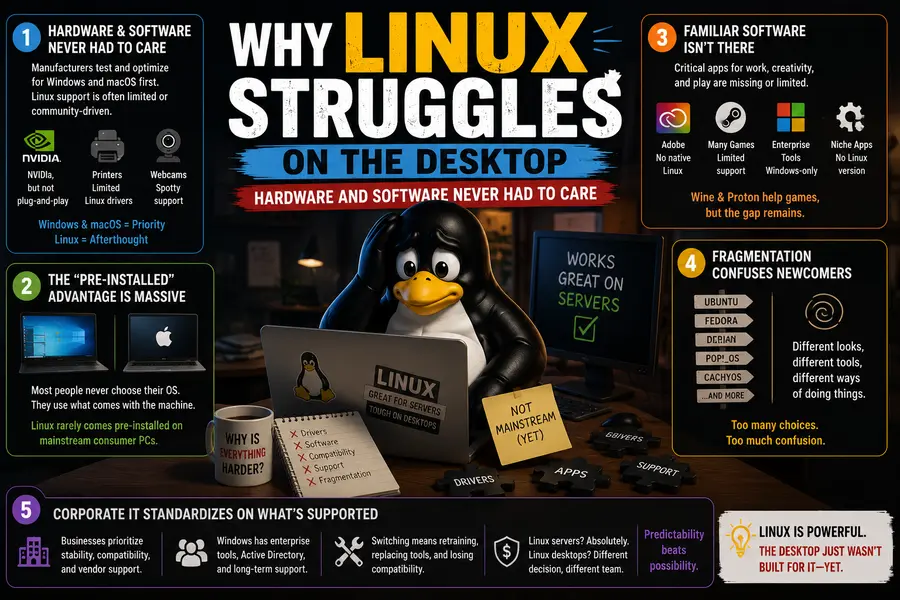
This is the biggest structural issue, and it’s mostly not Linux’s fault. When you buy a laptop, it ships with Windows or macOS pre-installed, and every driver, every firmware update, and every peripheral is tested against those two operating systems first. Printer manufacturers, webcam makers, and GPU vendors write drivers for Windows and macOS because that’s where the volume is. Linux support, when it exists, often comes from community reverse-engineering rather than the manufacturer. NVIDIA’s proprietary driver situation on Linux has improved a lot in recent years, but it’s still not as plug-and-play as it is on Windows.
The “Pre-Installed” Advantage Is Massive
Most people never actively choose an operating system. They buy a computer, and whatever comes on it becomes their OS by default. Windows ships on the overwhelming majority of consumer PCs sold worldwide, and Apple controls its own hardware-software pipeline end to end for macOS. Linux almost never comes pre-installed on mainstream consumer machines outside of a few boutique vendors like System76, Framework, and Lenovo’s limited Linux-certified lineups. Without that default-install advantage, Linux has to convince people to actively switch, which is a much higher bar than simply being good.
Familiar Software Isn’t There
Regular desktop users don’t think in terms of operating systems — they think in terms of the software they need. Adobe Creative Cloud, many AAA games without Proton support, certain enterprise tools, and plenty of niche professional software simply don’t have native Linux versions. Wine and Proton have closed a lot of that gap for gaming specifically, but professional creative and business software remains a real sticking point for anyone trying to switch full time.
Fragmentation Confuses Newcomers
Ask ten Linux users which distribution to install and you’ll get ten different answers, followed by a debate about desktop environments, package managers, and init systems. Ubuntu, Fedora, Debian, Linux Mint, CachyOS, Pop!_OS — they’re all “Linux,” but they look and behave differently enough that a first-time switcher can feel overwhelmed before they’ve even installed anything. Windows and macOS don’t have this problem because there’s exactly one version to choose (setting aside editions), and it just comes with the machine.
Corporate IT Standardizes on What’s Supported
Businesses buy in bulk, and IT departments prioritize predictability over ideology. Windows has decades of enterprise tooling, Active Directory integration, and support contracts built around it. Switching an entire company to desktop Linux means retraining staff, replacing internal tools, and losing compatibility with vendor software that assumes Windows. Even companies that run 100% Linux on their servers will often still hand employees Windows or Mac laptops, because the server and desktop decisions are made by completely different parts of the business with completely different priorities.
Server vs Desktop Linux: A Side-by-Side Comparison
| Factor | Servers & Cloud | Desktop PCs |
|---|---|---|
| Market share (2026) | ~45–51% of servers; 90%+ of cloud VMs; 100% of TOP500 supercomputers | ~3.09% globally (StatCounter, June 2026) |
| Hardware support | Standardized data center hardware, well-supported drivers | Fragmented consumer hardware, inconsistent driver support |
| Cost sensitivity | Extremely high at scale — licensing costs multiply fast | Low for a single machine — cost isn’t the deciding factor |
| Default install | Almost never pre-installed by consumer OEMs | Rarely pre-installed by mainstream PC makers |
| Software ecosystem | Purpose-built open-source tools (Docker, Kubernetes, databases) | Missing native versions of major consumer/creative apps |
| User expertise required | Managed by trained sysadmins and DevOps engineers | Expected to “just work” for non-technical users |
| Decision maker | IT/infrastructure teams optimizing for cost and uptime | Individual consumers or corporate IT standardizing on Windows/macOS |
| Growth trend | Steady, entrenched dominance for over a decade | Slow but real growth (US crossed 5% in 2025; Steam gaming rising) |
Is Desktop Linux Actually Growing?
Yes, modestly — and it’s worth being honest about both the growth and its limits. Windows 10’s end-of-life in October 2025 pushed a wave of users, especially in budget-conscious markets, to look at alternatives rather than pay for new Windows 11-compatible hardware or upgrade licenses. Distributions like Linux Mint and Ubuntu picked up some of that traffic. The Steam Deck has done more for desktop Linux visibility than almost anything else in the last five years, normalizing the idea that Linux can run mainstream games well through Proton. And developer-focused surveys consistently show Linux punching above its general-population weight — Stack Overflow’s 2025 Developer Survey found Ubuntu alone accounted for around 27–28% of both personal and professional developer usage, which tells you Linux desktop adoption skews heavily toward technical users rather than the general public.
But none of that changes the fundamental dynamic. Consumer hardware, mainstream software, and corporate IT all still default to Windows or macOS, and defaults are extraordinarily powerful in consumer technology. Linux desktop share might keep creeping upward by a percentage point or two a year, but a genuine mass-market shift would require OEMs shipping Linux by default at scale, which isn’t happening any time soon outside of niche vendors and Chromebook-style devices.
What This Split Actually Tells Us
The real lesson here isn’t that Linux is “winning” on servers and “losing” on desktops — it’s that operating systems succeed when they match the priorities of the people choosing them. Server operators care about uptime, cost at scale, automation, and control, and Linux was purpose-built to deliver exactly that. Desktop users care about hardware just working out of the box, familiar software being available without hassle, and not having to think about the operating system at all. Windows and macOS have spent decades optimizing for that second set of priorities, backed by manufacturer partnerships and software ecosystems that Linux simply hasn’t had the same commercial incentive to build for consumers.
Frequently Asked Questions
Does any major company actually run its whole business on Linux, top to bottom?
Very few run everything on Linux, and that’s part of what makes this split so interesting. Most large companies run their backend infrastructure — servers, databases, container clusters — almost entirely on Linux, while still issuing Windows or macOS laptops to employees. Google, Amazon, and Meta are known for running Linux internally at massive scale, yet even their own employees often work day-to-day on Mac or Windows machines. The server decision and the desktop decision are made by different teams solving different problems.
If Linux is free, why don’t more companies just switch their desktops to save money?
Because the license fee is rarely the biggest cost of running a desktop fleet. Retraining staff, replacing line-of-business software that only runs on Windows, losing compatibility with vendor tools, and fielding help-desk tickets from confused employees all cost far more than a Windows license ever would. For a single laptop, “free” sounds great; for a 5,000-person company, “familiar and supported” wins almost every time.
Will Linux ever catch up to Windows or macOS on the desktop?
Not in the way it dominates servers, at least not without a major shift in how PCs are sold. Desktop share moves slowly because it’s tied to hardware defaults and software ecosystems, not just the quality of the OS itself. Realistically, Linux desktop share will likely keep growing a percentage point or two at a time, driven by gaming (Steam Deck and Proton), Windows 10’s retirement pushing budget-conscious users toward alternatives, and steady interest from developers — but a genuine majority shift would require PC manufacturers shipping Linux by default at real scale.
Is desktop Linux good enough for a non-technical user today?
For a lot of everyday tasks — web browsing, email, office documents, streaming — yes, distributions like Linux Mint or Ubuntu are genuinely easy to use and often smoother than a bloated Windows install. Where it still gets tricky is specialized software: certain professional creative tools, some enterprise applications, and games without Proton support. If someone’s daily workflow doesn’t depend on those, desktop Linux is a realistic option; if it does, it’s still a compromise.
Why does Microsoft itself run so much Linux on Azure?
Because Azure’s customers choose their own operating systems for their cloud workloads, and a large share of them prefer Linux for the same reasons any other cloud user does — cost efficiency, open tooling, and compatibility with container-based deployments. Microsoft makes money either way, so it has every incentive to support Linux well on its cloud platform even while promoting Windows as the default choice for PCs.
Final Thoughts
So, why does Linux dominate servers but not desktop PCs? Because the two environments reward completely different strengths. On the server, Linux’s openness, efficiency, low cost at scale, and rock-solid stability make it the obvious choice for anyone running serious infrastructure — which is why it powers essentially all of cloud computing and every single supercomputer on the TOP500 list. On the desktop, none of those advantages matter as much to the average buyer, while hardware compatibility, pre-installed convenience, and mainstream software support matter enormously — and that’s exactly where Linux still falls short for most people. Both trends have held steady for over a decade, and while desktop Linux is inching forward thanks to gaming, Windows 10’s retirement, and growing developer enthusiasm, the structural reasons behind this split aren’t going away any time soon. Linux isn’t failing on the desktop. It’s just playing a different game than the one it already won in the server room.
Disclaimer
Market share figures cited are based on publicly available data from StatCounter, TOP500, W3Techs, and other third-party sources as of July 2026. Figures may vary by methodology and change over time; readers should verify current statistics independently before making business or purchasing decisions.
Continue Reading
If you’re interested in Linux, these expert guides will help you troubleshoot Ubuntu, compare the latest Tails releases, and choose the best lightweight Linux distribution for older PCs.