
Hey everyone, if you’re deep into the Linux world like I am, you’ve probably crossed paths with Gentoo Linux at some point. It’s that distro that’s earned its stripes as the go-to for folks who aren’t afraid to get their hands dirty—compiling packages from source, fine-tuning every last detail, and ending up with a system that’s as unique as your fingerprint. But fast-forward to 2025, and the Linux landscape is buzzing with newcomers like AI-optimized distros, container-heavy setups, and even more user-friendly options. So, does Gentoo Linux in 2025 still hold the crown for power users? Or has it been outpaced by flashier alternatives?
In this deep dive, we’ll explore everything from the latest official updates to real-world pros and cons, comparisons with rivals like Arch Linux, and even some community stories straight from the trenches. I’ll pull from the most recent data from Gentoo’s official channels, forums, and beyond to give you the full picture. Whether you’re a longtime Gentoo fan considering an upgrade or a curious Arch user eyeing a switch, stick around—we’re about to unpack why Gentoo Linux in 2025 might just be more relevant than ever.
Gentoo Linux Basics: Why It Stands Out in the Crowd
Let’s start with the fundamentals for anyone new to this. Gentoo isn’t your grandma’s Ubuntu—it’s a source-based distribution that lets you build software directly on your machine. Launched in 2000 by Daniel Robbins, it’s all about flexibility. The heart of it is Portage, Gentoo’s package management system, which uses “ebuilds” to compile packages tailored to your hardware. Want to squeeze every ounce of performance from your AMD Ryzen or ARM setup? Gentoo’s USE flags let you enable or disable features at compile time, creating a lean system without the bloat.
In 2025, Gentoo remains a rolling-release distro, meaning no massive version jumps—just continuous updates at your pace. It’s community-driven, with a strong emphasis on documentation like the legendary Gentoo Handbook, which walks you through everything from installation to advanced tweaks. This approach appeals to power users who value control over convenience, but it also means longer install times and a steeper learning curve. Still, if you’re optimizing for scientific computing, gaming rigs, or embedded devices, Gentoo’s customization is unmatched.
The Latest Buzz: Gentoo Linux Updates in 2025
2025 has been a pivotal year for Gentoo, with enhancements that blend its traditional strengths with modern needs. Drawing from official news and downloads, here’s what’s fresh off the press.
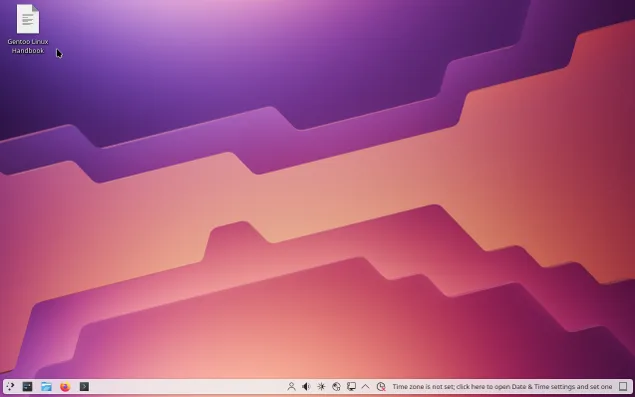
First, installation media got a boost. In July 2025, Gentoo released updated LiveGUI USB images featuring KDE Plasma 6.3.5, Linux kernel 6.12 LTS, and GCC 14.3 compiler. This makes booting into a graphical environment smoother for testing or recovery. The Minimal Installation CD was refreshed on August 31, clocking in at 761 MiB, perfect for lightweight setups.
Cloud enthusiasts, rejoice: February brought bootable QCOW2 disk images for amd64 (x86-64) and arm64 (aarch64), updated weekly. These come in “no root password” (for quick local testing) and “cloud-init” variants (for seamless integration with platforms like AWS or Proxmox). It’s Gentoo’s way of embracing virtualization without compromising on source-based purity—spin up an optimized instance in minutes.
Package management saw incremental wins too. GCC 14 was stabilized late 2024 but carried into 2025 with better C++ support and efficiency gains. Python 3.13 became default in mid-2025, keeping scripts cutting-edge. KDE Plasma 6 has been rock-solid since its stabilization, with updates to KDE Gear for a polished desktop experience.
Hardware and architecture support expanded. Thanks to collaborations like Arm Ltd. providing servers, arm64 binaries and stages improved. However, some shifts: SPARC keywords moved to ~sparc (testing) on September 1, 2025, due to a shrinking user base. s390x baseline raised to z10 in April, dropping older hardware. MIPS and Alpha got volunteer revivals, while IA-64 was axed.
Security remains a priority. 2025 GLSAs patched issues like heap corruption in Atop (CVE-2025-31160) and XZ Utils vulnerabilities. OpenSSH updates fixed remote exploits. Power users love this transparency—you can inspect and rebuild packages yourself.
But challenges persist. April’s urgent plea for Oregon State University’s Open Source Lab (OSL) highlighted infrastructure woes—they needed $250,000 to avoid shutdown, as they host key Gentoo servers. Since associating with Software in the Public Interest (SPI) in 2024, donations are tax-deductible, but it underscores Gentoo’s volunteer roots.
Community-wise, Gentoo marked 25 years at FOSDEM in February and held a user meetup in Germany in August. Forums are alive with discussions on non-standard installs and upgrades.
One big 2025 game-changer: A full suite of binary packages is now available, speeding up installations without ditching source builds. This hybrid approach lets you bootstrap quickly then optimize—ideal for power users testing new hardware.
Why Power Users Swear by Gentoo Linux in 2025
If you’re the type who overclocks CPUs, runs custom kernels, or needs a system tuned for AI training or high-performance computing, Gentoo’s allure is timeless. Here’s a deeper look at why it shines:
- Customization on Steroids: USE flags let you micromanage packages. Strip telemetry from browsers, enable hardware-specific optimizations—it’s like building your own distro. As one Reddit user noted, “Gentoo is somewhat a meta distribution.” In 2025, with binary options, you can mix pre-built speed with source tweaks.
- Performance Perks: Source compilation means binaries scream on your hardware. GCC 14.3 and kernel 6.12 deliver efficiency boosts—users report 10-20% faster compute tasks on optimized setups. For embedded or server use, it’s gold.
- Educational Edge: Gentoo teaches Linux inside out. Kernel config, dependency hell—it’s a rite of passage. “Gentoo will teach you the fundamentals,” says a reviewer. In 2025, updated handbooks make it more approachable.
- Rolling Stability: Control your updates—mask risky packages or chase bleeding-edge. No forced reboots like in point releases.
- Architecture Versatility: From x86 to RISC-V experiments, Gentoo supports it. QCOW2 images make it cloud-native.
Real stories from X (formerly Twitter) echo this: One user shared compiling Gentoo on PS3 with custom kernels, praising its flexibility. Another switched from Ubuntu to Gentoo for better control, saying, “Why would anyone need Gentoo over Arch? I’m 3 hours in and loving it.”
The Flip Side: Challenges of Gentoo Linux in 2025
No rose without thorns. Compile times can drag—hours for Chromium on older hardware, though 2025’s faster CPUs help. Binary packages mitigate this, but purists might grumble.
Installation? It’s manual: partitioning, chrooting, kernel building. The handbook is stellar, but expect a weekend project. A LinkedIn guide calls it “comprehensive but demanding.” YouTube tutorials, like installing on x86 in 2025, show it’s doable but not plug-and-play.
Package ecosystem: Portage is vast, but niche software might need custom ebuilds. Stabilization lags behind Arch sometimes. Funding hiccups, like the OSL crisis, remind us of its grassroots nature.
From X: A user quipped, “Jak ktoś uważa, że Linux jest trudny to nie widział GenToo” (If you think Linux is hard, you haven’t seen Gentoo). It’s not for everyone.
Gentoo vs. Competitors: Head-to-Head in 2025
Let’s pit Gentoo against the big dogs for power users.
- Gentoo vs. Arch Linux in 2025: Both rolling, both customizable. Arch’s Pacman and AUR make it quicker—install in hours vs. Gentoo’s days. Arch has more users, so better community support. But Gentoo edges in optimization; source builds yield better performance for specialized tasks. A YouTube showdown calls it a tie for power users, with Gentoo for “fine-grained control.” Slant ranks Arch #1 for desktops, Gentoo #3. X debates: “Arch over Gentoo for simplicity.”
- Gentoo vs. Ubuntu/Fedora: Binary-based for ease. Ubuntu’s LTS suits servers, but lacks Gentoo’s tweaks. Fedora’s edge is close to Arch, but Gentoo wins minimalism. A user path: Ubuntu to Arch to Gentoo for depth.
- Other Contenders: Slackware for simplicity, LFS for from-scratch builds—Gentoo balances with Portage. Derivatives like Pentoo for pentesting extend its reach.
| Feature | Gentoo Linux | Arch Linux | Ubuntu |
|---|---|---|---|
| Package System | Source (with binaries now) | Binary (AUR for source) | Binary (PPAs) |
| Customization Level | Extreme (USE flags) | High (AUR, ABS) | Medium |
| Install Complexity/Time | High/Long | Medium | Low/Short |
| Update Model | Rolling | Rolling | Point/LTS |
| Best For | Optimization experts | Quick customizers | Stability seekers |
| Community Size | Niche | Large | Massive |
Community Vibes and Ecosystem in 2025
Gentoo’s community is tight-knit and passionate. Forums tackle everything from kernel upgrades to dovecot migration pitfalls. Wiki updates in 2025 refreshed software stacks and guides. On X, discussions range from “Gentoo on PS3” to “Switch to Gentoo for control.”
Derivatives thrive: BesGnuLinux for lightweight stability, GhostBSD for FreeBSD vibes—but Gentoo’s core flexibility inspires them. Ties to mobile like postmarketOS show versatility.
Peering into the Future: Gentoo Linux Beyond 2025
No crystal ball, but trends point up. Binary packages could attract more users, bridging the gap with Arch. Cloud focus grows with QCOW2 and arm64 pushes. If funding stabilizes, exotic arches like RISC-V get binaries.
Challenges? An aging base, but revivals in MIPS/Alpha are hopeful. Broader Linux shifts—like Wayland dominance or kernel schedulers—influence Gentoo too.
Final Thoughts: Is Gentoo Linux in 2025 Your Power User Dream?
In a word: Yes, if control and optimization are your jam. With 2025 updates like binaries, QCOW2, and Plasma 6, it’s evolved without losing soul. Sure, it’s work-heavy compared to Arch’s speed or Ubuntu’s ease, but that’s the appeal for power users.
Ready to try? Hit the handbook, grab a LiveGUI image, and build your beast. Gentoo Linux in 2025 isn’t fading—it’s flexing. What’s your take? Drop a comment below!
Disclaimer
This blog post on Gentoo Linux in 2025 uses the latest official data and community insights as of September 5, 2025. While accurate at publication, changes may occur. The author isn’t liable for errors, omissions, or issues from using this info. Gentoo use carries risks like system instability; consult the Gentoo Handbook and back up data before proceeding. Opinions are the author’s, not the Gentoo Project’s. Check gentoo.org for updates.
Also Read
Linux Mint 22.2 “Zara” Is Here: Your Ultimate Guide to Its Best Features!