
Think about the last time you connected to the internet using an actual cable. If you’re like most people, you can’t remember. That’s the quiet, almost invisible power of wireless networking — it became so normal that we forgot it was ever a big deal.
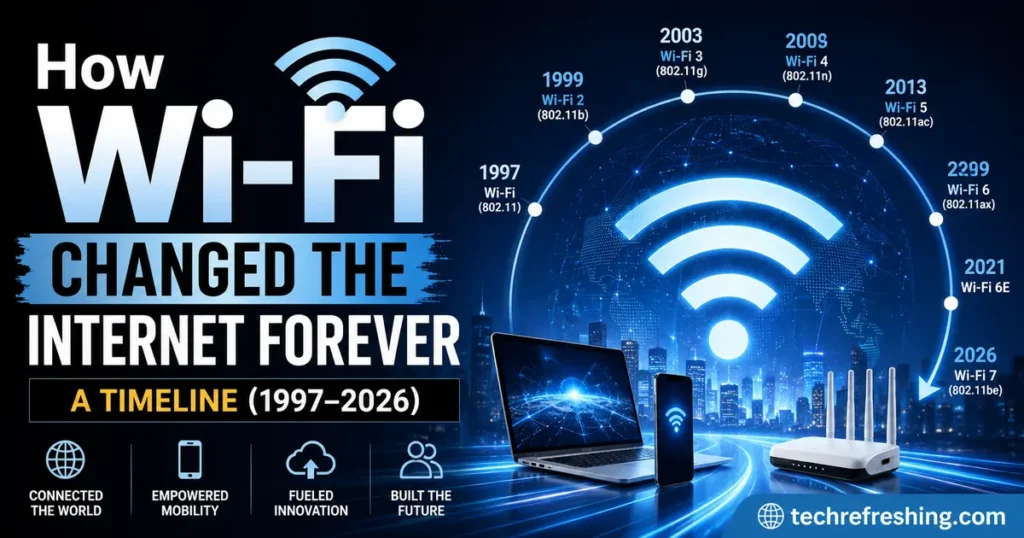
But it was a very big deal. Understanding how Wi-Fi changed the internet forever means looking back at nearly three decades of engineering decisions, standards battles, and quiet infrastructure work that turned the internet from something you plugged into a wall into something that simply surrounds you. This timeline walks through that journey — from a 2 Mbps lab standard in 1997 to the multi-gigabit, AI-aware networks rolling out in 2026 — using facts pulled straight from the organizations that built it: the IEEE and the Wi-Fi Alliance.
1997: The Standard Nobody Noticed Yet
Wi-Fi’s origin story doesn’t start with a product launch or a keynote speech. It starts with a technical document. In 1997, the IEEE published the original 802.11 standard, enabling wireless data transmission at up to 2 Mbit/s over the unlicensed 2.4 GHz radio band. Two Mbps sounds laughably slow today — it wouldn’t even load a single high-resolution photo in under a second — but at the time, the idea that you could move data through the air without a cable at all was the actual breakthrough.
The standard used three different physical layer options, including infrared and spread-spectrum radio, and none of them were fast or reliable enough for mainstream use. What 1997 really delivered wasn’t speed. It was proof that the concept worked.
Behind this milestone were people whose names rarely come up outside networking circles. Vic Hayes of NCR chaired the IEEE 802.11 working group for a full decade, and a team of Australian scientists at CSIRO had already been working on wireless LAN technology since 1989, developing signal-processing techniques that would later become foundational to how Wi-Fi handles interference. Even the frequency-hopping concept that made spread-spectrum wireless possible traces back to patented work from the 1940s. Wi-Fi wasn’t invented by one company in one year — it was assembled from decades of separate research finally converging.
1999: The Year Wi-Fi Got Its Name
Two years after the original standard, everything accelerated. The IEEE released 802.11b, bumping speeds up to 11 Mbit/s — a huge jump that finally made wireless networking practical for real files and real web pages. The same year, 802.11a arrived as a companion standard operating in the 5 GHz band, using a modulation scheme called OFDM that would become the backbone of every future Wi-Fi generation.
But 1999 mattered for another reason entirely: branding. A group of companies formed the Wireless Ethernet Compatibility Alliance, which would later become the Wi-Fi Alliance, to make sure products from different manufacturers could actually talk to each other. Nobody wanted to sell customers on “IEEE 802.11b Direct Sequence” — that’s not a phrase anyone puts on a box. The Alliance hired the branding firm Interbrand, which coined the term “Wi-Fi” as a playful nod to “hi-fi.” It wasn’t originally an acronym for anything technical; it was simply a name designed to be catchy and trustworthy.
That same certification logo — the little yin-yang mark — still means the same thing today it meant in 1999: this device has been tested and will actually work with other Wi-Fi products, regardless of who made them. That interoperability promise is arguably as important to Wi-Fi’s success as any speed improvement that followed.
Apple helped push the technology into the mainstream almost immediately, launching AirPort based on 802.11b and putting wireless networking in front of everyday consumers rather than just enterprise IT departments.
2003: Wi-Fi Comes Home
The early 2000s were about making Wi-Fi affordable and ordinary. In 2003, the IEEE introduced 802.11g, which pushed speeds up to 54 Mbit/s while staying on the cheaper, more widely available 2.4 GHz band that 802.11b already used. That combination — faster speeds without a price jump — is what actually got Wi-Fi into homes.
Between roughly 2003 and 2008, wireless routers became a normal household purchase alongside a broadband modem, not a specialty IT product. This is the period where “Wi-Fi” stopped being a technology term and became a household verb. People started asking for the Wi-Fi password the same way they’d ask where the bathroom was.
2009: The Multi-Antenna Leap (Wi-Fi 4)
The 802.11n standard, retroactively branded Wi-Fi 4, arrived in 2009 and introduced something genuinely transformative: MIMO, or multiple-input multiple-output antenna technology. Instead of a single antenna sending a single stream of data, routers could now use multiple antennas simultaneously, dramatically increasing both speed and range.
Wi-Fi 4 supported both the 2.4 GHz and 5 GHz bands and pushed theoretical speeds up to 600 Mbit/s. This is roughly the era where streaming video over Wi-Fi — rather than a wired connection — became something people actually trusted enough to rely on daily.
2013–2014: Wi-Fi 5 and the Streaming Era
802.11ac, later named Wi-Fi 5, launched in 2013 and moved exclusively into the 5 GHz band, where there’s more open spectrum and less interference from neighboring devices, microwaves, and cordless phones. Theoretical link rates climbed as high as roughly 6.9 Gbit/s under the final specification, though real-world speeds were always a fraction of that number.
This generation is the one that quietly made Netflix, YouTube 4K, and multi-device households actually work. Before Wi-Fi 5, having three or four devices streaming simultaneously in one house could genuinely choke a home network. After it, that stopped being a noticeable problem for most households.
2019–2021: Wi-Fi 6 and 6E Open a New Highway
Wi-Fi 6 (802.11ax) introduced a philosophy shift that still shapes how Wi-Fi is engineered today: it stopped optimizing purely for peak speed and started optimizing for density — how well a network performs when dozens of devices are competing for the same airspace at once, which is exactly the situation in most modern homes and offices packed with phones, laptops, smart speakers, doorbells, and thermostats.
Then came Wi-Fi 6E, which extended Wi-Fi 6 technology into an entirely new slice of spectrum: the 6 GHz band. This was the single biggest expansion of usable Wi-Fi spectrum in the technology’s history, opening a huge amount of interference-free bandwidth that didn’t exist for wireless networking before. According to research commissioned by the Wi-Fi Alliance, the combined value created specifically by Wi-Fi 6 and 6E technology was projected to grow from $58 billion to $527.5 billion by 2025 — a figure that reflects just how much economic activity depends on having enough clean spectrum to work with.
2024: Wi-Fi 7 Redefines What “Fast” Means
If Wi-Fi 6 was about handling more devices gracefully, Wi-Fi 7 — based on the 802.11be standard and officially launched through the Wi-Fi CERTIFIED 7 program in January 2024 — was about raw capability at a scale previous generations never touched.
The headline numbers are genuinely dramatic:
- Channel width doubled from 160 MHz to 320 MHz, roughly doubling throughput potential compared to Wi-Fi 6.
- Modulation improved from 1024-QAM to 4096-QAM, adding about 20% higher transmission rates on top of the channel gains.
- Peak theoretical speeds jumped from roughly 10 Gbps in Wi-Fi 6 to more than 40 Gbps in Wi-Fi 7.
But the feature that actually changes daily experience is Multi-Link Operation, or MLO. Kevin Robinson, president and CEO of the Wi-Fi Alliance, described it as a device’s ability to transmit and receive simultaneously over more than one wireless link at the same time — conceptually similar to carrier aggregation in cellular networks. In practice, this means a laptop can use the 5 GHz and 6 GHz bands together at once instead of picking just one, which cuts latency and makes connections far more resilient to interference from a neighbor’s network or a crowded office floor.
Wi-Fi 7 was also the first Wi-Fi generation to work natively across the 6 GHz band from day one, rather than adding it as an extension the way Wi-Fi 6E did.
The Wi-Fi Alliance projected more than 233 million Wi-Fi 7 devices would ship in 2024 alone, with that number expected to climb to roughly 2.1 billion devices by 2028 — a scale of adoption that outpaces nearly every prior Wi-Fi generation at the same point in its rollout.
January 2026: Wi-Fi 7 Reaches Down to the Smallest Devices
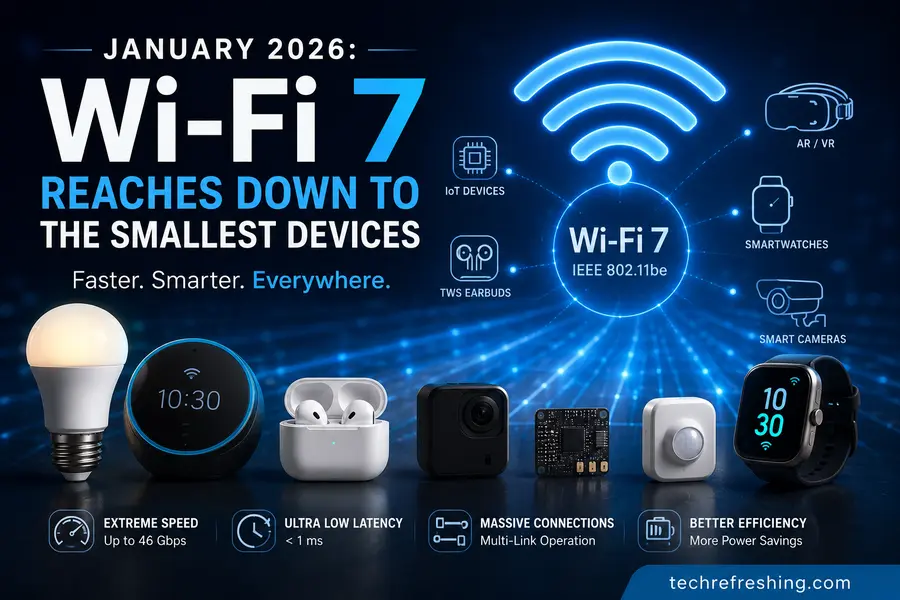
Here’s a fact most consumer tech coverage misses: Wi-Fi generations don’t just get adopted by phones and laptops. They eventually have to reach thermostats, door locks, and sensors too, and those devices have very different power and cost constraints than a flagship smartphone.
On January 6, 2026, the Wi-Fi Alliance released a new certification extending Wi-Fi CERTIFIED 7 to client devices that only operate on narrow 20 MHz channels — the kind of low-power, low-cost radios found in smart home sensors, wearables, industrial endpoints, and healthcare devices. Historically, these categories of devices simply couldn’t take advantage of newer Wi-Fi generations because the full feature set assumed wider, power-hungrier channels.
This certification means a battery-powered door sensor or a wearable health monitor can now benefit from Wi-Fi 7 features like Multi-Link Operation and multi-user MIMO without needing a more complex, power-draining radio. It’s a good example of how Wi-Fi’s evolution isn’t only about speed records — it’s also about making advanced networking accessible to the cheapest, most power-constrained devices in your house.
2026: Wi-Fi’s Economic Footprint Becomes Undeniable
It’s easy to think of Wi-Fi purely as a convenience. The economic data tells a different story. Research commissioned by the Wi-Fi Alliance and conducted by Telecom Advisory Group estimated the global economic surplus value of Wi-Fi at $3.3 trillion in 2021, projected to climb to $4.9 trillion by 2025 — a 150% increase in value from 2018 through 2025. That value comes from a combination of factors: free public Wi-Fi access, residential and enterprise cost savings compared to wired alternatives, the broader Wi-Fi device manufacturing ecosystem, and the capacity unlocked by newly available 6 GHz spectrum.
For context on how that value breaks down by country, the same study estimated the United States’ Wi-Fi-driven economic contribution would grow from $995 billion to roughly $1.58 trillion by 2025 — larger than the entire GDP of most countries on Earth, generated by a technology most people associate with a router blinking in the corner of a room.
What’s Coming: Wi-Fi 8 and the Shift From “Faster” to “More Reliable”
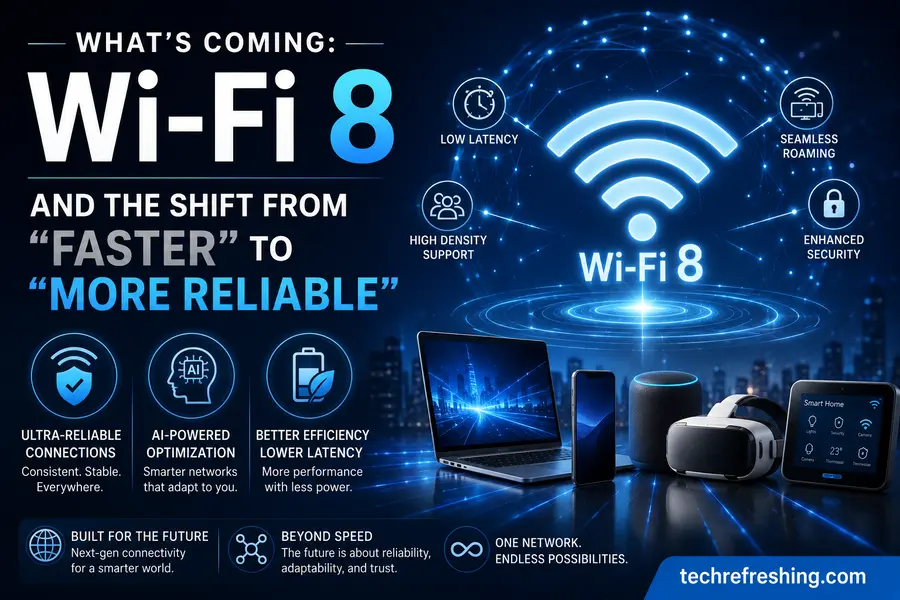
For the first time in roughly three decades, the next Wi-Fi generation isn’t chasing a bigger speed number. Wi-Fi 8, based on the IEEE 802.11bn amendment officially named Ultra High Reliability (UHR), keeps the same theoretical maximum speed as Wi-Fi 7 — around 46 Gbps — and channel bandwidths up to 320 MHz, unchanged from the previous generation.
Instead, Wi-Fi 8 targets roughly 25% improvements in three areas that matter far more in everyday use than peak throughput ever did:
- Better real-world throughput in poor signal conditions, not just ideal lab conditions
- Lower worst-case latency, which matters enormously for video calls, gaming, and industrial applications
- Fewer dropouts when devices roam between access points, such as walking through a large office or a stadium
As of the IEEE’s May 2026 interim session, the task group working on 802.11bn (internally called TGbn) had resolved around 75% of the comments on its first draft. The standard’s formal ratification is targeted for around May 2028, with Wi-Fi Alliance certification testing expected to launch near the end of 2027. Some manufacturers, including Broadcom, already had early Wi-Fi 8 chipsets available by late 2025, and pre-standard hardware appeared publicly at CES 2026 — but as the IEEE process itself makes clear, none of this is finalized yet. Consumers eyeing Wi-Fi 8 routers in 2026 should treat anything on shelves as early, pre-certification hardware rather than a finished standard.
Separately, the IEEE 802.11 working group also opened a new AI Offload study group in 2026, exploring how compute-intensive AI inference tasks might eventually be offloaded to edge AI-enabled Wi-Fi access points — a sign that future Wi-Fi generations may be shaped as much by on-device AI demand as by traditional data throughput needs.
Wi-Fi Generations at a Glance
| Generation | IEEE Standard | Year Introduced | Peak Theoretical Speed | Key Innovation |
|---|---|---|---|---|
| Original 802.11 | 802.11 | 1997 | 2 Mbit/s | Proved wireless LAN was viable |
| Wi-Fi (802.11b) | 802.11b | 1999 | 11 Mbit/s | First mass-market wireless standard |
| — | 802.11a | 1999 | 54 Mbit/s | Introduced OFDM and 5 GHz band |
| — | 802.11g | 2003 | 54 Mbit/s | Brought 5 GHz-class speed to cheaper 2.4 GHz band |
| Wi-Fi 4 | 802.11n | 2009 | 600 Mbit/s | MIMO multi-antenna technology |
| Wi-Fi 5 | 802.11ac | 2013 | ~6.9 Gbit/s | Moved fully into 5 GHz spectrum |
| Wi-Fi 6 / 6E | 802.11ax | 2019 / 2021 | ~9.6 Gbit/s | Optimized for device density; opened 6 GHz band |
| Wi-Fi 7 | 802.11be | 2024 | ~40+ Gbps | 320 MHz channels, 4096-QAM, Multi-Link Operation |
| Wi-Fi 8 (upcoming) | 802.11bn | Target 2028 | ~46 Gbps (unchanged) | Ultra-High Reliability: lower latency, fewer dropouts |
Why This History Actually Matters
It’s tempting to read a timeline like this as a list of trivia — bigger numbers, newer acronyms. But the real story is what Wi-Fi quietly removed from daily life: the cable. Every video call, every smart doorbell, every laptop moved from the kitchen table to the couch without anyone thinking twice about it — that’s the legacy of this specific chain of engineering decisions stretching back to 1997.
The shift in Wi-Fi 8’s priorities is also worth sitting with. For the first time, the industry isn’t racing toward a bigger speed headline. It’s racing toward dependability — because at this point, billions of devices already assume Wi-Fi will simply work, instantly, everywhere, all the time. That expectation itself is the clearest evidence of how Wi-Fi changed the internet forever: it didn’t just make the internet wireless. It made wireless internet the default assumption for how connectivity is supposed to feel, and an entire generation of engineers is now being asked to protect that assumption rather than simply outrun it.
Disclaimer
This article is for informational purposes only. Figures, standards timelines, and product details (including Wi-Fi 8 / 802.11bn projections) reflect publicly available data as of July 2026 and are subject to change as standards bodies and vendors finalize their work. Readers should verify current specifications with the IEEE and Wi-Fi Alliance before making purchasing or technical decisions.
Continue Your Open-Source Journey
Explore more expert Linux, BSD, hardware compatibility and creative software guides from TechRefreshing.