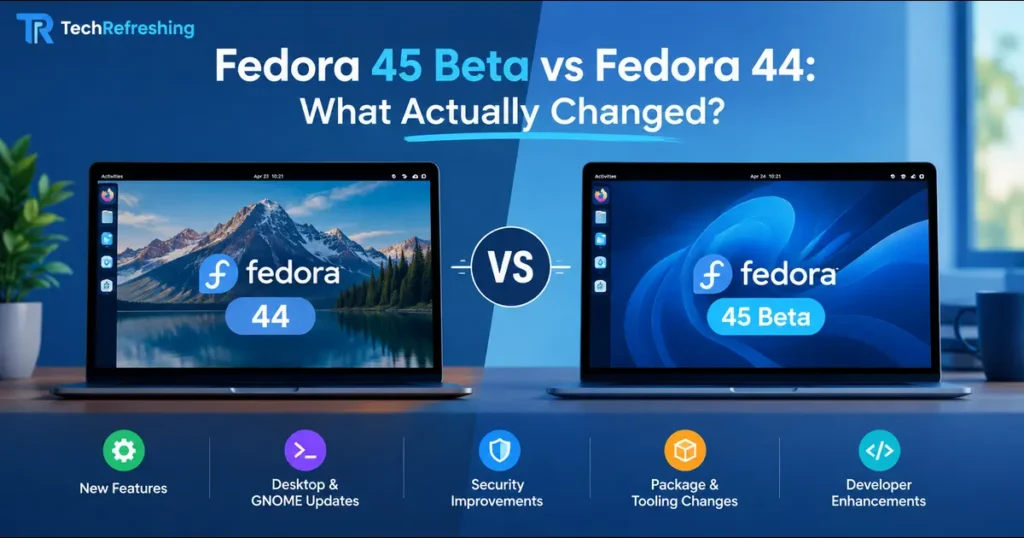
Fedora 45 Beta landed on September 15, 2026, right on schedule, and comparing Fedora 45 Beta vs Fedora 44 side by side shows it’s the kind of release that looks quiet on the surface but rewires a fair amount of what’s happening under the hood. If you’ve been running Fedora 44 since April 28, 2026, don’t mistake this for a minor point release with a newer GNOME — this cycle touches the console stack, the package manager’s trust model, kernel-level process isolation, and the very first pixels you see before the desktop even loads.
I’ve been testing Fedora Beta releases for a while now, and this one felt different from the moment I booted the ISO — before GNOME even appeared, I noticed the boot console rendering text differently. That’s not a fluke; it’s one of the headline changes we’ll dig into below.
Every specific version number and feature status in this piece is cross-checked against Fedora’s own Change Set wiki (the canonical, community-maintained tracker Fedora’s release engineering team uses internally), not just secondary tech coverage — including a couple of corrections below where popular reporting got ahead of what Fedora’s tracker actually confirms.
This guide walks through every meaningful difference between Fedora 45 Beta and Fedora 44, why each change matters in practice, and whether you should actually install the beta right now or wait for the stable release, which is targeted for October 20, 2026 (with a contingency fallback of October 27 if blocker bugs show up).
Quick Answer: The Big Picture
If you only have thirty seconds, here’s the gist. Fedora 45 swaps out the ancient in-kernel console renderer for a modern userspace one, tightens security defaults around process debugging and package signatures, ships GNOME 51 and KDE Plasma 6.7, and refreshes essentially every major development toolchain — Python, Go, GCC, glibc, and LLVM all move up a version. None of this is flashy in a screenshot, but it’s the kind of infrastructure work that makes Fedora feel more solid a year from now.
Release Timeline: Where Each Version Stands
- Fedora 44 — General availability April 28, 2026. Currently the stable, production-ready release.
- Fedora 45 Beta — Released September 15, 2026. This build is identical to the third release candidate (Beta-RC3) that shipped on September 5, so if you already grabbed that ISO, there’s genuinely nothing new to download.
- Fedora 45 Final — Fedora’s official key-task schedule targets October 20, 2026, with October 27 as the built-in contingency date if outstanding blocker bugs push the release back a week. Like every Fedora milestone, this is a target the release team works toward, not a guarantee — Beta itself was hit exactly on schedule (September 15), which is a reasonably good sign for Final landing close to plan.
Fedora sticks to its usual six-month cadence here, and each release gets roughly 13 months of support, so Fedora 44 users have plenty of breathing room even after 45 ships. If you want to track the beta’s progress toward final yourself, Phoronix’s coverage of the Fedora 45 Beta launch is worth bookmarking alongside Fedora’s own schedule page.
The Console Overhaul: fbcon Is Finally Retired
This is, honestly, the change I find most interesting, even though most users will never consciously notice it. Fedora 45 replaces the old in-kernel framebuffer console (fbcon) with kmscon, a userspace console implementation.
Why does this matter? The in-kernel console has been part of Linux since forever, and it shows its age — clunky font rendering, weak Unicode support, and quirky behavior on modern KMS-based graphics stacks. kmscon runs in userspace, which means it can lean on modern font rendering libraries, handle Unicode properly, and generally look and behave more like a real terminal rather than a relic from the text-mode era. Fedora describes it as rendering more smoothly and staying more stable across a wider range of hardware.
On Fedora 44, if you drop to a virtual console (Ctrl+Alt+F3, for example), you’re looking at fbcon’s blocky rendering. On Fedora 45 Beta, that same console looks noticeably crisper, and international characters actually render instead of showing up as boxes or garbage.
Practical impact: If you regularly work outside the graphical desktop — server admins doing headless recovery, or anyone who SSHes less than they’d like to admit — this is a real quality-of-life bump. For typical desktop users who never leave GNOME or Plasma, you likely won’t notice this at all day to day.
Security Defaults Get Noticeably Stricter
Fedora has been on a multi-release security hardening streak, and Fedora 45 pushes further than Fedora 44 did.
ptrace Restrictions for Unprivileged Users
Fedora 45 disables certain debugging permissions for unprivileged users by default, using a system-wide kernel setting. In plain English: a random unprivileged process on your machine can no longer poke around and inspect other unprivileged processes using ptrace, which is exactly the kind of thing malware loves to abuse to steal data from other running applications.
The nice part is that this isn’t a hard wall. If you install debugging tools like gdb or strace, a sysctl file re-enables the normal, permissive behavior — the same behavior Fedora 44 shipped with by default. So developers and sysadmins aren’t locked out of their own workflows; the restriction only bites when you haven’t signaled that you need debugging access.
Fedora 44, by comparison, left ptrace in its traditional, more permissive state system-wide, which is what most Linux distributions have done for decades.
Package Signature Verification by Default
Fedora 45 changes RPM’s default package verification mode to enforcing signature checking, matching upstream RPM’s own default: only packages with a verified signature can install, unless you explicitly override it with --nosignature or the matching API call. Fedora’s own change tracker marks this one as 100% code-complete, so it’s landing.
Fedora 44 shipped without this strict enforcement turned on by default, meaning unsigned packages from third-party repos could slip through more easily. If you’re the type who adds COPR repos or third-party RPM sources without double-checking their signing setup, Fedora 45 is going to be more vocal about it. This is clearly aimed at supply-chain security — the same category of concern that’s been driving a lot of the broader Linux ecosystem’s hardening work.
One correction worth making explicitly: a lot of coverage (including an earlier pass of this article) pins this change to “RPM 6.1.” Checking Fedora’s own Change Set wiki directly, the RPM-6.1-version-bump proposal itself is currently listed with the status “Not being worked on” — separate from the signature-enforcement change, which stands on its own and is fully code-complete regardless of which RPM point release it ships on. In other words, don’t be surprised if Fedora 45 ships this stricter default without technically being “RPM 6.1” by release day.
Reproducible Builds
Fedora 45 also moves toward expecting package builds to be reproducible, meaning the same source code and build environment should produce bit-for-bit identical binaries. This is more of a project-level trust and auditability improvement than something you’ll interact with directly, but it matters if you care about verifying that the binaries you’re running actually match the published source.
Desktop Environments: GNOME 51 and KDE Plasma 6.7
GNOME 50 (Fedora 44) vs GNOME 51 (Fedora 45)
Fedora 44 shipped GNOME 50, which itself was a meaningful jump from GNOME 48 — it introduced native Parental Controls in Settings, better color management, improved remote desktop handling, and refinements to Variable Refresh Rate and fractional scaling that GNOME 49 had first introduced. GNOME 50 also nudged default apps forward, with Document Viewer, File Manager, and Calendar all getting updates, and quietly disabled middle-click paste by default (annoying for longtime X11 users, though re-enabling it is a one-line gsettings command).
Fedora 45 moves to GNOME 51, continuing that same refinement trajectory rather than a dramatic redesign. If you’ve used GNOME across the last few cycles, you know the pattern by now: each release polishes what’s already there instead of throwing out the interface. The animations, workflow, and general shell behavior will feel immediately familiar if you’re coming from GNOME 50 — this isn’t the kind of jump that GNOME 49 was, when X11 support was dropped entirely and Wayland became mandatory.
KDE Plasma 6.6 (Fedora 44) vs KDE Plasma 6.7 (Fedora 45)
Fedora KDE Plasma Desktop 44 launched with Plasma 6.6, whose standout additions were the new Plasma Login Manager and Plasma Setup utility — both aimed at making the very first boot experience feel more cohesive, plus full “Fedora Ready” support status for the KDE edition.
Fedora 45 bumps this to Plasma 6.7. As with GNOME, this is an incremental version bump within the same major series rather than a from-scratch redesign, so expect continued polish on tiling, drawing tablet support, and accessibility rather than a UI you need to relearn.
Development Toolchain: Nearly Everything Gets a Version Bump
This is where Fedora 45 quietly does the most work, and it’s the section developers should actually read carefully before upgrading a dev machine.
| Component | Fedora 44 | Fedora 45 Beta |
|---|---|---|
| Linux Kernel | 6.19 | 7.2 |
| Python | 3.14 | 3.15 |
| GCC | 16.1.1 | 16.2 |
| binutils | 2.46 | 2.47 |
| glibc | 2.43 | 2.44 |
| gdb | 16.3 | 17.2 |
| Go | 1.26 | 1.27 |
| LLVM | 22 | 23 |
| Perl | 5.42.x | 5.44 |
| Lua | 5.4 | 5.5 |
| RPM signature default | Permissive (opt-in) | Enforcing (default-on) |
| GNOME | 50 | 51 |
| KDE Plasma | 6.6 | 6.7 |
| Console | fbcon (in-kernel) | kmscon (userspace) |
GCC, binutils, glibc, and gdb are bundled together under Fedora’s “GNU Toolchain Update” change for each release. Fedora 45’s figures come directly from Fedora’s own Change Set wiki; Fedora 44’s are confirmed from its shipped uname/package output rather than estimated.
A few of these deserve extra context:
Kernel jump (6.19 → 7.2): This isn’t just a version bump — Fedora 44 actually missed the Linux 7.0 kernel because it landed too late in that release’s development cycle, so Fedora 44 shipped on the older 6.19 series. Fedora 45 catches all the way up to 7.2, meaning you’re getting several kernel generations’ worth of hardware support, scheduler tweaks, and driver improvements in one jump rather than a gradual step.
Python 3.15: Following on from Python 3.14’s template string literals and performance work in Fedora 43/44, Python 3.15 continues that performance-focused trajectory. If you maintain Python packages or CI pipelines, budget time to test against the new version before switching your daily driver.
RPM 6.1: Beyond the signature enforcement mentioned above, this is also the release where DNF5’s behavior shifts — by default, DNF5 no longer automatically switches an installed package from one vendor to another during upgrades or dependency resolution. If you’ve ever had a package silently swap providers during a system upgrade and wondered why, Fedora 45 closes that door by default.
Storage and Installer: Stratis Comes to Anaconda
Fedora 45 adds support for installing directly onto Stratis filesystems through Anaconda, including Kickstart automation support for it. Stratis is Fedora’s own storage management layer, and previously setting it up as your root filesystem meant configuring it after installation. Now it’s a first-class option in the installer itself.
Fedora 44 didn’t offer this — Stratis existed, but it wasn’t something you could pick during the initial install flow for your root filesystem.
Separately, Fedora 45 switches the build process for Atomic Desktop ISOs from lorax to image-builder, and adds new output formats like qcow2 and raw disk images for those variants. If you deploy Silverblue, Kinoite, or other Atomic images in virtualized or cloud environments, this means more ready-made image formats without manual conversion.
Hardware Support: Apple Silicon Gets Real Attention
Fedora Linux Asahi Remix — the project’s build for Apple Silicon Macs — gets a genuinely notable upgrade in Fedora 45. This is the first release to add initial out-of-the-box support for Apple M3, M3 Pro, and M3 Max systems.
There’s an important caveat, though: 3D acceleration on M3 hardware isn’t ready yet in this beta and will arrive later via a Mesa update. Hardware-accelerated H.264 and VP9 video decoding, on the other hand, already works across Apple Silicon Macs in this release. So if you’re hoping to run Fedora on a newer MacBook with full GPU acceleration, hold off until that Mesa update lands — but if you just want a usable Linux environment on M3 hardware with working video playback, this is a big step forward compared to Fedora 44, which didn’t have M3 support at all.
Small But Real Changes Worth Knowing About
A handful of smaller Fedora 45 changes won’t make headlines but will affect specific workflows:
- Secrets Service provider switch: Fedora desktops move from KWallet and GNOME Keyring to oo7 as the default Secrets Service provider — relevant if you rely on password/credential storage integrations.
- Fontconfig 2.17 → 2.18: A routine but real update affecting font rendering behavior across applications.
- RPM repo config relocation: Repository configuration data moves from /etc to /usr, which matters mostly for configuration management and automation scripts that hardcode the old path.
- bash-color-prompt rewrite: The default colored prompt introduced back in Fedora 39 gets a cleaner rewrite (version 1.0) built on bash’s
PROMPT_COMMAND, replacing the older, more complex setup with a single customization function. - DRM Panic front-end: A web-based interface for Fedora’s DRM Panic feature that makes kernel-panic information easier to read and even helps route bug reports straight into Bugzilla, instead of leaving you with a cryptic dump of kernel messages.
- libxml2 2.15.3: This is a bigger deal than it sounds — it’s a system-wide ABI-breaking change (up from 2.13.9) that ships with security fixes and forces a mass rebuild of dependent packages. It also formally deprecates the libxml2 Python bindings, which are slated for full removal in 2.16. If you maintain software that links against libxml2 directly, this is worth testing early rather than discovering it on upgrade day.
- Lua 5.5: Fedora’s Lua interpreter moves from 5.4 to 5.5, a routine but real bump for anyone packaging or scripting against it.
None of these are individually dramatic, but taken together they show the kind of continuous housekeeping that keeps a rolling six-month release model from accumulating cruft.
Should You Upgrade Now or Wait for Stable?
Here’s my honest take after running the beta for a bit: Fedora 45 Beta is stable enough for a spare laptop, a VM, or a secondary machine where you don’t mind troubleshooting the occasional rough edge. It is not something I’d put on a primary work machine yet, and Fedora’s own release engineering agrees — beta means active testing, not production readiness. If you do want to grab it, download the ISO directly from Fedora’s official get-fedora page rather than a mirror you’re unsure about.
That said, if any of the following apply to you, it’s worth spinning up a test install now rather than waiting:
- You maintain software that touches ptrace-based debugging tools and need to verify compatibility with the new restricted default.
- You distribute packages through unsigned or self-signed third-party repos and need to prepare your users for the new signature enforcement.
- You’re targeting Apple Silicon and want to validate Asahi Remix support ahead of the stable release.
- You maintain CI pipelines against Python, Go, or GCC and want a head start on compatibility testing before the version bump hits your production systems.
For everyone else — regular desktop users who just want a smooth, dependable Fedora Workstation or KDE experience — Fedora 44 remains the sensible choice until Fedora 45 hits stable in late October, and honestly even for a week or two after that while any last-minute post-release bugs get squashed.
This post reflects Fedora 45 Beta as of September 15, 2026. Fedora is an active development release, and features, defaults, or version numbers described here may change before the final release ships in October 2026. Always check Fedora’s official documentation before upgrading a production system.
Frequently Asked Questions
Is Fedora 45 Beta stable enough for daily use?
No — beta releases are meant for testing and bug reporting, not production or daily-driver use; stick with Fedora 44 for anything mission-critical.
When does Fedora 45 become the stable release?
Fedora 45 Final is targeted for October 20, 2026, with October 27, 2026 as a contingency date if blocker bugs delay the release.
Does Fedora 45 support Apple M3 Macs?
Yes, Fedora Linux Asahi Remix 45 adds initial out-of-the-box support for Apple M3, M3 Pro, and M3 Max, though full 3D acceleration isn’t ready yet and arrives later via a Mesa update.
What replaces fbcon in Fedora 45?
Fedora 45 replaces the legacy in-kernel fbcon console with kmscon, a userspace console that offers better font rendering, Unicode support, and stability.
Will my unsigned third-party repos still work on Fedora 45?
Not by default — Fedora 45 enforces package signature verification out of the box, so packages without valid signatures will be blocked unless you override it explicitly or adjust your configuration.
More Linux Guides from TechRefreshing
Testing Fedora 45 Beta or considering another Linux distribution? These related guides can help you compare desktop experiences, troubleshoot hardware, and evaluate an upgrade.
TechRefreshing Linux Review: Is It a Good Linux Alternative to Windows?
Explore TR Linux 1.0, its Debian 13 foundation, KDE Plasma 6 desktop, included software, and considerations for Windows users.
Read the Linux review →Linux Cannot Detect Wi-Fi Adapter: Causes and Fixes
Learn how to investigate missing Wi-Fi adapters, identify driver problems, and troubleshoot wireless connectivity on Linux.
Fix Linux Wi-Fi problems →Should You Upgrade to Ubuntu 24.04.5 LTS Right Now?
Review the considerations around Ubuntu 24.04.5 LTS, including its kernel, security updates, and whether upgrading fits your setup.
Read the Ubuntu upgrade guide →