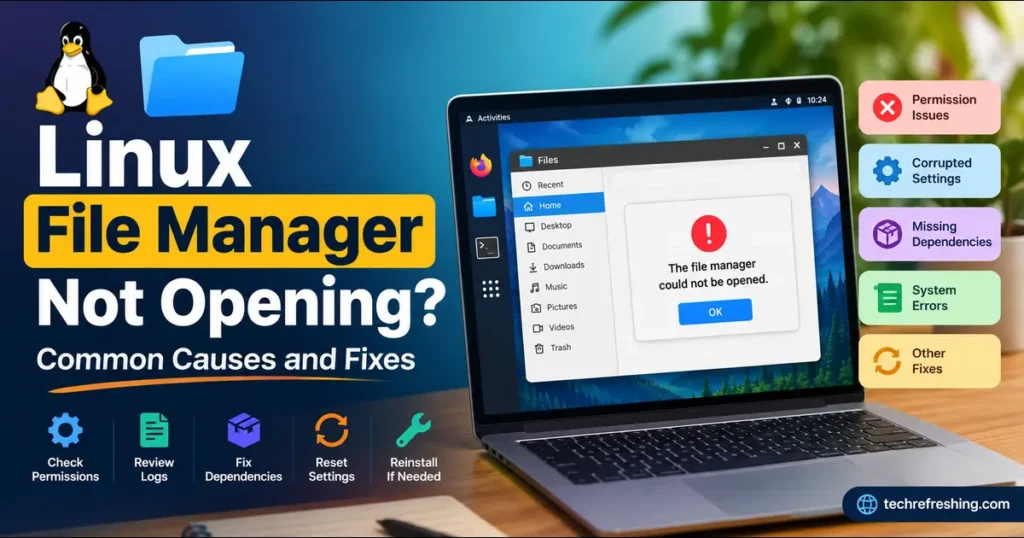
You click the Files icon and nothing happens. No window, no error. Or the window flashes for half a second and disappears. It’s frustrating because the file manager is the tool you’d normally use to fix other problems.
If you’re dealing with Linux File Manager Not Opening, the cause is rarely serious. Most of the time it’s a stuck process, a corrupted setting, a broken extension, a hung network share, or a permissions slip after a sudo session.
This guide covers Nautilus, Dolphin, Nemo, Thunar, Caja and COSMIC Files across Ubuntu, Fedora, Debian, Linux Mint, Arch and their major desktop editions. Version details were checked against project announcements on October 10, 2026.
Where Linux Releases Stand in October 2026
Version context matters, because a bug on one release is often fixed on the next.
- Ubuntu 26.04 LTS (released April 23, 2026) is the current long-term release. Ubuntu 26.10 is scheduled for October 15, 2026. See Canonical’s Ubuntu release cycle page for support dates.
- Fedora 44 ships GNOME 50 and KDE Plasma 6.6. Fedora 45 entered Final Freeze on October 6 and targets October 20 with GNOME 51 and Plasma 6.7.
- Debian 13 “trixie” is at point release 13.7 and ships GNOME 48. Details are on the official Debian 13 release page.
- Linux Mint 22.3 is current, with Mint 23 expected around Christmas 2026.
- KDE Plasma 6.7.5 is the latest stable Plasma, with Plasma 6.8 expected October 14. KDE posts every release on its announcements page.
Quick Reference: File Managers by Distro and Desktop
| Distro / Edition | Desktop (Oct 2026) | File Manager | Terminal Command |
|---|---|---|---|
| Ubuntu 26.04 LTS | GNOME 50 | Files (Nautilus) | nautilus |
| Fedora 44 Workstation | GNOME 50 | Files (Nautilus) | nautilus |
| Fedora 44 KDE | Plasma 6.6 | Dolphin | dolphin |
| Debian 13.7 (GNOME) | GNOME 48 | Files (Nautilus) | nautilus |
| Linux Mint 22.3 | Cinnamon 6.6 | Nemo | nemo |
| Kubuntu / openSUSE KDE | Plasma 6.x | Dolphin | dolphin |
| Xubuntu / Debian Xfce | Xfce 4.20 | Thunar | thunar |
| Ubuntu MATE / Mint MATE | MATE | Caja | caja |
| Pop!_OS | COSMIC | COSMIC Files | cosmic-files |
| Arch / EndeavourOS / Manjaro | Your choice | Depends on DE | Same as above |
Step Zero: Launch It From the Terminal
A desktop icon hides errors. The terminal doesn’t. Press Ctrl + Alt + T, type the command from the table, and read what it prints.
If the terminal shows nothing, check the logs:
journalctl --user -b | grep -i -E "nautilus|dolphin|nemo|thunar|caja"Here’s how to read the most common messages:
| Terminal message | Likely cause | Jump to |
|---|---|---|
| Python traceback naming an extension | Broken plugin | Cause 3 |
Permission denied on a config path | Root-owned files | Cause 5 |
Failed to connect to the session bus | D-Bus or session problem | Cause 1, then log out and in |
No space left on device | Full disk or inodes | Cause 6 |
Segmentation fault | Driver or package issue | Causes 7 and 9 |
error while loading shared libraries | Partial update | Cause 9 |
| No output, command hangs | Dead network mount | Cause 4 |
Cause 1: A Stuck Process Is Still Running
A previous instance froze or half-closed, and the new launch hands off to it and does nothing.
Fix: Kill it completely, then relaunch.
nautilus -q      # GNOME
nemo -q          # Cinnamon
thunar -q        # Xfce
caja -q          # MATE
killall dolphin  # KDE
If the quit flag is ignored, pkill -9 nautilus (or the matching name) finishes the job.
Cause 2: Corrupted User Settings
If the app crashes the moment it starts, bad configuration is a prime suspect. Forced shutdowns, interrupted updates and full disks can all scramble settings.
Nautilus:
dconf reset -f /org/gnome/nautilus/Nemo:
dconf reset -f /org/nemo/Dolphin:
mv ~/.config/dolphinrc ~/.config/dolphinrc.bak
mv ~/.local/share/dolphin ~/.local/share/dolphin.bak
Thunar:
mv ~/.config/Thunar ~/.config/Thunar.bakCOSMIC Files:
mv ~/.config/cosmic/com.system76.CosmicFiles ~/.config/cosmic/com.system76.CosmicFiles.bakRenaming to .bak lets you roll back if the reset wasn’t the answer. The GNOME Help documentation is useful if you want to understand what the Files settings control.
Cause 3: A Broken Extension or Plugin
Cloud sync tools, “Open in Terminal” helpers and preview add-ons hook straight into the file manager. When one breaks after an update, the whole app can refuse to start.
A typical case: someone upgrades their distro, and the Dropbox or Nextcloud integration, built for the older libraries, silently breaks Nautilus on the next launch.
Fix: Find the extension named in your terminal output, then list and remove it.
dpkg -l | grep -i nautilus      # Debian, Ubuntu, Mint
rpm -qa | grep -i nautilus      # Fedora
Restart the file manager, and reinstall the extension only once an updated version exists. For Dolphin, move suspicious files out of ~/.local/share/kio/servicemenus/.
Cause 4: Hung Network Mounts (Samba, NFS, SFTP)
If the file manager tries to open but no window ever appears, a dead network location is a strong candidate. It’s trying to reconnect to a saved share, and the server or VPN is gone.
Picture a laptop that closes its lid mid-VPN session. The next morning, the remembered share points nowhere, and the file manager waits indefinitely.
Fix:
- Check mounts:
mount | grep -E "cifs|nfs|sshfs|gvfs" - Force-unmount the dead one:
sudo umount -f -l /path/to/mount - For GNOME virtual mounts:
gio mount -u smb://servername/share - In
/etc/fstab, addnofail,x-systemd.automountto network entries to prevent repeat hangs.
Cause 5: Permissions and Ownership Damage
Commands like sudo nautilus or sudo thunar create root-owned config files inside your home directory. Your normal launch then can’t read them.
Check:
ls -la ~/.config ~/.cache | grep rootFix:
sudo chown -R $USER:$USER ~/.config ~/.cache ~/.localKeep this scoped to your own folders. Never run it against /home or /. For protected files, use pkexec or sudoedit instead of launching a whole file manager as root.
Cause 6: Full Disk or Exhausted Inodes
A full partition makes the app unable to write cache or session data, so it quietly dies.
df -h
df -i
The second command catches inode exhaustion, which can happen with plenty of free space showing. Free some room:
sudo apt clean && sudo apt autoremove    # Debian, Ubuntu, Mint
sudo dnf clean all                       # Fedora
sudo pacman -Sc                          # Arch
sudo journalctl --vacuum-size=200M       # systemd distros
Cause 7: Wayland, X11 and GPU Quirks
Wayland is the default on GNOME, KDE Plasma and COSMIC. Some older graphics driver combinations, particularly NVIDIA, can cause blank windows or instant crashes in GTK and Qt apps. Mint is the exception: Cinnamon still defaults to X11 in 22.3.
Test:
- Log out.
- Click the gear icon on the login screen and pick the X11 session (“Plasma (X11)” on KDE, where installed).
- Log in and try the file manager.
If it works on X11 only, update your graphics drivers. On Ubuntu, ubuntu-drivers devices shows recommended NVIDIA packages. On Fedora, make sure the NVIDIA stack matches your running kernel.
Cause 8: Wrong Default Folder Handler
Sometimes the file manager launches fine, but “Show in folder” from other apps does nothing. The system has lost track of which program opens folders. The Arch Wiki’s guide to XDG MIME applications explains how this association works on any distro.
Check:
xdg-mime query default inode/directoryReset:
xdg-mime default org.gnome.Nautilus.desktop inode/directory   # Nautilus
xdg-mime default org.kde.dolphin.desktop inode/directory      # Dolphin
xdg-mime default nemo.desktop inode/directory                 # Nemo
xdg-mime default thunar.desktop inode/directory               # Thunar
This commonly happens after installing a second file manager “just to try it.”
Cause 9: Partial Updates and Broken Packages
If the trouble began right after an update, a half-finished upgrade may be the culprit.
# Debian / Ubuntu / Mint
sudo apt update
sudo apt --fix-broken install
sudo dpkg --configure -a
sudo apt install --reinstall nautilus

# Fedora
sudo dnf distro-sync
sudo dnf reinstall nautilus

# Arch
sudo pacman -Syu
sudo pacman -S nautilus
On Arch and other rolling distros, avoid partial upgrades (installing a package without a full -Syu). Fedora users moving between releases should check the Fedora documentation for upgrade guidance first.
With Ubuntu 26.10 and Fedora 45 about to ship, give any new release a week or two of updates before relying on it for daily work.
Distro-Specific Notes
- Ubuntu and Debian: Check for Snap-versus-deb confusion with
snap list | grep -i nautilus. Debian 13 on GNOME 48 is conservative, so crashes there usually come from user-added extensions. - Fedora: Run
sudo dnf distro-syncafter any version jump, and usednf historyto roll back a bad transaction. - Linux Mint: Nemo is being reworked for faster directory loading ahead of Mint 23. If Nemo is slow rather than dead, disable thumbnails for big folders first.
- KDE Plasma: Rebuild the service cache with
kbuildsycoca6 --noincremental. Also check Baloo indexing withbalooctl6 status. - Xfce, MATE, COSMIC: Thunar and Caja are lightweight and rarely crash on their own. Install
gvfsandgvfs-backendsif drives don’t appear. COSMIC is newer, so keep it fully updated.
Pros and Cons of Each Repair Approach
| Approach | Pros | Cons |
|---|---|---|
| Reset settings | Fast, reversible, files untouched | Loses bookmarks and view preferences |
| Remove extensions | Fixes the most frequent crash cause | Cloud-sync features pause |
| Reinstall file manager | Repairs missing program files | Useless if the fault is in your home folder |
| Test with a new user | Shows instantly if the issue is user-specific | Diagnoses only, repairs nothing |
| Switch file managers | Gets you working immediately | Masks a fault that may return |
My suggested order: terminal output, settings reset, extensions, reinstall. A fresh test user is the best shortcut. If a new account works, the problem lives in your home configuration.
Troubleshooting Checklist
- Launch from the terminal and read the error
- Kill any stuck process
- Check disk space and inodes
- Look for unreachable network mounts
- Rename config folders and retry
- Remove third-party extensions
- Fix ownership of
~/.config,~/.cache,~/.local - Try an X11 session if you’re on Wayland
- Repair packages and reinstall
- Test with a new user account
Prevention Tips
- Don’t run graphical file managers with
sudo. - Update fully, not partially, and reboot after desktop-library updates.
- Install only the extensions you use, and expect to reinstall them after major upgrades.
- Use
nofailfor network mounts infstab. - Learn
cp,mvandrsync, so you’re never stranded without a file manager. - Take snapshots before big upgrades with Timeshift or Snapper.
Conclusion
A Linux File Manager Not Opening problem feels dramatic, but the cause is usually small: a stuck process, one broken extension, a corrupted setting or a dead network share. Start with the terminal, since the error message tells you where to look. Then work down the list from killing the process to resetting configs to repairing packages.
Whichever desktop you run, the logic holds. Find the error, isolate the cause, and apply the smallest fix that works. If the checklist doesn’t solve it, test with a new user and search your distro’s bug tracker. With Ubuntu 26.10 and Fedora 45 landing soon, a fix may already be waiting in the newest updates.
Frequently Asked Questions
Why is my Linux file manager not opening when I click the icon?
A stuck process, corrupted settings or a broken extension is usually blocking it. Launch it from the terminal to see the exact error.
How do I restart the file manager in Linux?
Run nautilus -q (or nemo -q, thunar -q, killall dolphin) and reopen it. This clears any frozen instance.
How do I reset Nautilus to default settings?
Run dconf reset -f /org/gnome/nautilus/ and relaunch Files. Your personal files are not affected.
Can I fix this without a working file manager?
Yes. The terminal handles copying files with cp or rsync and repairing packages with apt, dnf or pacman.
Does Wayland cause file manager problems?
Occasionally, especially with older NVIDIA drivers. Try an X11 session at the login screen, then update your graphics drivers.
Why does Dolphin not open on KDE Plasma?
A corrupted dolphinrc file or stale service cache is the usual cause. Rename the config file and run kbuildsycoca6 --noincremental.
Is it safe to run the file manager as root?
It’s best avoided, because it creates root-owned files in your home folder that break normal launches. Use pkexec or sudoedit instead.
Should I upgrade to Ubuntu 26.10 or Fedora 45 right away?
Not necessarily. New releases can bring early bugs, so wait for the first updates if stability matters to you.
Disclaimer: The commands in this guide are provided for general informational purposes. Commands such as chown, umount and dconf reset change system or user files, so back up important data first and double-check paths before running them. Software versions and release dates reflect information available on October 12, 2026, and may change. Always consult your distribution’s official documentation if your setup differs.
More Linux Troubleshooting Guides
Still having problems with your Linux desktop? Explore these practical guides to diagnose and fix common system issues.
More Linux tips and practical fixes at TechRefreshing.com.